Big Timber in Sweet Grass County, Montana — The American West (Mountains)
St. Mark's Episcopal Church
Photographed by Barry Swackhamer, July 23, 2021
1. St. Mark's Episcopal Church Marker
Inscription.
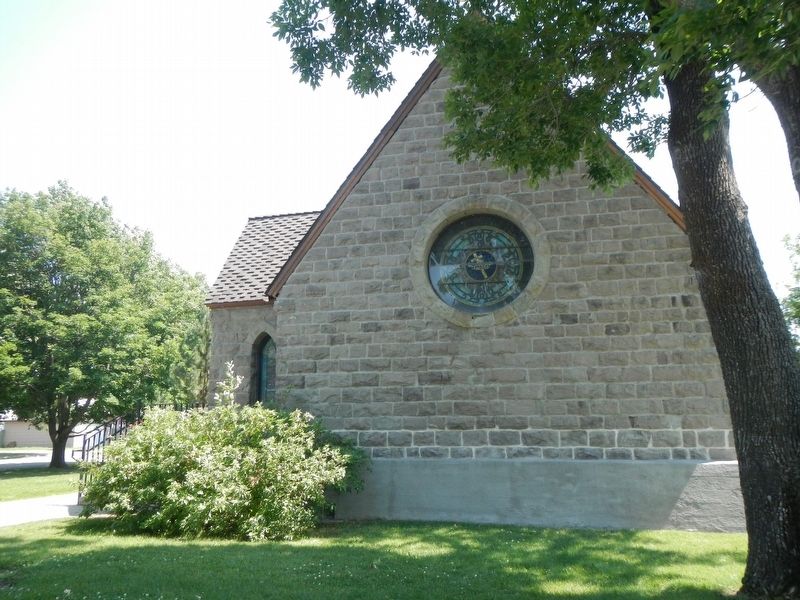
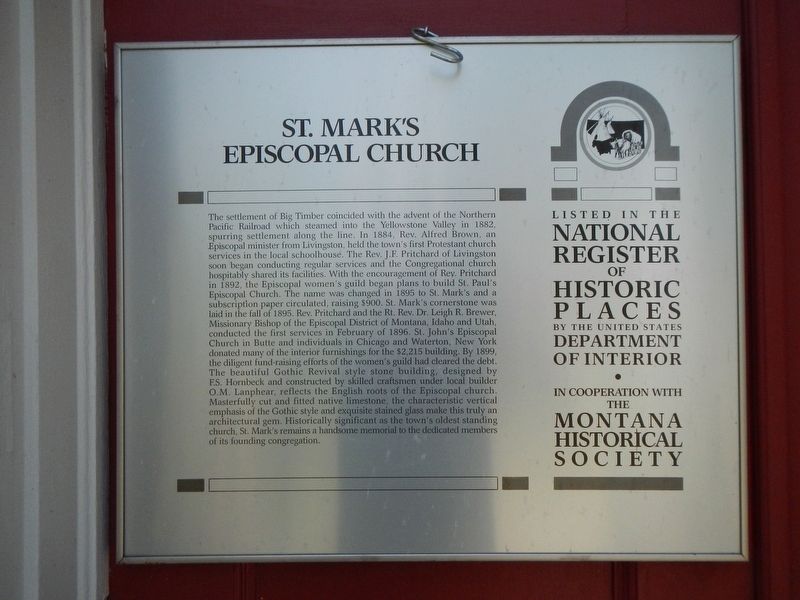
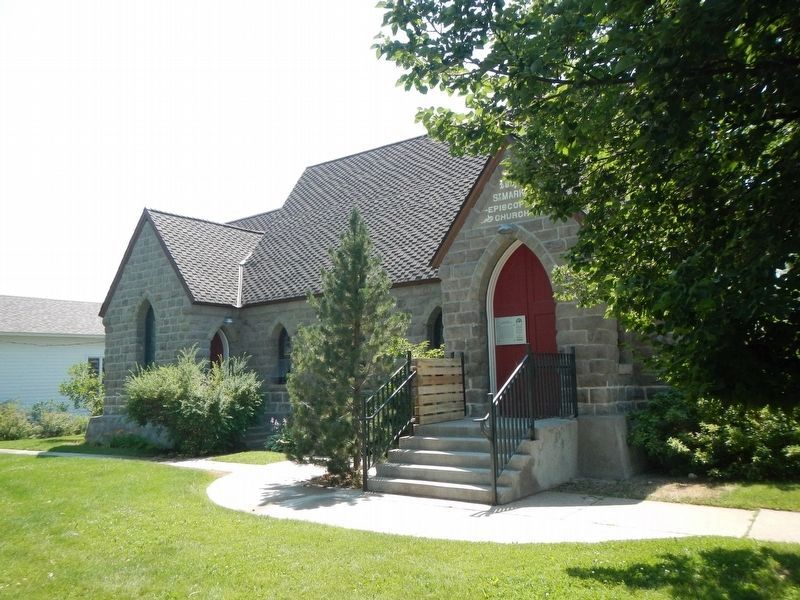
St. Mark's Episcopal Church. . The settlement of Big Timber coincided with the advent of the Northern Pacific Railroad, which steamed into the Yellowstone Valley in 1882, spurring settlement along the line. In 1884, Rev. Alfred Brown, an Episcopal minister from Livingston, held the town’s first Protestant church services in the local schoolhouse. The Rev. J. F. Pritchard of Livingston soon began conducting regular services and the Congregational church hospitably shared its facilities. With the encouragement of Rev. Pritchard in 1892, the Episcopal women’s guild began plans to build St. Paul’s Episcopal Church. The name was changed in 1895 to St. Mark’s and a subscription paper circulated, raising $900. St. Mark’s cornerstone was laid in the fall of 1895. Rev. Pritchard and the Rt. Rev. Dr. Leigh R. Brewer, Missionary Bishop of the Episcopal District of Montana, Idaho and Utah, conducted the first services in February of 1896. St. John’s Episcopal Church in Butte and individuals in Chicago and Waterton, New York, donated many of the interior furnishings for the $2,215 building. By 1899, the diligent fund-raising efforts of the women’s guild had cleared the debt. The beautiful Gothic Revival style stone building, designed by F. S. Hornbeck and constructed by skilled craftsmen under local builder O. M. Lanphear, reflects the English roots of the Episcopal church. Masterfully cut and fitted native limestone, the characteristic vertical emphasis of the Gothic style and exquisite stained glass make this truly an architectural gem. Historically significant as the town’s oldest standing church, St. Mark’s remains a handsome memorial to the dedicated members of its founding congregation.
The settlement of Big Timber coincided with the advent of the Northern Pacific Railroad, which steamed into the Yellowstone Valley in 1882, spurring settlement along the line. In 1884, Rev. Alfred Brown, an Episcopal minister from Livingston, held the town’s first Protestant church services in the local schoolhouse. The Rev. J. F. Pritchard of Livingston soon began conducting regular services and the Congregational church hospitably shared its facilities. With the encouragement of Rev. Pritchard in 1892, the Episcopal women’s guild began plans to build St. Paul’s Episcopal Church. The name was changed in 1895 to St. Mark’s and a subscription paper circulated, raising $900. St. Mark’s cornerstone was laid in the fall of 1895. Rev. Pritchard and the Rt. Rev. Dr. Leigh R. Brewer, Missionary Bishop of the Episcopal District of Montana, Idaho and Utah, conducted the first services in February of 1896. St. John’s Episcopal Church in Butte and individuals in Chicago and Waterton, New York, donated many of the interior furnishings for the $2,215 building. By 1899, the diligent fund-raising efforts of the women’s guild had cleared
Click or scan to see this page online
the debt. The beautiful Gothic Revival style stone building, designed by F. S. Hornbeck and constructed by skilled craftsmen under local builder O. M. Lanphear, reflects the English roots of the Episcopal church. Masterfully cut and fitted native limestone, the characteristic vertical emphasis of the Gothic style and exquisite stained glass make this truly an architectural gem. Historically significant as the town’s oldest standing church, St. Mark’s remains a handsome memorial to the dedicated members of its founding congregation.
Location. 45° 49.895′ N, 109° 57.225′ W. Marker is in Big Timber, Montana, in Sweet Grass County. It is on West 4th Avenue near Hooper Street, on the left when traveling west. Touch for map. Marker is at or near this postal address: 203 West 4th Avenue, Big Timber MT 59011, United States of America.
Regionally, this marker is in Montana’s Yellowstone Country. It is also in the American Mountain West and in the Lewis & Clark Corridor. Globally, it is in North America, the Rocky Mountains, the Western Hemisphere, the Western World, and the Anglosphere. Historically, it finds itself in what was once Rupert’s Land and also the Louisiana Purchase.
Credits. This page was last revised on December 27, 2024. It was originally submitted on January 27, 2022, by Barry Swackhamer of Brentwood, California. This page has been viewed 272 times since then and 26 times this year. Photos:1, 2, 3. submitted on January 27, 2022, by Barry Swackhamer of Brentwood, California.