Bozeman in Gallatin County, Montana — The American West (Mountains)
Blackmore Apartments
Photographed by Barry Swackhamer, July 25, 2021
1. Blackmore Apartments Marker
Inscription.
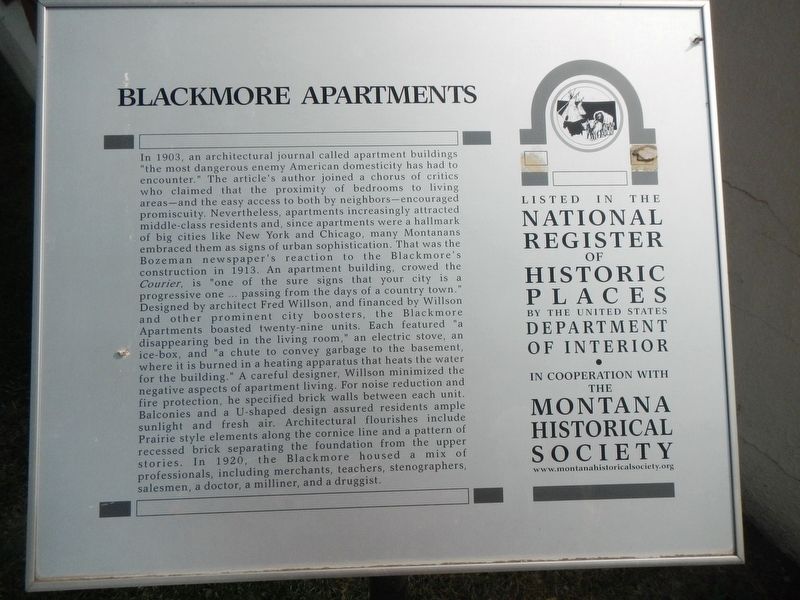
In 1903, an architectural journal called apartment buildings “the most dangerous enemy American domesticity has had to encounter.” The article’s author joined a chorus of critics who claimed that the proximity of bedrooms to living areas—and the easy access to both by neighbors—encouraged promiscuity. Nevertheless, apartments increasingly attracted middle-class residents and, since apartments were a hallmark of big cities like New York and Chicago, many Montanans embraced them as signs of urban sophistication. That was the Bozeman newspaper’s reaction to the Blackmore’s construction in 1913. An apartment building, crowed the Courier, is “one of the sure signs that your city is a progressive one … passing from the days of a country town.” Designed by architect Fred Willson, and financed by Willson and other prominent city boosters, the Blackmore Apartments boasted twenty-nine units. Each featured “a disappearing bed in the living room,” an electric stove, an ice-box, and “a chute to convey garbage to the basement, where it is burned in a heating apparatus that heats the water for the building.” A careful designer, Willson
Click or scan to see this page online
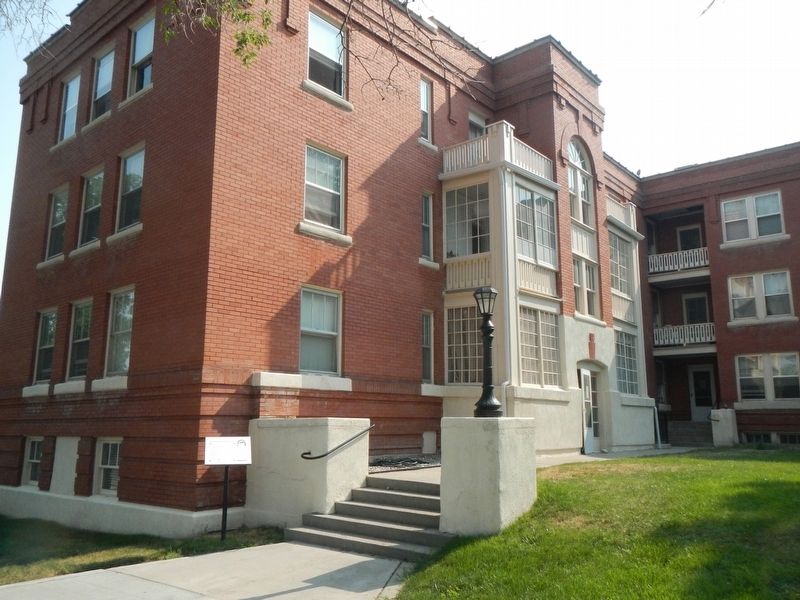
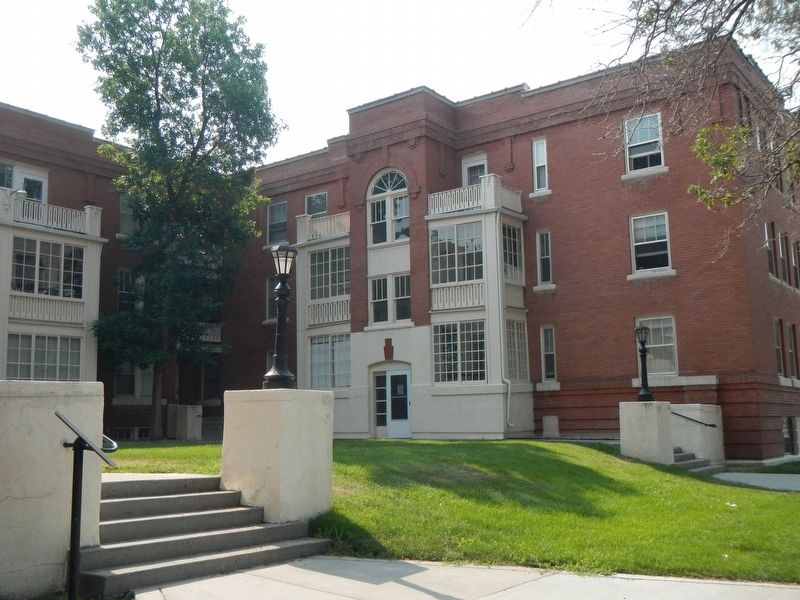
minimized the negative aspects of apartment living. For noise reduction and fire protection, he specified brick walls between each unit. Balconies and a U-shaped design assured residents ample sunlight and fresh air. Architectural flourishes include Prairie style elements along the cornice line and a pattern of recessed brick separating the foundation from the upper stories. In 1920, the Blackmore housed a mix of professionals, including merchants, teachers, stenographers, salesmen, a doctor, a milliner, and a druggist.
Erected by Montana Historical Society.
Topics and series. This historical marker is listed in this topic list: Architecture. In addition, it is included in the Montana National Register Sign Program series list. A significant historical year for this entry is 1903.
Location. 45° 40.656′ N, 111° 2.131′ W. Marker is in Bozeman, Montana, in Gallatin County. It is on South Black Avenue near East Olive Street, on the right when traveling north. Touch for map. Marker is at or near this postal address: 120 South Black Avenue, Bozeman MT 59715, United States of America. Touch for directions.
Regionally, this marker is in
Photographed by Barry Swackhamer, July 25, 2021
2. Blackmore Apartments and Marker
Montana’s Yellowstone Country. It is also in the American Mountain West and in the Lewis & Clark Corridor. Globally, it is in North America, the Rocky Mountains, the Western Hemisphere, the Western World, and the Anglosphere. Historically, it finds itself in what was once Rupert’s Land and also the Louisiana Purchase.
Credits. This page was last revised on November 4, 2024. It was originally submitted on February 17, 2022, by Barry Swackhamer of Brentwood, California. This page has been viewed 539 times since then and 18 times this year. Photos:1, 2, 3. submitted on February 17, 2022, by Barry Swackhamer of Brentwood, California.