Mendota in LaSalle County, Illinois — The American Midwest (Great Lakes)
Railroads and the Founding of Mendota
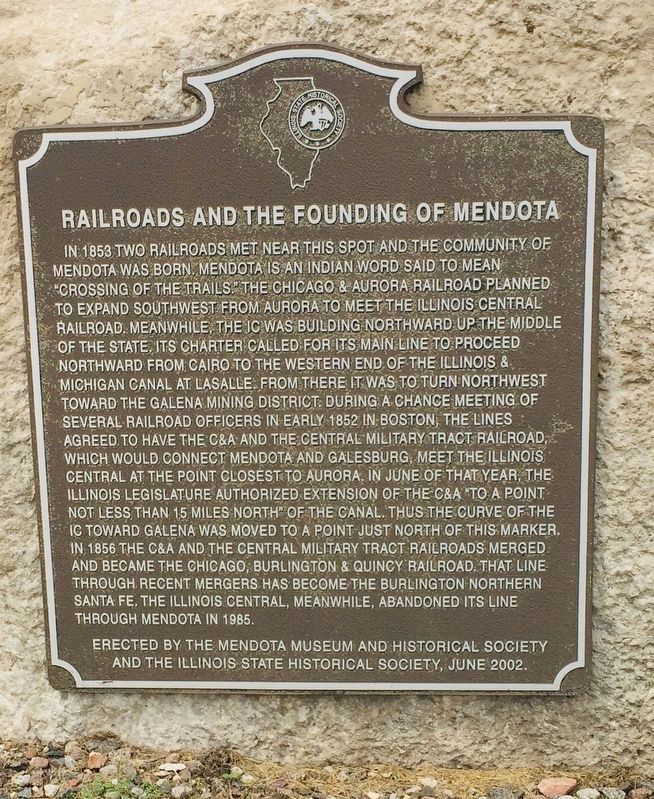
this page online
Erected 2002 by Mendota Museum and Historical Society • Illinois State Historical Society.
Topics. This historical marker is listed in this topic list: Railroads & Streetcars. A significant historical year for this entry is 1853.
Location. 41° 33.004′ N, 89° 7.076′ W. Marker is in Mendota, Illinois, in LaSalle County. It is at the intersection of 8th Street and Main Street, on the left when traveling east on 8th Street. Marker is in front of the Breaking the Prairie Museum. Touch for map. Marker is at or near this postal address: 684 8th St, Mendota IL 61342, United States of America. Touch for directions.

Regionally, this marker is in Northern Illinois and specifically in the Illinois River Valley. It is also in the American Midwest and in the Corn Belt. Globally, it is in North America, the Western Hemisphere, the Western World, and the Anglosphere. Historically, it finds itself in what was once the territory of the Mississippian Culture and also the Northwest
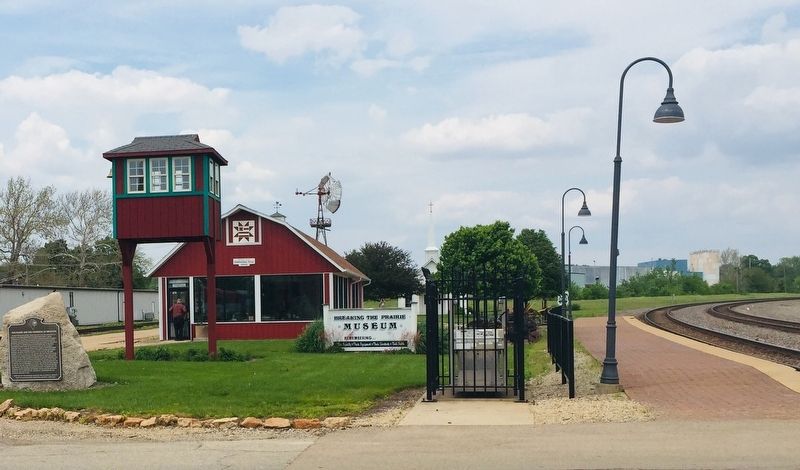
Other nearby markers. At least 8 other markers are within 10 miles of this marker, measured as the crow flies: Troy Grove Township Veterans Memorial (approx. 6 miles away); James Butler "Wild Bill" Hickok (approx. 6.1 miles away); Prudence Crandall: Abolitionist, Educator, and Woman’s Rights Advocate (approx. 6.1 miles away); Wild Bill Hickok (approx. 6.1 miles away); Civil War Memorial (approx. 6.1 miles away); Cherry Mine Disaster (approx. 9.7 miles away); We of Cherry Honor Our Service Personnel (approx. 9.7 miles away); Cherry Miner's Memorial / Afterward-at-Cherry (approx. 9.9 miles away).
Also see . . . Mendota, IL (MDT). The city remains connected to the railroad, with the 1888 Union Depot still serving as an passenger station (now for Amtrak). It also houses a museum with a model railroad layout of the town as it appeared in the 1930s. (The Great American Stations project) (Submitted on February 22, 2022, by Duane and Tracy Marsteller of Murfreesboro, Tennessee.)
Credits. This page was last revised on February 22, 2022. It was originally submitted on February 21, 2022, by Duane and Tracy Marsteller of Murfreesboro, Tennessee. This page has been viewed 713 times since then and 102 times this year. Photos: 1. submitted on February 21, 2022, by Duane and Tracy Marsteller of Murfreesboro, Tennessee. 2. submitted on February 22, 2022, by Duane and Tracy Marsteller of Murfreesboro, Tennessee.
