French Quarter in Charleston in Charleston County, South Carolina — The American South (South Atlantic)
Farmers and Exchange Bank
Photographed by Stanley and Terrie Howard, May 16, 2009
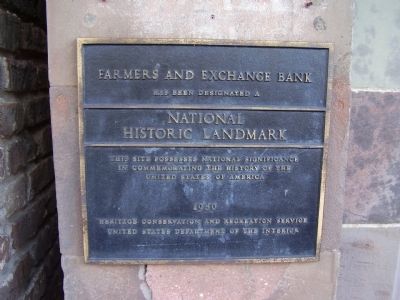
1. Farmers and Exchange Bank Marker
Farmers' and Exchange Bank *** (added 1973 - - #73001685)
141 E. Bay St. , Charleston
• Historic Significance: Architecture/Engineering
• Period of Significance: 1850-1874
National Historic Landmark
This site possesses national significance in commemorating the history of the United States of America
1980
Heritage Conservation and Recreation Service
United States Department of the Interior
Erected 1980 by Heritage Conservation and Recreation Service United States Department of the Interior.
Topics and series. This historical marker is listed in these topic lists: Landmarks • Notable Buildings. In addition, it is included in the National Historic Landmarks series list. A significant historical year for this entry is 1980.
Location. 32° 46.665′ N, 79° 55.627′ W. Marker is in Charleston, South Carolina, in Charleston County. It is in the French Quarter. It is on East Bay Street. Touch for map. Marker is at or near this postal address: 141 East Bay Street, Charleston SC 29401, United States of America. Touch for directions.

Regionally, this marker is in Historic Charleston and in the Lowcountry. It is also in the American South, specifically in the Deep South, and on the Eastern Seaboard. Globally, it is in the North Atlantic Region, North America,
this page online
Other nearby markers. At least 8 other markers are within walking distance of this marker: Slave Auctions (within shouting distance of this marker); 19 State Street (about 300 feet away, measured in a direct line); The Old Exchange (about 300 feet away); Lee Cohen Harby (about 300 feet away); Elizabeth Timothy (about 300 feet away); One Broad Street (about 400 feet away); 8 Queen Street (about 400 feet away); Convention on Ratification (about 400 feet away). Touch for a list and map of all markers in Charleston.
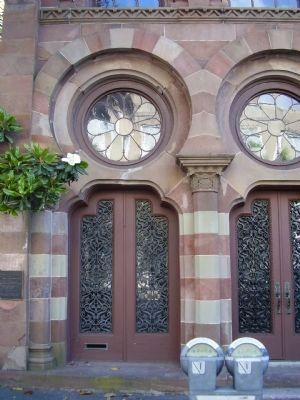
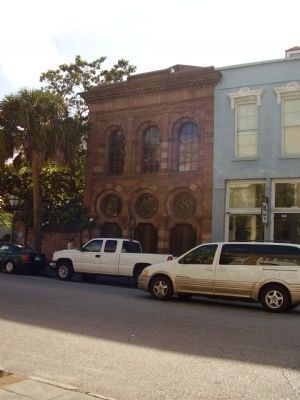
Regarding Farmers and Exchange Bank. The building was designed by Edward C. Jones and Francis D. Lee in 1853 and was completed in 1854. Both of these architects were Charlestonians. The Farmers’ and Exchange Bank is perhaps the only example of the Moorish picturesque style that evolved from one aspect of English Regency architecture. The building is stucco
Photographed by Stanley and Terrie Howard, May 16, 2009
2. Farmers and Exchange Bank
Photographed by Stanley and Terrie Howard, May 16, 2009
3. Farmers and Exchange Bank
Credits. This page was last revised on February 16, 2023. It was originally submitted on June 5, 2009, by Stanley and Terrie Howard of Greer, South Carolina. This page has been viewed 1,235 times since then and 30 times this year. Photos: 1, 2, 3. submitted on June 5, 2009, by Stanley and Terrie Howard of Greer, South Carolina. • Kevin W. was the editor who published this page.
