Taylors in Greenville County, South Carolina — The American South (South Atlantic)
Taylors First Baptist Church
Photographed by Tom Bosse, May 14, 2022
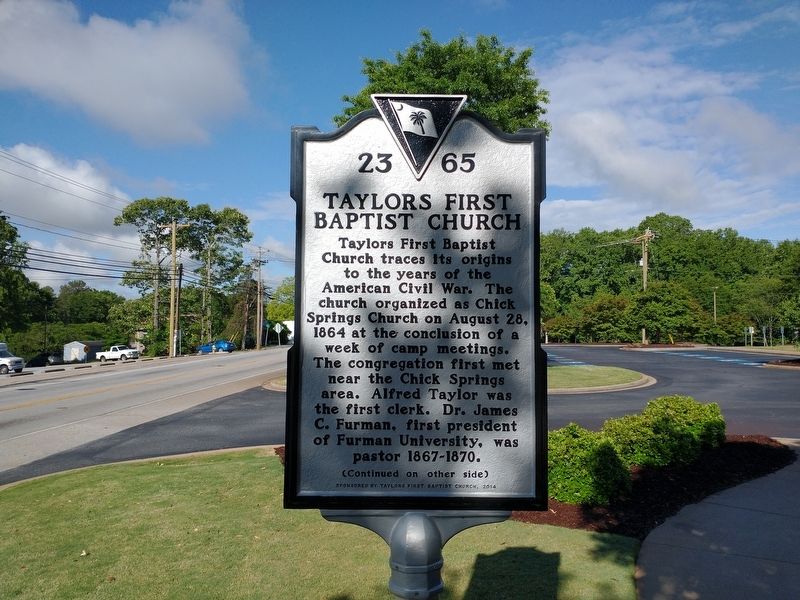
1. Taylors First Baptist Church Marker (Front)
(front)
Taylors First Baptist Church traces its origins to the years of the American Civil War. The church organized as Chick Springs Church on August 28, 1864 at the conclusion of a week of camp meetings. The congregation first met near the Chick Springs area. Alfred Taylor was the first clerk. Dr. James C. Furman, first president of Furman University, was pastor 1867-1870.
Erected 2014 by Taylors First Baptist Church. (Marker Number 23-65.)
Topics. This historical marker is listed in these topic lists: Railroads & Streetcars • Religion & Religious Structures. A significant historical date for this entry is August 28, 1864.
Location. 34° 55.18′ N, 82° 18.186′ W.
this page online

Regionally, this marker is in Upstate and in the Greater Greenville-Spartanburg Area. It is also in the American South, specifically in the Deep South, in Appalachia, and specifically in Southern Appalachia. Globally, it is in North America, the Western Hemisphere, the Western World, and the Anglosphere. Historically, it finds itself in what was once the original Cherokee Nation, the territory of the Mississippian Culture, one of the original Thirteen Colonies, one of the Confederate States of America, and the Antebellum South.
Other nearby markers. At least 8 other markers are within 4 miles of this marker, measured as the crow flies: Southern Bleachery Mill Village / Mill Superintendent House (approx. 0.6 miles away); Rev. James R. Rosemond (approx. 2.1 miles away); Suber's Mill (approx. 2.4 miles away); Methodist Men Memorial (approx.
Photographed by Tom Bosse, May 14, 2022
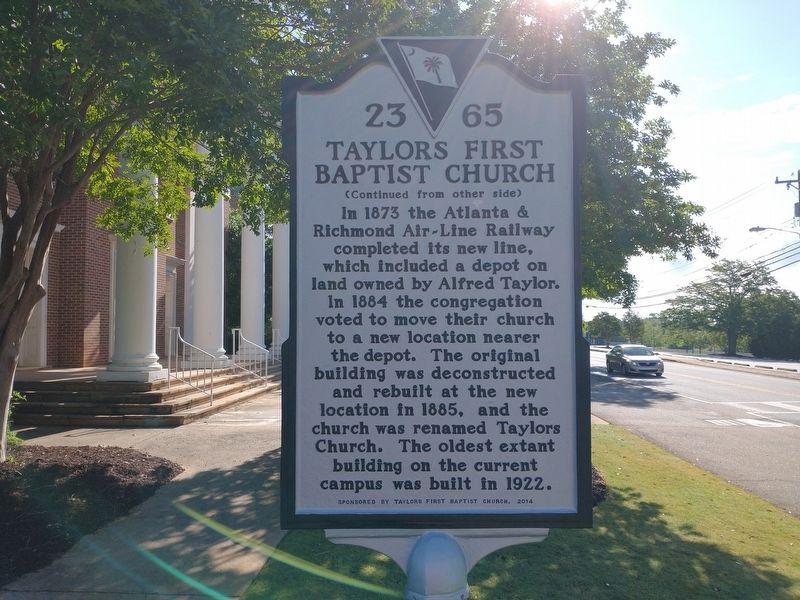
2. Taylors First Baptist Church Marker (Back)
Another marker is no longer nearby. Chick Springs (was approx. 1.1 miles away but has been confirmed missing).
Also see . . . Our History. Church website entry (Submitted on May 21, 2022, by Tom Bosse of Jefferson City, Tennessee.)
Photographed by Tom Bosse, May 14, 2022
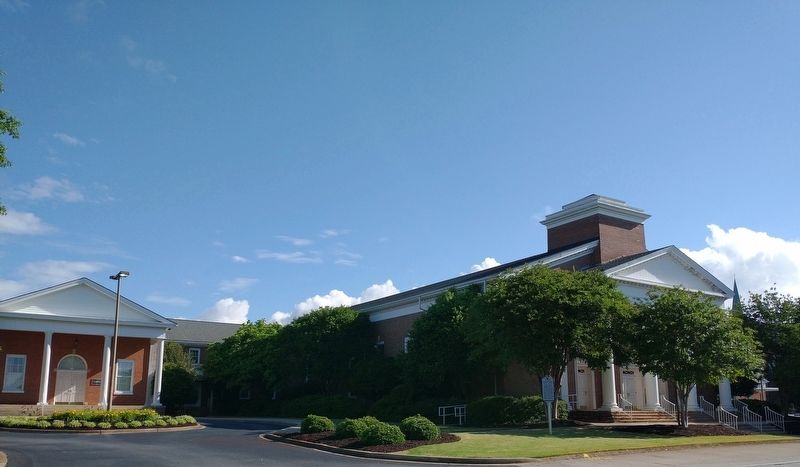
3. Taylors First Baptist Church Marker
Credits. This page was last revised on October 19, 2022. It was originally submitted on May 21, 2022, by Tom Bosse of Jefferson City, Tennessee. This page has been viewed 526 times since then and 41 times this year. Photos: 1, 2, 3. submitted on May 21, 2022, by Tom Bosse of Jefferson City, Tennessee. • Bernard Fisher was the editor who published this page.
