Fort Norfolk , Virginia — The American South (Mid-Atlantic)
Atlantic City
Photographed by Brandon D Cross, June 8, 2022
1. Atlantic City Marker
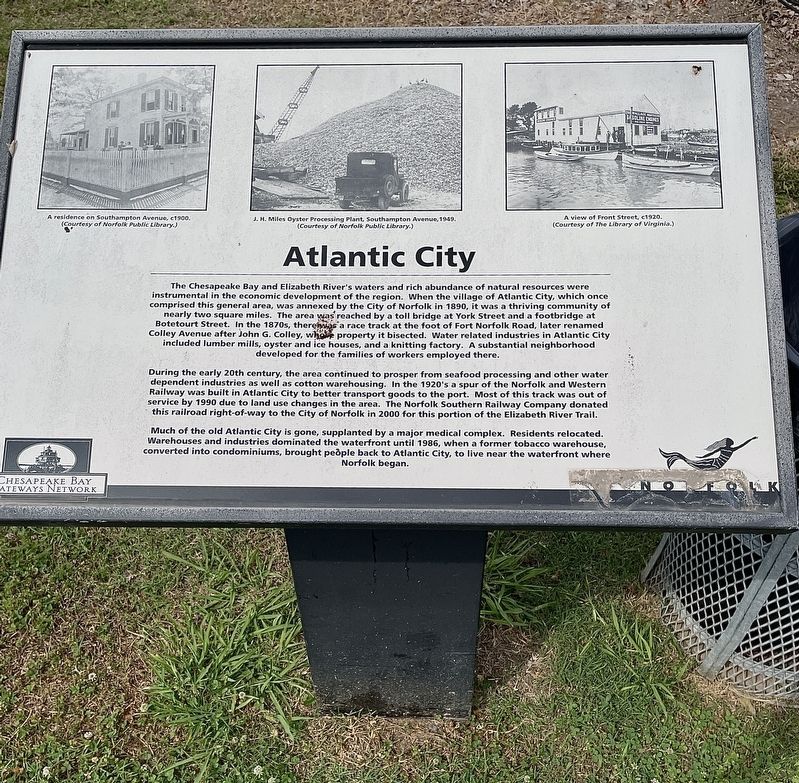
During the early 20th century, the area continued to prosper from seafood processing and other water dependent industries as well as cotton warehousing. In the 1920's a spur of the Norfolk and Western Railway was built in Atlantic City to better transport goods to the port. Most of this track was out of service by 1990 due to land use changes in the area. The Norfolk Southern
this page online
Much of the old Atlantic City is gone, supplanted by a major medical complex. Residents relocated. Warehouses and industries dominated the waterfront until 1986, when a former tobacco warehouse, converted into condominiums, brought peòple back to Atlantic City, to live near the waterfront where Norfolk began.
(captions)
A residence on Southampton Avenue, c.1900. (Courtesy of Norfolk Public Library.)
J. H. Miles Oyster Processing Plant, Southampton Avenue, 1949. (Courtesy of Nortolk Public Library.)
A view of Front Street, c.1920. (Courtesy of The Library of Virginia.)
Erected by City of Norfolk and the Chesapeake Bay Gateways Network.
Topics. This historical marker is listed in these topic lists: Bridges & Viaducts • Industry & Commerce. A significant historical year for this entry is 1890.
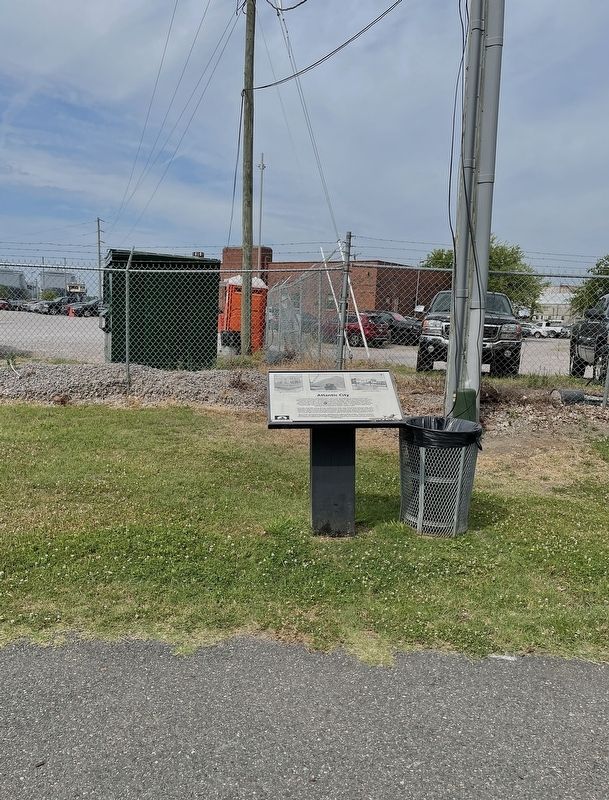
Location. 36° 51.528′ N, 76° 18.4′ W. Marker is in Norfolk, Virginia. It is in Fort Norfolk. It is at the intersection of Riverview Avenue and Southampton Avenue, on the left when traveling north on Riverview
Photographed by Brandon D Cross, June 8, 2022
2. Atlantic City Marker

Regionally, this marker is in Virginia’s Hampton Roads, specifically in Coastal Virginia, and in the Hampton Roads Metropolitan Area. It is also in the American South, specifically in the Upper South, in the Tidewater, and on the Eastern Seaboard. Globally, it is in the North Atlantic Region, North America, the Western Hemisphere, the Western World, and the Anglosphere. Historically, it finds itself in what was once the territory of the Mississippian Culture, one of the original Thirteen Colonies, one of the Confederate States of America, and the Antebellum South.
Other nearby markers. At least 8 other markers are within walking distance of this marker: Fort Norfolk (within shouting distance of this marker); Elizabeth River Restoration (about 500 feet away, measured in a direct line); Historical Points of Interest (about 800 feet away); War of 1812 Elizabeth River Defenses/War of 1812 (approx. 0.2 miles away); The Creation of Plum Point Park (approx. 0.2 miles away); Development and Architecture of Fort Norfolk (approx. 0.2 miles away); Managing Sediments in the Chesapeake Bay (approx. 0.2 miles away); Fort Norfolk Veterans of the War of 1812 Memorial (approx. 0.2 miles away). Touch for a list and map of all markers in Norfolk.
Also see . . . Atlantic City. (Submitted on June 13, 2022, by Brandon D Cross of Flagler Beach, Florida.)
Credits. This page was last revised on February 1, 2023. It was originally submitted on June 13, 2022, by Brandon D Cross of Flagler Beach, Florida. This page has been viewed 1,255 times since then and 145 times this year. Photos: 1, 2. submitted on June 13, 2022, by Brandon D Cross of Flagler Beach, Florida. • Bernard Fisher was the editor who published this page.
