East Village District in Tulsa in Tulsa County, Oklahoma — The American South (West South Central)
Warehouse Market
10th Street & Elgin Street
| — | Tulsa's Historic Route 66 | — |
Photographed by Mark Hilton, June 15, 2022
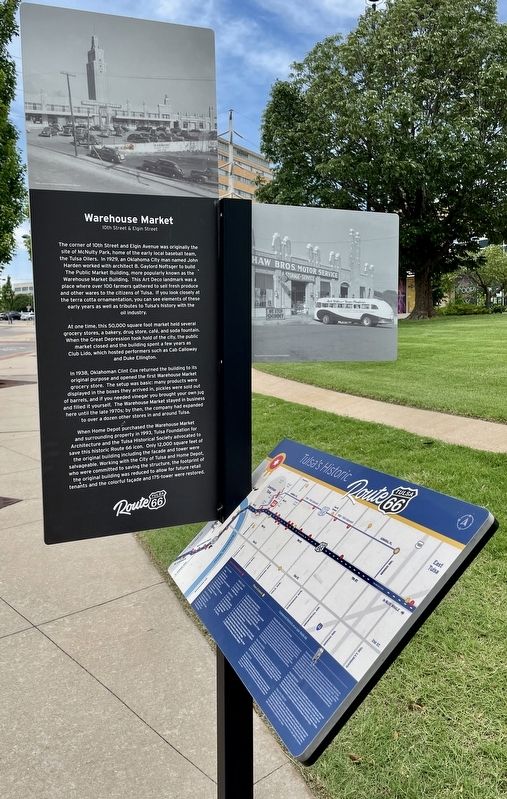
1. Warehouse Market Marker
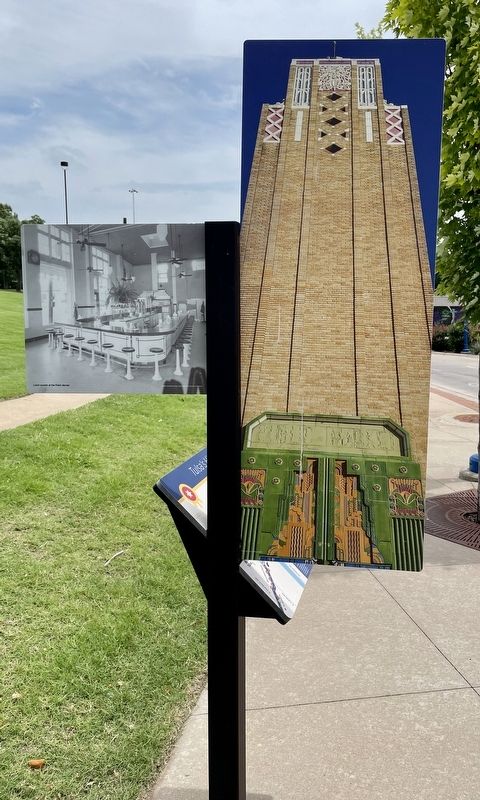
The corner of 10th Street and Elgin Avenue was originally the site of McNulty Park, home of the early local baseball team, the Tulsa Oilers. In 1929, an Oklahoma City man named John Harden worked with architect B. Gaylord Noftsger to build The Public Market Building, more popularly known as the Warehouse Market Building. This Art Deco landmark was a place where over 100 farmers gathered to sell fresh produce and other wares to the citizens of Tulsa. If you look closely at the terra cotta ornamentation, you can see elements of these early years as well as tributes to Tulsa's history with the oil industry.
At one time, this 50,000 square foot market held several grocery stores, a bakery, drug store, café, and soda fountain. When the Great Depression took hold of the city, the public market closed and the building spent a few years as Club Lido, which hosted performers such as Cab Calloway and Duke Ellington.
In 1938, Oklahoman Clint Cox returned the building to its original purpose and opened the first Warehouse Market grocery store. The setup was basic: many products were displayed in the boxes they arrived in, pickles were sold out of barrels, and if you needed vinegar you brought your own jug and filled it yourself. The Warehouse Market stayed in business here until the late 1970s; by then, the company had expanded to over a dozen other stores in and around Tulsa.
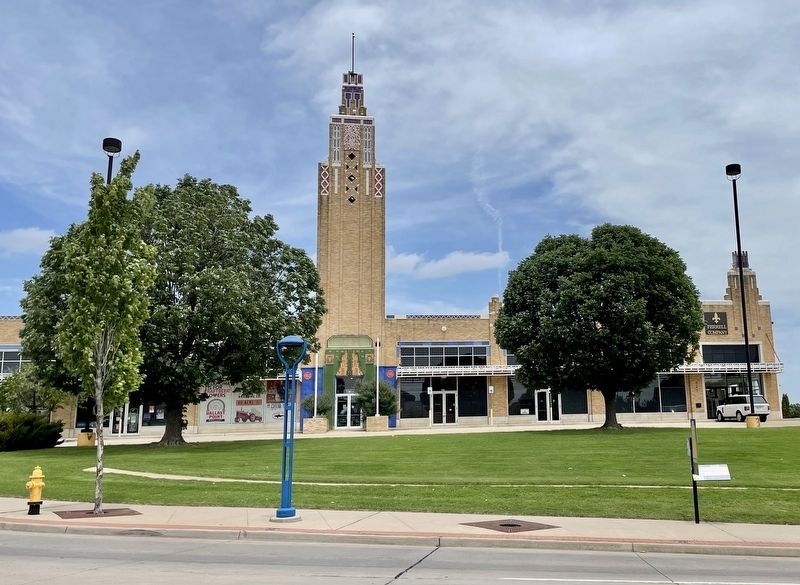
When Home Depot purchased the Warehouse Market and surrounding property in 1993, Tulsa Foundation for Architecture and the Tulsa Historical Society advocated to save this historic Route 66 icon. Only 12,000 square feet of the original building including the facade and tower were salvageable. Working with the City of Tulsa and Home Depot, who were committed to saving the structure, the footprint of the original building was reduced
this page online
Erected 2019 by Tulsa Route 66 Commission. (Marker Number 12.)
Topics. This historical marker is listed in these topic lists: Architecture • Industry & Commerce. A significant historical year for this entry is 1929.
Location. 36° 8.88′ N, 95° 58.933′ W. Marker is in Tulsa, Oklahoma, in Tulsa County. It is in the East Village District. It is on East 11th Street (U.S. 66), on the right when traveling west. Touch for map. Marker is in this post office area: Tulsa OK 74106, United States of America. Touch for directions.

Regionally, this marker is in the Muscogee Nation, specifically in the Cherokee Nation, and in Northeast Oklahoma—Green Country. It is also in the American South, specifically on the prairies, and on the Southern Plains. Globally, it is in North America, the Western Hemisphere, the Western World, and the Anglosphere. Historically, it finds itself in what was once the territory of the Mississippian Culture and also the Louisiana Purchase.
Other nearby markers. At least 8 other markers are within walking distance
Photographed by Mark Hilton, June 15, 2022
2. Reverse side Warehouse Market Marker
Photographed by Mark Hilton, June 15, 2022
3. Warehouse Market Marker with original facade & tower.
Photographed by Mark Hilton, June 15, 2022
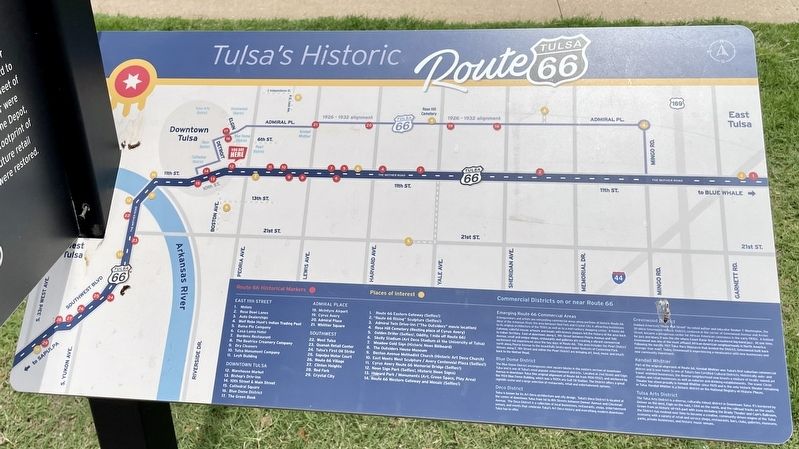
4. Included map showing the Tulsa Historical Route 66 trail.
Credits. This page was last revised on February 14, 2026. It was originally submitted on June 17, 2022, by Mark Hilton of Montgomery, Alabama. This page has been viewed 3,451 times since then and 349 times this year. Photos: 1, 2, 3, 4. submitted on June 17, 2022, by Mark Hilton of Montgomery, Alabama.
