Hill City in Pennington County, South Dakota — The American Midwest (Upper Plains)
BNSF Railroad Signal
Photographed by James Hulse, June 17, 2022
1. BNSF Railroad Signal Marker
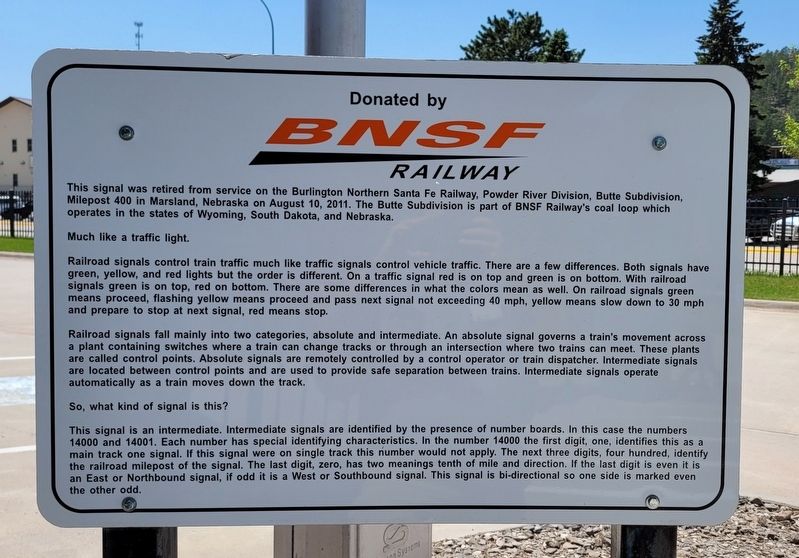
This signal was retired from service on the Burlington Northern Santa Fe Railway, Powder River Division, Butte Subdivision, Milepost 400 in Marsland, Nebraska on August 10, 2011. The Butte Subdivision is part of BNSF Railway's coal loop which operates in the states of Wyoming, South Dakota, and Nebraska.
Much like a traffic light.
Railroad signals control train traffic much like traffic signals control vehicle traffic. There are a few differences. Both signals have green, yellow, and red lights but the order is different. On a traffic signal red is on top and green is on bottom. With railroad signals green is on top, red on bottom. There are some differences in what the colors mean as well. On railroad signals green means proceed, flashing yellow means proceed and pass next signal not exceeding 40 mph, yellow means slow down to 30 mph and prepare to stop at next signal, red means stop.
Railroad signals fall mainly into two categories, absolute and intermediate. An absolute signal governs a train's movement across a plant containing switches where a train can change tracks or through an intersection where two
this page online
So, what kind of signal is this?
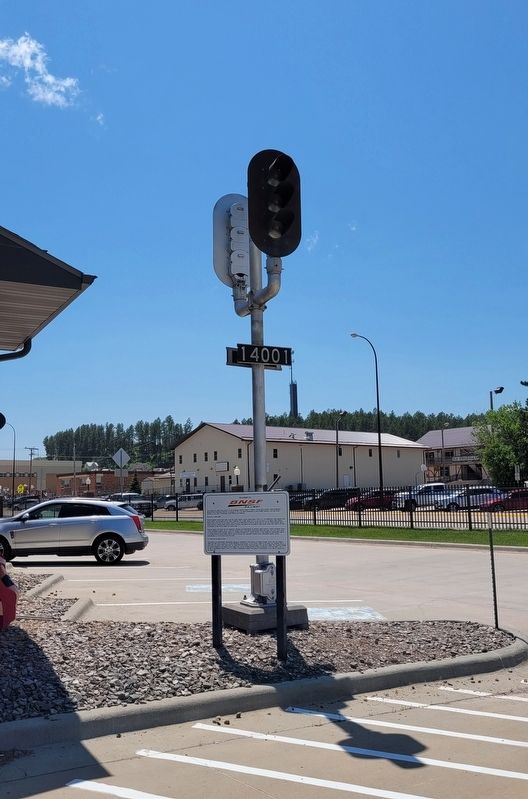
This signal is an intermediate. Intermediate signals are identified by the presence of number boards. In this case the numbers 14000 and 14001. Each number has special identifying characteristics. In the number 14000 the first digit, one, identifies this as a main track one signal. If this signal were on single track this number would not apply. The next three digits, four hundred, identify the railroad milepost of the signal. The last digit, zero, has two meanings tenth of mile and direction. If the last digit is even it is an East or Northbound signal, if odd it is a West or Southbound signal. This signal is bi-directional so one side is marked even the other odd.
Erected by BNSF Railroad.
Topics. This historical marker is listed in these topic lists: Communications
Photographed by James Hulse, June 17, 2022
2. BNSF Railroad Signal Marker
Location. 43° 55.895′ N, 103° 34.428′ W. Marker is in Hill City, South Dakota, in Pennington County. It can be reached from the intersection of Railroad Avenue and Elm Street. The marker is located at the central section of the 1880 Train - Hill City Depot. Touch for map. Marker is at or near this postal address: 222 Railroad Avenue, Hill City SD 57745, United States of America. Touch for directions.

Regionally, this marker is in West River, in the Badlands, and in Greater Rapid City. It is also in the American Black Hills, in the Lewis & Clark Corridor, on the prairies, and on the Northern Plains. Globally, it is in North America, the Western Hemisphere, the Western World, and the Anglosphere. Historically, it finds itself in what was once Rupert’s Land and also the Louisiana Purchase.
Other nearby markers. At least 8 other markers are within walking distance of this marker: Semaphore & Telegraph (within shouting distance of this marker); Hill City Depot (within shouting distance of this marker); The Black Hills Central Railroad (about 300
Photographed by James Hulse, June 17, 2022
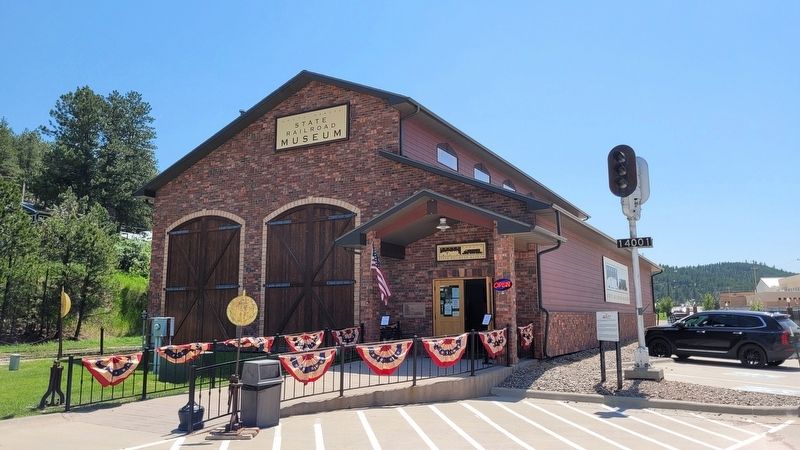
3. The view of the BNSF Railroad Signal Marker from the parking lot
Also see . . .
1. 1880 Train History. (Submitted on July 25, 2022, by James Hulse of Medina, Texas.)
2. North American railroad signals. Wikipedia (Submitted on July 25, 2022, by James Hulse of Medina, Texas.)
Credits. This page was last revised on August 21, 2026. It was originally submitted on July 25, 2022, by James Hulse of Medina, Texas. This page has been viewed 918 times since then and 80 times this year. Photos: 1, 2, 3. submitted on July 25, 2022, by James Hulse of Medina, Texas.
