Cape May in Cape May County, New Jersey — The American Northeast (Mid-Atlantic)
The Franklin Street School
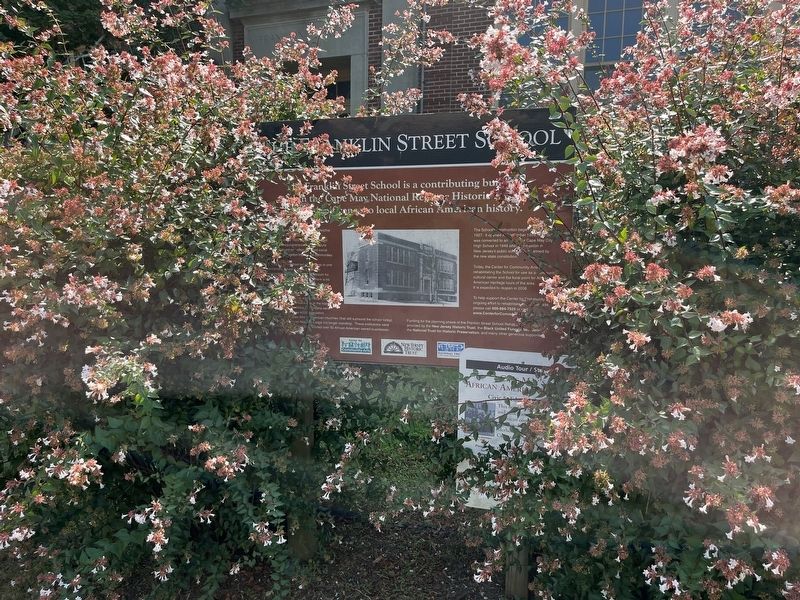
The Franklin Street School is a contributing building in the Cape May National Register Historic District for its significance to local African American history.
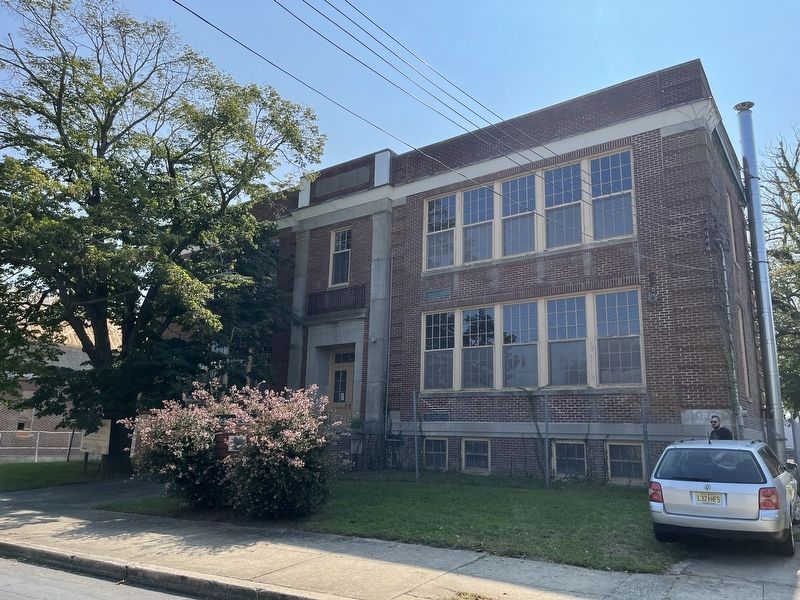
Designed by Edwards and Green of Philadelphia and Camden in the Colonial Revival Style (a popular style in the 1920's thanks to interest in the nation's sesquicentennial), the structure shows the profound and often awkward social landscape of segregation imposed on communities.
The Franklin Street School is two buildings in one: the elementary school in front, for African American children, and the rear gymnasium for Cape May's integrated high school. There is no internal connection between these two parts of the overall building.
Today the School stands as a testimony to the central role African Americans play in the history of Cape May. In 1930, African Americans were about 20 percent of Cape May's population. On this block stood three African American churches (that still surround the school today) and the African American Masonic Lodge (no longer standing). these institutions were part of a thriving community that included over 50 African American
this page online
The School's construction began on December 6, 1927. It opened in September 1928. The School was converted to an annex for Cape May City High School in 1948 after segregation in New Jersey's public schools was banned in the new state constitution.
Today, the Center for Community Arts is rehabilitating the School for use as a community cultural center and the focal point for African American Heritage tours of the area. It is expected to reopen in 2008.
To help support the Center for Community Arts' ongoing effort to rehabilitate this historic site, please call 609-884-7525 or visit www.CenterforCommunityArts.org.
Funding for the planning phase of the Franklin Street School Rehabilitation Project is provided by the New Jersey Historic Trust, the Black Untied Fund of New Jersey, the National Trust for Historic Preservation, and many other generous supporters.
Erected by The Center for Community Arts.
Topics. This historical marker is listed in these topic lists: African Americans • Architecture • Education. A significant historical month for this entry is September 1928.
Location. 38° 56.127′ N, 74° 55.243′ W.

Regionally, this marker is on New Jersey’s Jersey Shore. It is also in the American Northeast, in the Mid-Atlantic, and on the Eastern Seaboard. Globally, it is in the North Atlantic Region, North America, the Western Hemisphere, the Western World, and the Anglosphere. Historically, it finds itself in what was once New Netherland and also one of the original Thirteen Colonies.
Other nearby markers. At least 8 other markers are within walking distance of this marker: Civic & Education Center (here, next to this marker); Historically Black Franklin Street School (here, next to this marker); Historic Macedonia Baptist Church of Cape May (within shouting distance of this marker); Stephen Smith's Summer House, 1846 (within shouting distance of this marker); The Stephen Smith House (within shouting distance of this marker); Original Fire Hydrant (about 300 feet away, measured in a direct line); The Space Shuttle Tree (about 300 feet away); Opra Huff's Bakery, 1950s (about 300 feet away). Touch for a list and map of all markers in Cape May.
Credits. This page was last revised on September 18, 2022. It was originally submitted on September 18, 2022, by Devry Becker Jones of Washington, District of Columbia. This page has been viewed 410 times since then and 30 times this year. Photos: 1, 2. submitted on September 18, 2022, by Devry Becker Jones of Washington, District of Columbia.
Editor’s want-list for this marker. A clearer photo of the marker once the shrubbery is pruned. • A link to the National Register of Historic Places nomination form with a citation of the school's historical significance. • Can you help?
