Grange Park in Toronto, Ontario — Central Canada (North America)
Sir William Campbell
1758-1834
Photographed by Cosmos Mariner, May 29, 2022
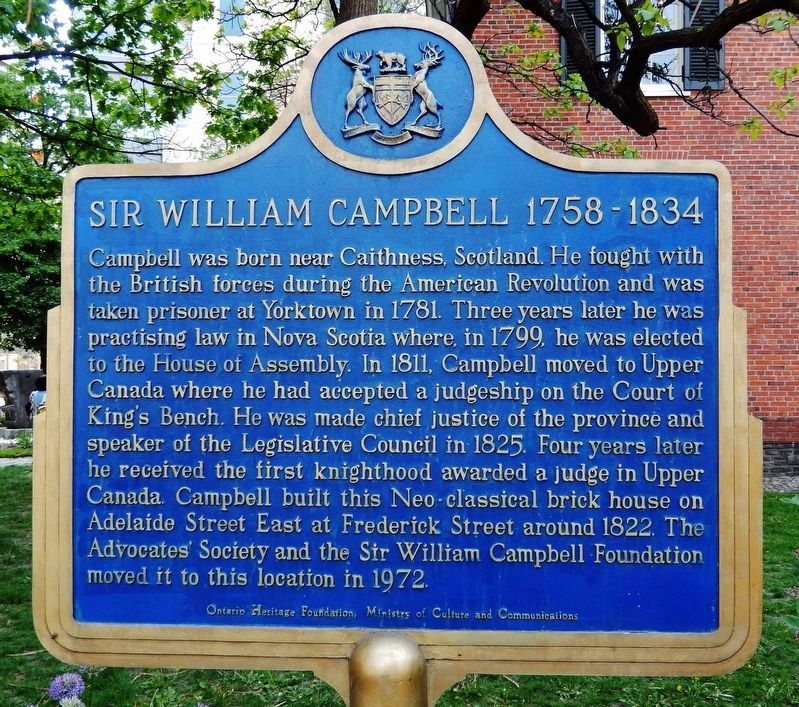
1. Sir William Campbell Marker (east side)

[English]
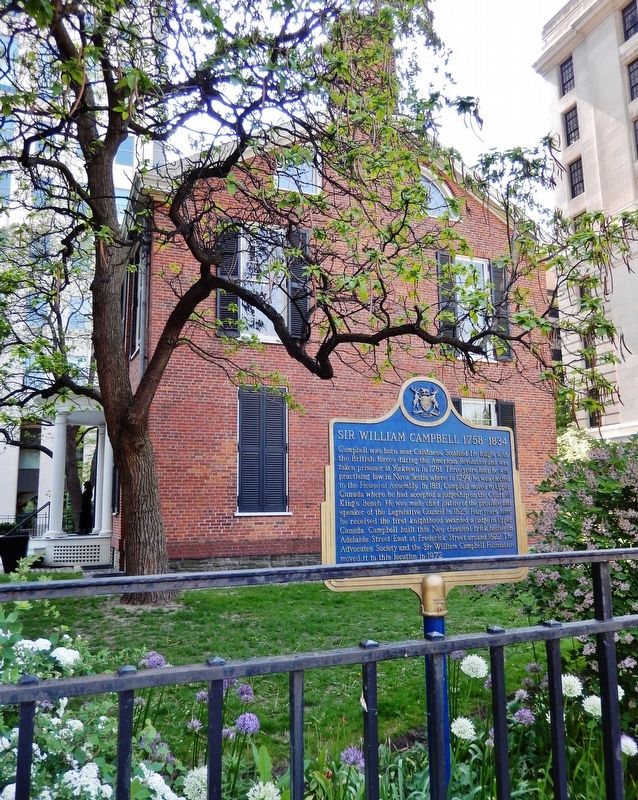
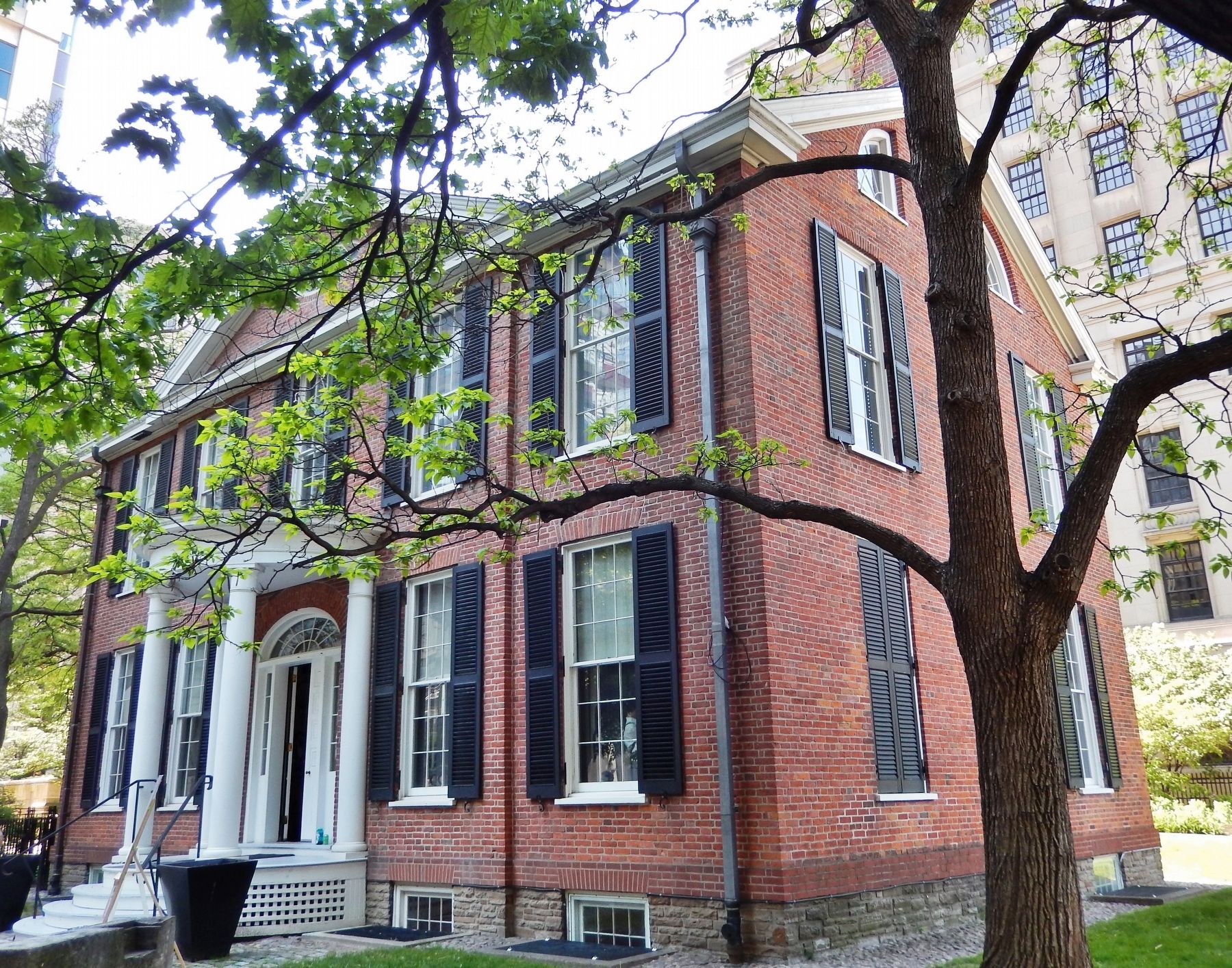
Campbell was born near Caithness, Scotland. He fought with the British forces during the American Revolution and was taken prisoner at Yorktown in 1781. Three years later he was practising law in Nova Scotia where, in 1799, he was elected to the House of Assembly. In 1811, Campbell moved to Upper Canada where he had accepted a judgeship on the Court of King's Bench. He was made chief justice of the province and speaker of the Legislative Council in 1825. Four years later he received the first knighthood awarded a judge in Upper Canada. Campbell built this Neo-classical brick house on Adelaide Street East at Frederick Street around 1822. The Advocates' Society and the Sir William Campbell Foundation moved it to this location in 1972.
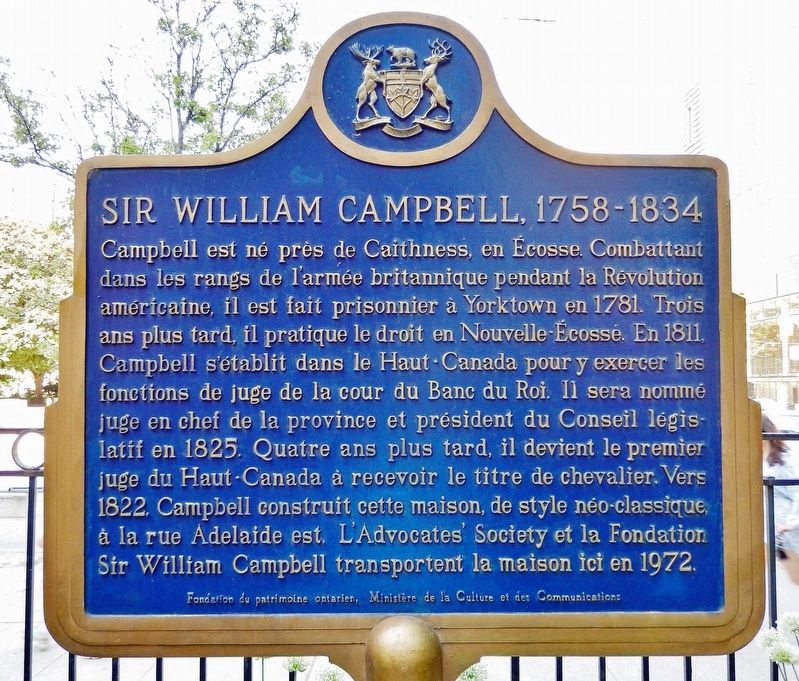
Campbell est né près de Caithness, en Écosse. Combattant dans les rangs de l’armée britannique pendant la Révolution américaine, il est fait prisonnier à Yorktown en 1781. Trois ans plus tard, il pratiquait le droit en Nouvelle-Écosse. En 1811, Campbell s’établit dans le Haut-Canada pour y exercer les fonctions de juge de la cour du Banc du Roi. Il sera nommé juge en
this page online
Erected by Ontario Heritage Foundation, Ministry of Culture and Communications / Fondation du patrimoine ontarien, Ministre de la Culture et des Communications.
Topics and series. This historical marker is listed in these topic lists: Architecture • Notable Buildings • War, US Revolutionary. In addition, it is included in the Canada, Ontario Heritage Trust series list. A significant historical year for this entry is 1758.
Location. 43° 39.063′ N, 79° 23.223′ W. Marker is in Toronto, Ontario. It is in Grange Park. It is on University Avenue just north of Queen Street West, on the right when traveling south. Marker is located near the sidewalk, on the east side of the Campbell House Museum. Touch for map. Marker is at or near this postal address: 160 Queen Street West, Toronto ON
Photographed by Cosmos Mariner, May 29, 2022
2. Sir William Campbell Marker (west side)

Regionally, this marker is in Greater Toronto and on the Golden Horseshoe. It is also in Central Canada. Globally, it is in North America, on the Great Lakes, in the Western Hemisphere, in the Western World, and in the Anglosphere. Historically, it finds itself in what was once a British colony, the Viceroyalty of New France, the Haudenosaunee (Iroquois) Confederacy, and Rupert’s Land.
Other nearby markers. At least 8 other markers are within walking distance of this marker: York Courthouse Cornerstone (a few steps from this marker); George Cox (within shouting distance of this marker); South African War Memorial (within shouting distance of this marker); Walter Seymour Allward, R.C.A. (within shouting distance of this marker); Women's Law Association of Ontario (about 120 meters away, measured in a direct line); Osgoode Hall (about 150 meters away); University Avenue Armouries (about 150 meters away); Osgoode Hall Fence (about 180 meters away). Touch for a list and map of all markers in Toronto.
Also see . . .
1. William Campbell.
Sir William Campbell was Chief(Submitted on October 18, 2022, by Cosmos Mariner of Cape Canaveral, Florida.)Justice of the Supreme Court of Upper Canada and a resident of York, Upper Canada. He also held political appointments in both Nova Scotia and Upper Canada. In 1825, he succeeded William Powell as Chief Justice and became a member of the Executive Council and speaker for the Legislative Council. He retired in 1829 due to failing health; he was knighted in April 1829. Campbell died in Toronto in 1834.via Wikipedia3. Sir William Campbell

2. Campbell House.
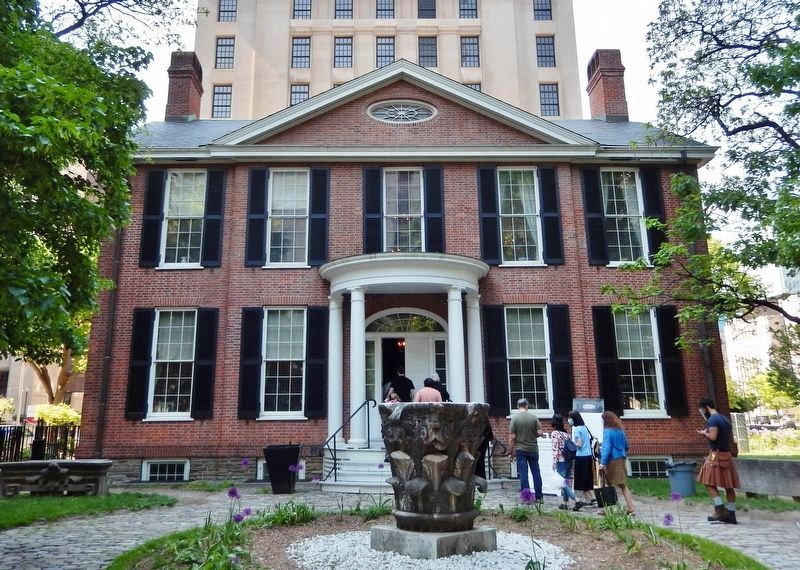
Campbell House is an 1822 heritage house and museum in downtown Toronto, Ontario, Canada. The home was designed for entertaining and comfort, and constructed at a time when the Campbells were socially and economically established, and their children had grown to adulthood. The house is one of the few remaining examples of Georgian architecture left in Toronto and is constructed in a style in vogue during the late Georgian era known as Palladian architecture. The home is owned by the City of Toronto government and operated by the Sir William Campbell Foundation.(Submitted on October 18, 2022, by Cosmos Mariner of Cape Canaveral, Florida.)
Photographed by Cosmos Mariner, May 29, 2022
4. Sir William Campbell Marker
Photographed by Cosmos Mariner, May 29, 2022
5. Campbell House Museum (south/front elevation)
Photographed by Cosmos Mariner, May 29, 2022
6. Campbell House Museum (southeast elevation)
Credits. This page was last revised on November 29, 2025. It was originally submitted on October 18, 2022, by Cosmos Mariner of Cape Canaveral, Florida. This page has been viewed 469 times since then and 50 times this year. Photos: 1, 2. submitted on October 18, 2022, by Cosmos Mariner of Cape Canaveral, Florida. 3. submitted on November 29, 2025, by Larry Gertner of New York, New York. 4, 5, 6. submitted on October 18, 2022, by Cosmos Mariner of Cape Canaveral, Florida.
