Hell's Kitchen in Manhattan in New York County, New York — The American Northeast (Mid-Atlantic)
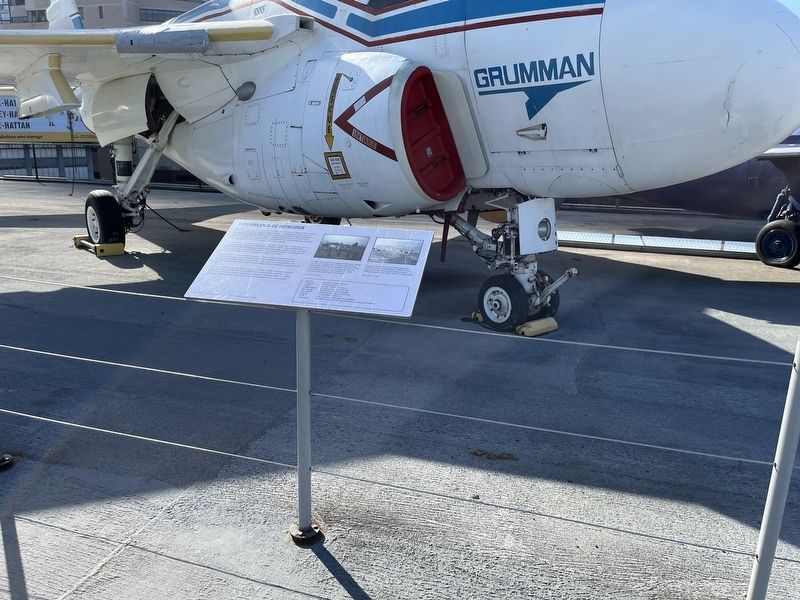
Grumman A-6E Intruder
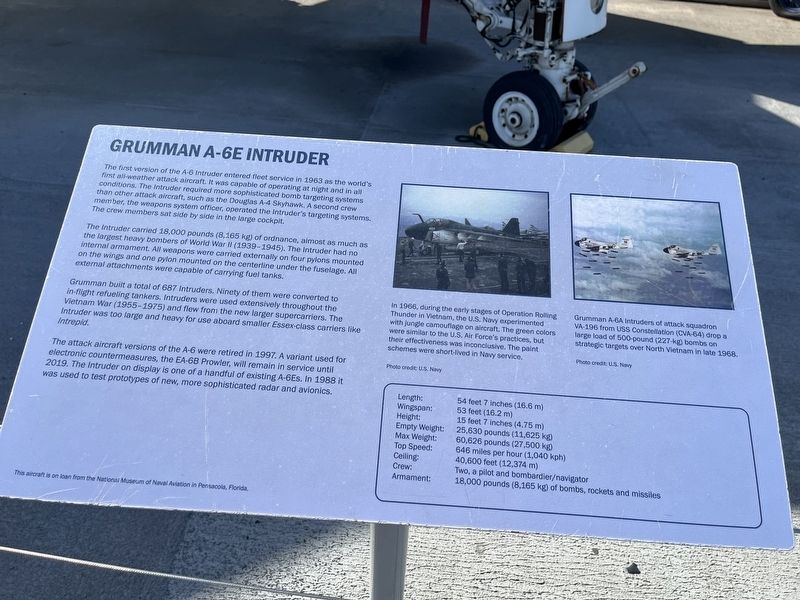
The first version of the A-6 Intruder entered fleet service in 1963 as the world's first all-weather attack aircraft. It was capable of operating at night and in all conditions. The Intruder required more sophisticated bomb targeting systems than other attack aircraft, such as the Douglas A-4 Skyhawk. A second crew member, the weapons system officer, operated the Intruder's targeting systems. The crew members sat side by side in the large cockpit.
The Intruder carried 18,000 pounds (8,165 kg) of ordnance, almost as much as the largest heavy bombers of World War II (1939-1945). The Intruder had no internal armament. All weapons were carried externally on four pylons mounted on the wings and one pylon mounted on the centerline under the fuselage. All external attachments were capable of carrying fuel tanks.
Grumman built a total of 687 Intruders. Ninety of them were converted to in-flight refueling tankers. Intruders were used extensively throughout the Vietnam War (1955-1975) and flew from the new larger supercarriers. The Intruder was too large and heavy for use aboard smaller Essex-class carriers like Intrepid.
The
this page online
Length: 54 feet 7 inches (16.6 m)
Wingspan: 53 feet (16.2 m)
Height: 15 feet 7 inches (4.75 m)
Empty Weight: 25,630
Max Weight: 60,626 pounds (27,500 kg)
Top Speed: 656 miles per hour (1,040 kph)
Ceiling: 40,600 feet (12,374 m)
Crew: Two, a pilot and a bombardier/navigator
Armament: 18,000 pounds (8,165 kg) of bombs, rockets and missiles
[Captions:]
In 1966, during the early stages of Operation Rolling Thunder in Vietnam, the U.S. Navy experimented with jungle camouflage on aircraft. The green colors were similar to the U.S. Air Force's practices, but their effectiveness was inconclusive. The paint schemes were short-lived in Navy service.
Grumman A-6A Intruders of attack squadron VA-196 from USS Constellation (CVA-64) drop a large load of 500-pound (227-kg) bombs on strategic targets over North Vietnam in late 1968.
Erected by Intrepid
Topics. This historical marker is listed in these topic lists: Air & Space • War, Vietnam. A significant historical year for this entry is 1963.
Location. 40° 45.858′ N, 73° 59.99′ W. Marker is in Manhattan, New York, in New York County. It is in Hell's Kitchen. It can be reached from the intersection of 12th Avenue (New York State Route 9A) and West 46th Street, on the right when traveling south. Touch for map. Marker is at or near this postal address: 549 12th Ave, New York NY 10019, United States of America. Touch for directions.

Regionally, this marker is in New York City. It is also in the American Northeast, in the Mid-Atlantic, and on the Eastern Seaboard. Globally, it is in the North Atlantic Region, North America, the Western Hemisphere, the Western World, and the Anglosphere. Historically, it finds itself in what was once New Netherland and also one of the original Thirteen Colonies.
Other nearby markers. At least 8 other markers are within walking distance of this marker: Grumman Aircraft Engineering Corporation (here, next to this marker); Grumman F-11F (F-11A) Tiger (here, next to this marker); Lockheed A-12 (a few steps from this marker); Grumman F-14D Super Tomcat (a few steps from this marker); General Dynamics F-16A Fighting Falcon (a few steps from this marker); Grumman F9F-8 (AF-9J) Cougar (a few steps from this marker); Israel Aircraft Industries Kfir (a few steps from this marker); Grumman (WF-2) E-1B Tracer (within shouting distance of this marker). Touch for a list and map of all markers in Manhattan.
Other markers no longer nearby. Grumman F11F (F-11) Tiger (was here, next to this marker but has been replaced with another marker now near it); Grumman F-14 Tomcat (was here, next to this marker but has been permanently removed); Lockheed A-12 Blackbird (was a few steps from this marker but has been replaced with another marker now near it).
Credits. This page was last revised on January 31, 2023. It was originally submitted on November 9, 2022, by Devry Becker Jones of Washington, District of Columbia. This page has been viewed 205 times since then and 31 times this year. Photos: 1, 2. submitted on November 9, 2022, by Devry Becker Jones of Washington, District of Columbia.
