Abingdon in Washington County, Virginia — The American South (Mid-Atlantic)
Celebrate! A Social History of Abingdon
Designed and Painted by Ellen Elmes
| — | Abingdon, Virginia, 2014 | — |
Photographed by Duane and Tracy Marsteller, October 23, 2022
1. Celebrate! A Social History of Abingdon Marker
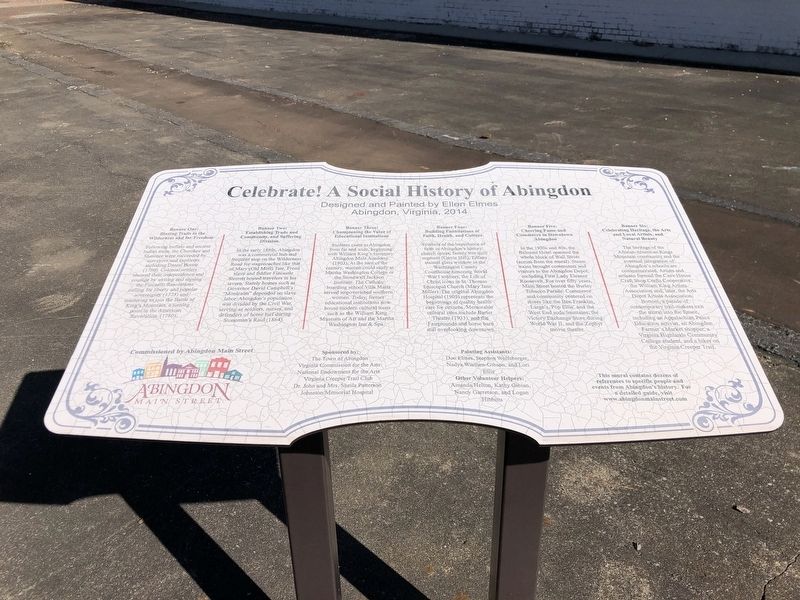
Banner Two: Establishing Trade and Community, and Suffering Division – In the early 1880s,Abingdon was a commercial hub and frequent stop on the Wilderness Road for stagecoaches like that of Mary (Old Moll) Tate. Freed slave and fiddler Fincastle Sterrett hosted travelers in his tavern. Stately homes such as Governor David Campbell's “Montcalm” depended on slave labor. Abingdon's population was divided by the Civil War, serving as soldiers, nurses, and defenders of home turf during Stoneman's Raid (1864).
Banner Three: Championing the Value of Educational Institutions – Students came to Abingdon from far and wide, beginning with William King's visionary Abingdon
this page online
Banner Four: Building Foundations of Faith, Health, and Culture – Symbols of the importance of faith in Abingdon's history: church spires, family tree quilt segment (Carrie Hill), Tiffany stained glass window in the Washington County Courthouse honoring World War I soldiers, the Life of Christ icons in St. Thomas Episcopal Church (Mary Jane Miller). The original Abingdon Hospital (1905) represents the beginnings of quality health care for citizens. Memorable cultural sites include Barter Theatre (1933), and the Fairgrounds and horse barn still overlooking downtown.
Banner Five: Cheering Fame and Commerce in Downtown Abingdon – In the 1930s and 40s, the Belmont Hotel spanned the whole block of Wall Street (across from the mural). Steam trains brought commuters and visitors to the Abingdon
Photographed by Duane and Tracy Marsteller, October 23, 2022
2. Celebrate! A Social History of Abingdon Marker
Panel Six: Celebrating Heritage, the Arts and Local Artists, and Natural Beauty – The heritage of the African-American Kings Mountain community and the eventual integration of Abingdon's schools are commemorated. Artists and artisans formed the Cave House Craft Shop Crafts Cooperative, the William King Artists Association and, later, the Arts Depot Artists Association. Bottom, a trail of contemporary trail-makers exit the mural into the future, including an Appalachian Peace Education activist, an Abingdon Farmer's Market shopper, a Virginia Highlands Community College student, and a biker on the Virginia Creeper Trail.
The Town of Abingdon • Virginia Commission for the Arts • National Endowment for the Arts • Virginia Creeper Trail Club • Dr. John and Mrs. Sheila Patterson • Johnston Memorial Hospital
Painting Assistants:
Don Elmes, Stephen Wolfsberger, Nadya Warthen-Gibson, and Lori Ellis
Other Volunteer Helpers:
Amanda Helton, Kathy Gibian, Nancy Garretson, and Logan Hibbitts
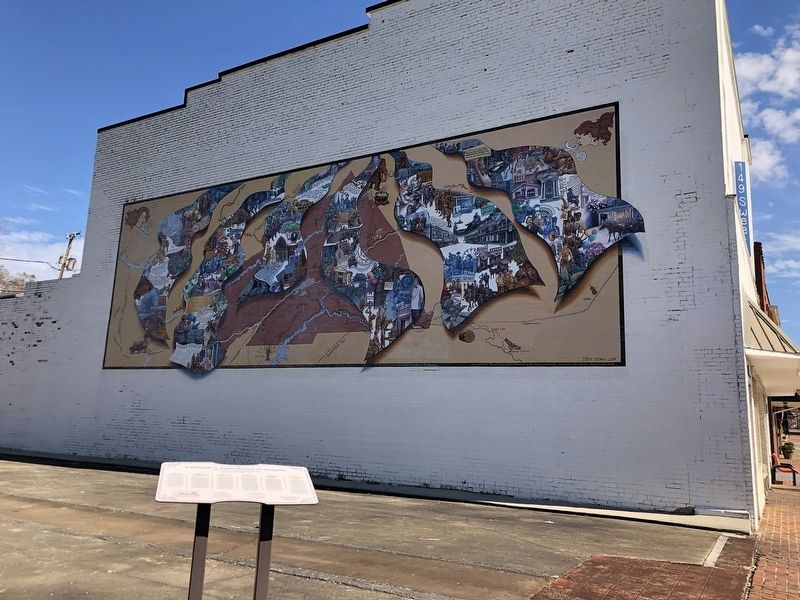
This mural contains dozens of references to specific people and events from Abingdon's history. For a more detailed guide, visit www.abingdonmainstreet.com
Erected 2014 by Abingdon Main Street.
Topics. This historical marker is listed in this topic list: Arts, Letters, Music.
Location. 36° 42.53′ N, 81° 58.829′ W. Marker is in Abingdon, Virginia, in Washington County. It is at the intersection of West Main Street (U.S. 11) and Wall Street, on the left when traveling east on West Main Street. Touch for map. Marker is at or near this postal address: 301 W Main St, Abingdon VA 24210, United States of America. Touch for directions.

Regionally, this marker is in Virginia’s Tri-Cities Area, in Southwest Virginia, and in the Blue Ridge Highlands. It is also in the American South, specifically in the Upper South, in Appalachia, and specifically in Southern Appalachia. Globally, it is in North America, the Western Hemisphere, the Western World, and the Anglosphere. Historically, it finds itself in what was once the territory of the Mississippian Culture, one of the original Thirteen Colonies, one of the Confederate States of America, and the Antebellum South.
Other nearby markers. At least 8 other markers are within walking distance of this marker: Lois H. Humphreys Park on Main Street (within shouting distance of this marker); Hubert J. Treacy, Jr. (about 300 feet away, measured in a direct line); The Cummings Cabin (about 500 feet away); Washington County, Virginia Revolutionary War Memorial (about 500 feet away); Sinking Spring Cemetery (about 500 feet away); Confederate General John Hunt Morgan (about 600 feet away); Henry Creswell (about 600 feet away); Sinking Springs Cemetery Confederate Memorial (about 700 feet away). Touch for a list and map of all markers in Abingdon.
Credits. This page was last revised on February 2, 2023. It was originally submitted on November 11, 2022, by Duane and Tracy Marsteller of Murfreesboro, Tennessee. This page has been viewed 746 times since then and 81 times this year. Photos: 1, 2. submitted on November 11, 2022, by Duane and Tracy Marsteller of Murfreesboro, Tennessee.
