Shaw in Northwest Washington in Washington, District of Columbia — The American Northeast (Mid-Atlantic)
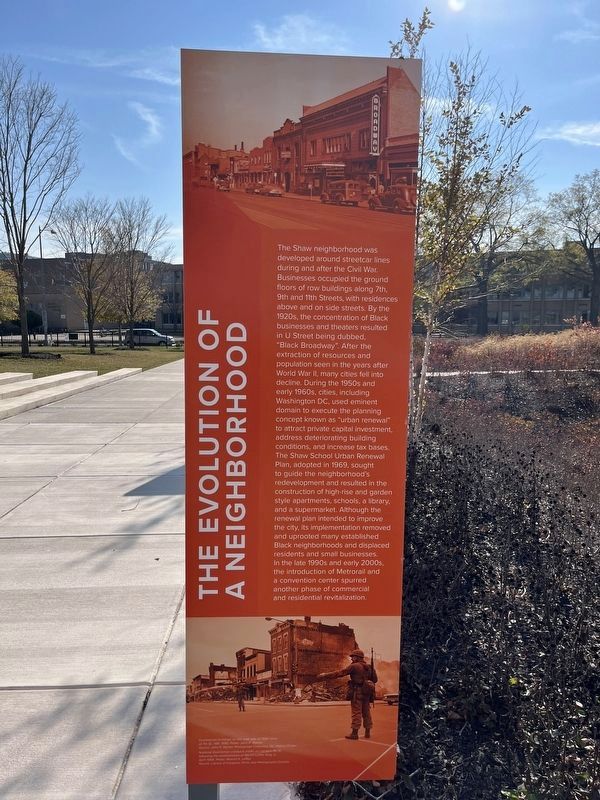
The Evolution of a Neighborhood
⎯⎯⎯
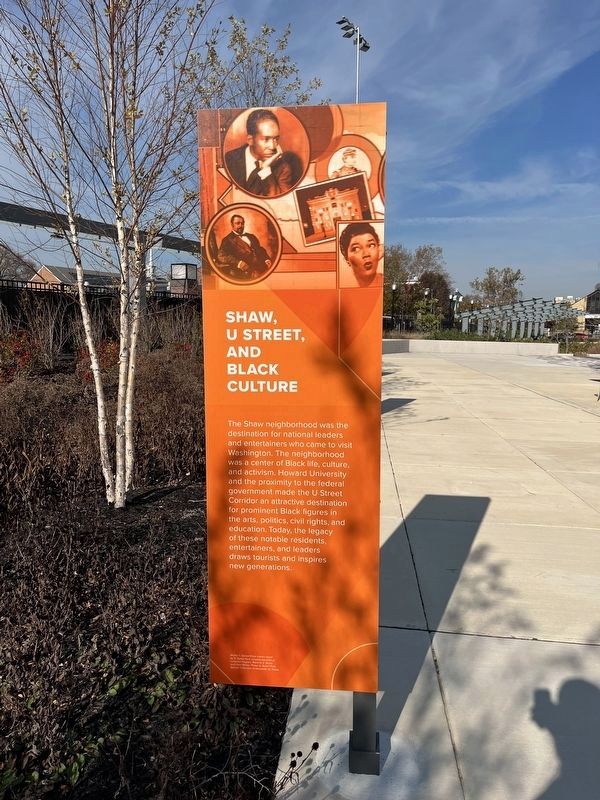
Shaw, U Street, and Black Culture
Photographed by Devry Becker Jones (CC0), November 24, 2022
1. The Evolution of a Neighborhood side of the marker
The Evolution of a Neighborhood. The Shaw neighborhood was developed around streetcar lines during and after the Civil War. Businesses occupied the ground floors of row buildings along 7th, 9th and 11th Streets, with residences above and on side streets. By the 1920s, the concentration of Black businesses and theaters resulted in U Street being dubbed "Black Broadway". After the extraction of resources and population seen in the years after World War II, many cities fell into decline. During the 1950s and early 1960s, cities, including Washington DC, used eminent domain to execute the planning concept known as "urban renewal" to attract private capital investment, address deteriorating building conditions, and increase tax bases. The Shaw School Urban Renewal Plan, adopted in 1969, sought to guide the neighborhood's redevelopment and resulted in the construction of high-rise and garden style apartments, schools, a library, and a supermarket. Although the renewal plan intended to improve the city, its implementation removed the uprooted many established Black neighborhoods and displaced residents and small businesses.
this page online
Shaw, U Street, and Black Culture. The Shaw neighborhood was the destination for national leaders and entertainers who came to visit Washington. The neighborhood was a center of Black life, culture, and activism. Howard University and the proximity to the federal government made the U Street Corridor an attractive destination for prominent Black figures in the arts, politics, civil rights, and education. Today, the legacy of these notable residents, entertainers, and leaders draws tourists and inspires new generations.
Topics. This historical marker is listed in these topic lists: African Americans • Industry & Commerce • Railroads & Streetcars • Settlements & Settlers. A significant historical year for this entry is 1969.
Location. 38° 54.699′ N, 77° 1.541′ W. Marker is in Northwest Washington in Washington, District of Columbia. It is in Shaw. It is at the intersection of Rhode Island Avenue Northwest (U.S. 29) and 10th Street Northwest, on the right when traveling
Photographed by Devry Becker Jones (CC0), November 24, 2022
2. Shaw, U Street, and Black Culture side of the marker

Regionally, this marker is in the Washington Metropolitan Area. It is also in the American Northeast, in the Upper South, in the Mid-Atlantic, in the Tidewater, and in the Chesapeake Bay Region. Globally, it is in North America, the Western Hemisphere, the Western World, and the Anglosphere.
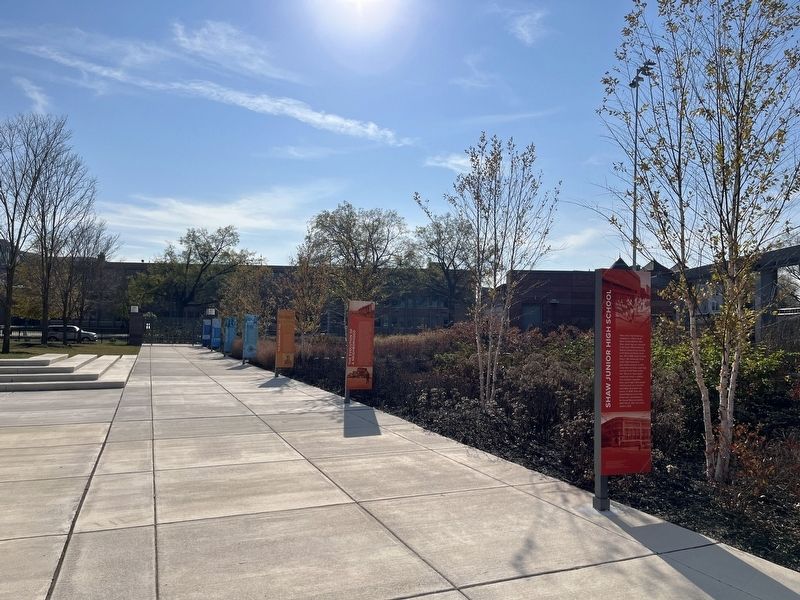
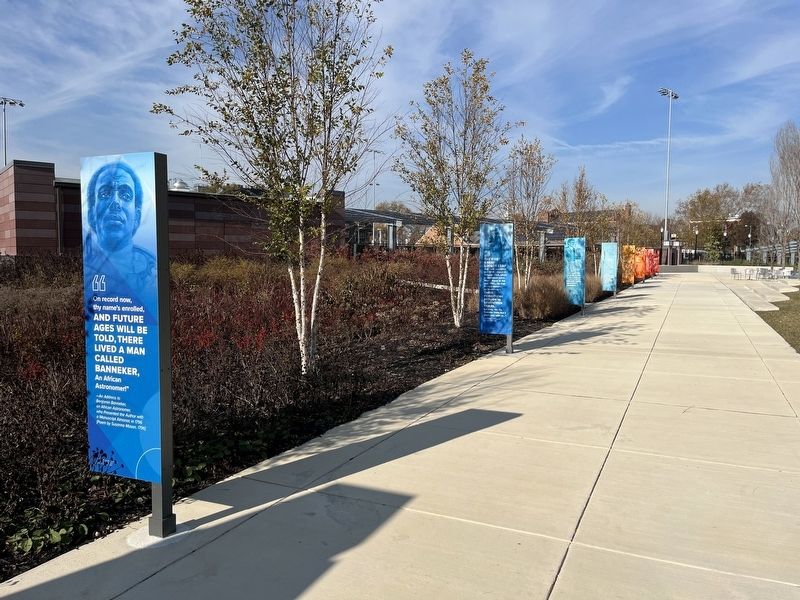
Other nearby markers. At least 8 other markers are within walking distance of this marker: The Almanac of 1792 / The Naming of a Neighborhood (here, next to this marker); Shaw Junior High School (here, next to this marker); The City & The Stars (a few steps from this marker); Benjamin Banneker Academic High School (a few steps from this marker); Benjamin Banneker - A Man of Science (a few steps from this marker); Planning the Federal City (within shouting distance of this marker); Squares 336, 337 & 364 (within shouting distance of this marker); 10th Street Gateway (within shouting distance of this marker). Touch for a list and map of all markers
Photographed by Devry Becker Jones (CC0), November 24, 2022
3. Markers on the grounds of Benjamin Banneker Academic High School from the north
Photographed by Devry Becker Jones (CC0), November 24, 2022
4. Markers on the grounds of Benjamin Banneker Academic High School from the south
Credits. This page was last revised on January 30, 2023. It was originally submitted on November 23, 2022, by Devry Becker Jones of Washington, District of Columbia. This page has been viewed 469 times since then and 62 times this year. Photos: 1, 2, 3, 4. submitted on November 25, 2022, by Devry Becker Jones of Washington, District of Columbia.
