Sault Ste. Marie in Chippewa County, Michigan — The American Midwest (Great Lakes)
Fort Brady
Photographed by J.T. Lambrou, January 3, 2023
1. Fort Brady Marker
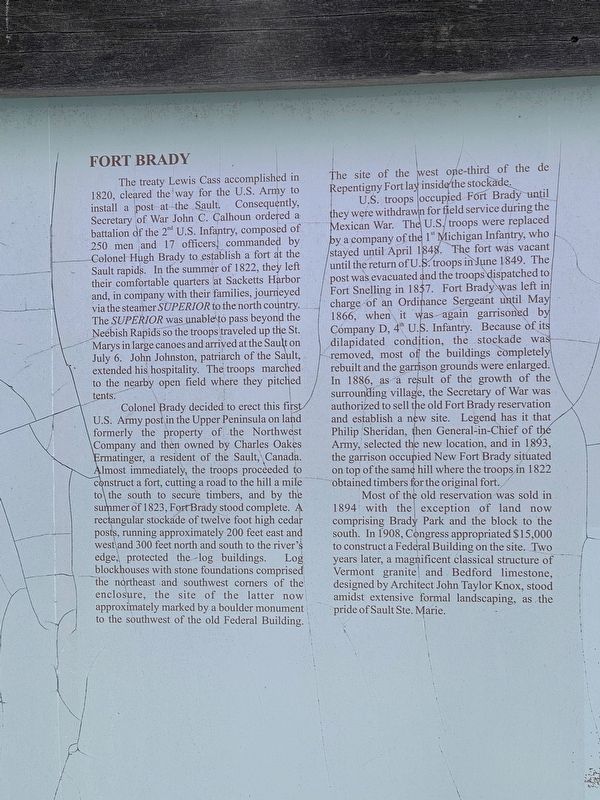
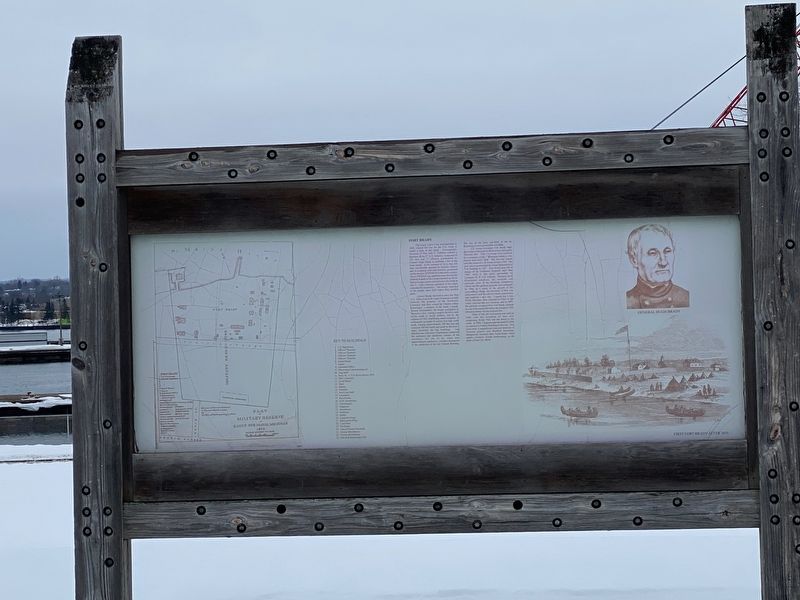
Colonel Brady decided to erect this first U.S. Army post in the Upper Peninsula on land formerly the property of the Northwest Company and then owned by Charles Oakes Ermatinger, a resident of the Sault, Canada. Almost immediately, the troops proceeded to construct a fort, cutting a road to the hill a mile to the south to secure timbers, and by the summer of 1823,
this page online
U.S. troops occupied Fort Brady until they were withdrawn for field service during the Mexican War. The U.S. troops were replaced by a company of the 1st Michigan Infantry, who stayed until April 1848. The fort was vacant until the return of U.S. troops in June 1849. The post was evacuated and the troops dispatched to Fort Snelling in 1857. Fort Brady was left in charge of an Ordinance Sergeant until May 1866, when it was again garrisoned by Company D, 4th U.S. Infantry. Because of its dilapidated condition, the stockade was removed, most of the buildings completely rebuilt and the garrison grounds were enlarged. In 1886, as a result
Photographed by J.T. Lambrou, January 3, 2023
2. Fort Brady Marker
Most of the old reservation was sold in 1894 with the exception of land now comprising Brady Park and the block to the south. In 1908, Congress appropriated $15,000 to construct a Federal Building on the site. Two years later, a magnificent classical structure of Vermont granite and Bedford limestone, designed by Architect John Taylor Knox, stood amidst extensive formal landscaping, as the pride of Sault Ste. Marie.
Topics. This historical marker is listed in these topic lists: Forts and Castles • Settlements & Settlers. A significant historical month for this entry is April 1848.
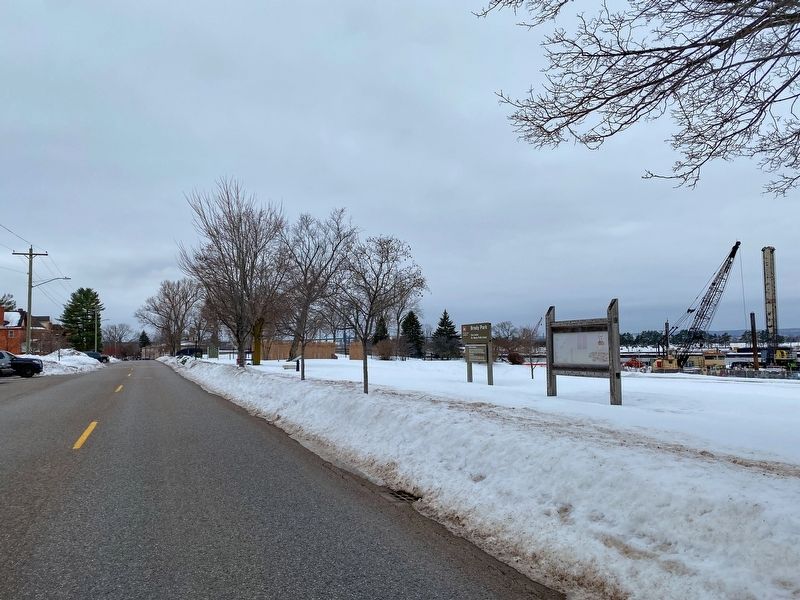
Location. 46° 29.994′ N, 84° 20.49′ W. Marker is in Sault Ste. Marie, Michigan, in Chippewa County. It is at the intersection of East Water Street and Brady Street, on the right
Photographed by J.T. Lambrou, January 3, 2023
3. Fort Brady Marker

Regionally, this marker is on the Upper Peninsula. It is also in the American Midwest and on Lake Superior’s South Shore Region. Globally, it is in North America, in the Great North Woods, on the Great Lakes, in the Western Hemisphere, in the Western World, and in the Anglosphere. Historically, it finds itself in what was once the Viceroyalty of New France and also the Northwest Territory.
Other nearby markers. At least 8 other markers are within walking distance of this marker: A Sampler of Vessels That Have Passed This Spot (within shouting distance of this marker); Fort Brady 1850 (within shouting distance of this marker); Statue of St. Mary (within shouting distance of this marker); The King's Grant (within shouting distance of this marker); a different marker also named Fort Brady (within shouting distance of this marker); Fort Chevalier DeRepentigny (within shouting distance of this marker); Ancient Anishinaabek Burial Ground
Photographed by J.T. Lambrou, January 3, 2023
4. General Hugh Brady
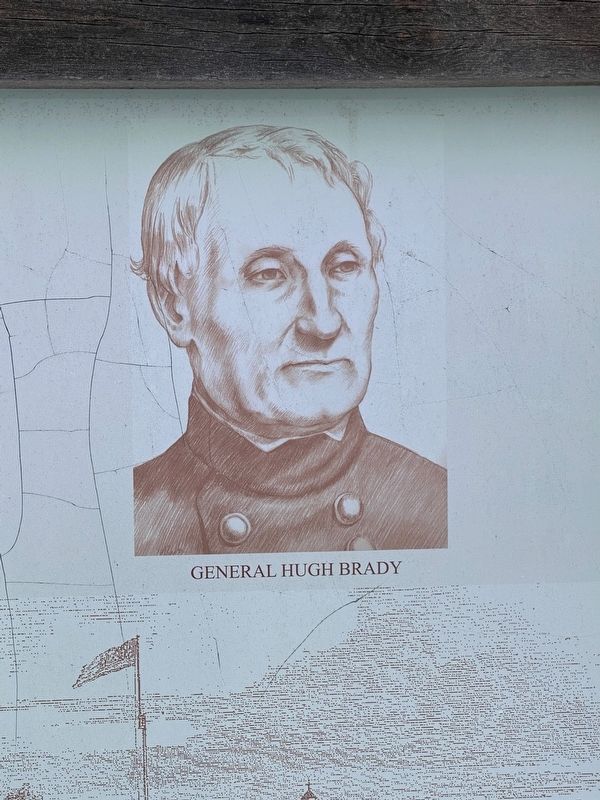
General Brady was the namesake of Fort Brady and its first commanding officer.
Also see . . . Fort Brady. Excerpt:
Fort Brady was a frontier fort established in Sault Sainte Marie, Michigan to guard against British incursions from Canada. The original location of the fort, known as Old Fort Brady, was along the Saint Mary's River. Fort Brady was located at this site from 1822 until 1893, when it was moved to a new location on higher ground, known as New Fort Brady. The fort was located at the new site from 1893 until its close in 1944. The site of Old Fort Brady was designated a Michigan State Historic Site in 1956 and listed on the National Register of Historic Places in 1971;(Submitted on January 17, 2023, by J.T. Lambrou of New Boston, Michigan.)
Photographed by J.T. Lambrou, January 3, 2023
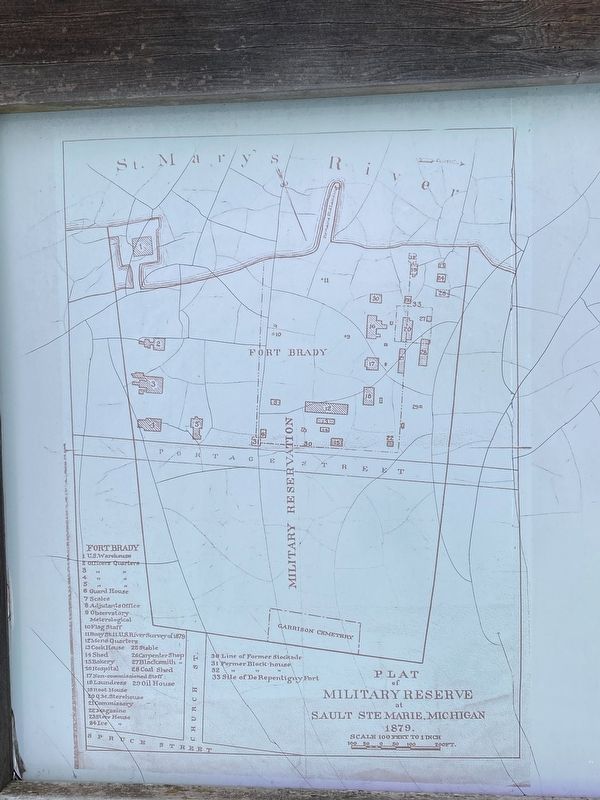
5. Plat of Fort Brady
A closeup view of the hand drawn plat of Fort Brady from 1879 showing the layout of the fort. It would be moved approximately 10 years later to a new location on higher ground.
Photographed by J.T. Lambrou, January 3, 2023
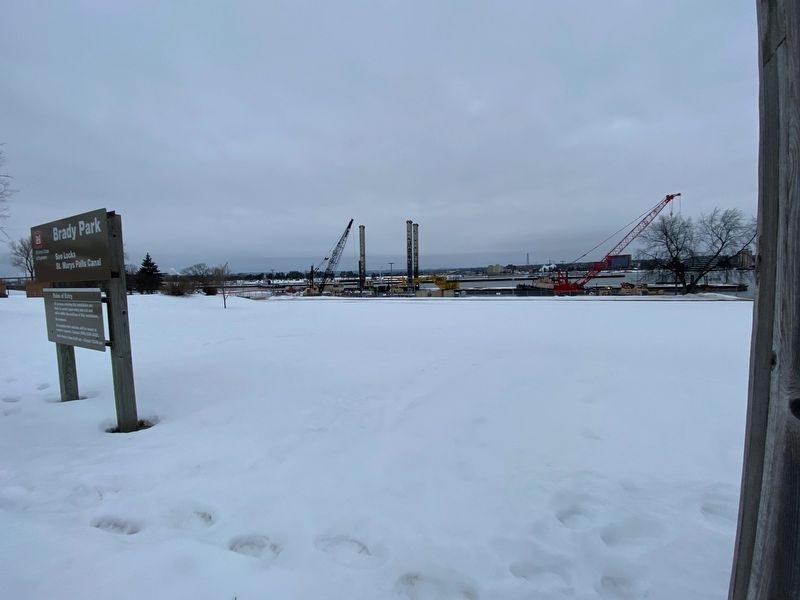
6. Fort Brady
This is the location of Fort Brady looking out over the St. Marys River.
Credits. This page was last revised on January 19, 2023. It was originally submitted on January 16, 2023, by J.T. Lambrou of New Boston, Michigan. This page has been viewed 576 times since then and 82 times this year. Photos: 1, 2, 3, 4, 5, 6. submitted on January 17, 2023, by J.T. Lambrou of New Boston, Michigan. • J. Makali Bruton was the editor who published this page.
