Mail in Paris in Département de Paris, Île-de-France, France — Western Europe
La Pâtisserie Stohrer
⎯⎯⎯
The Stohrer Pastry Shop
| — | Histoire de Paris | — |
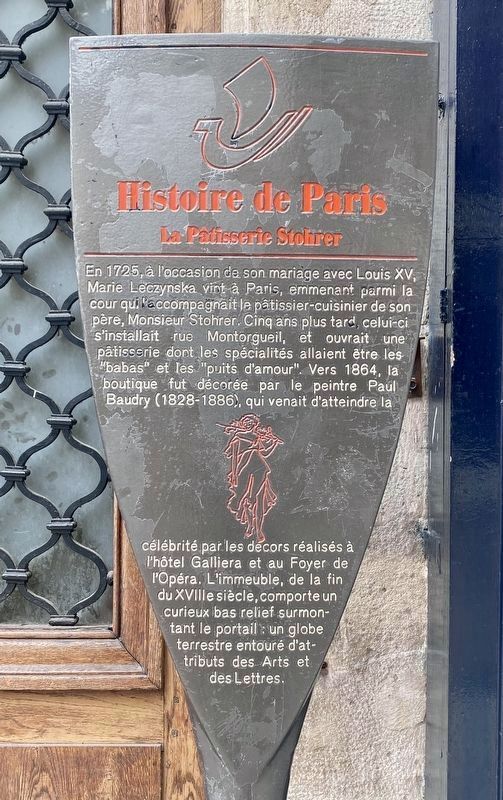
Photographed by Andrew Ruppenstein, July 26, 2022
1. La Pâtisserie Stohrer / The Stohrer Pastry Shop Marker

En 1725, à l'occasion de son mariage avec Louis XV, Marie Leczynska vint à Paris, emmenant parmi la cour qui l'accompagnait le pâtissier-cuisinier de son père, Monsieur Stohrer. Cinq ans plus tard, celui-ci s'installait rue Montorgueil, et ouvrait une pâtisserie dont les spécialités allaient être les "babas” et les "puits d'amour". Vers 1864, la boutique fut décorée par le peintre Paul Baudry (1828-1886), qui venait d'atteindre la célébrité par les décors réalisés à l'hôtel Galliera et au Foyer de l'Opéra. L'immeuble, de la fin du XVIIIe siècle, comporte un curieux bas relief surmontant le portail: un globe terrestre entouré d'attributs des Arts et des Lettres.
In 1725, on the occasion of her marriage to Louis XV, Marie Leczynska came to Paris, taking her father's pastry chef, Monsieur Stohrer, with her accompanying court. Five years later, he moved to rue Montorgueil, and opened a pastry shop whose specialties were to be "babas" and "puits d'amour" ("wells of love"). Around 1864, the shop was decorated by the painter Paul Baudry (1828 -1886), who had just achieved fame for the decorations made at the Hôtel Galliera and at the Foyer de l'Opéra. The building, from the end of the 18th century, has a curious bas relief surmounting the portal: a terrestrial globe surrounded by attributes of Arts and Letters.
Erected by Ville de Paris.
Topics and series. This historical marker is listed in this topic list: Industry & Commerce. In addition, it is included in the Histoire de Paris series list. A significant historical year for this entry is 1725.
Location. 48° 51.914′ N, 2° 20.812′ E. Marker is in Paris, Île-de-France, in Département de Paris. It is in Mail. It is on Rue Montorgueil, on the left when traveling north. Touch for map. Marker is at or near this
this page online

Regionally, it is in the North Atlantic Region, Europe, the European Union, Atlantic Europe, the Schengen Area, Western Europe, a coastal Mediterranean country, and the Western World. Historically, it finds itself in what was once a French colony and also the Roman Empire.
Other nearby markers. At least 8 other markers are within walking distance of this marker: Bruno Lenoir and Jean Diot (within shouting distance of this marker); La rue Mandar (about 90 meters away, measured in a direct line); Rue Montorgueil (about 120 meters away); La Rue Montmartre (about 120 meters away); Admiral Tourville (about 150 meters away); La rue de la Jussienne (about 180 meters away); Middle School Public César Franck Jewish Children’s Deportation Memorial (about 210 meters away); Eglise Saint-Eustache (approx. 0.3 kilometers away). Touch for a list and map of all markers in Paris.
Also see . . . About us (Stohrer).
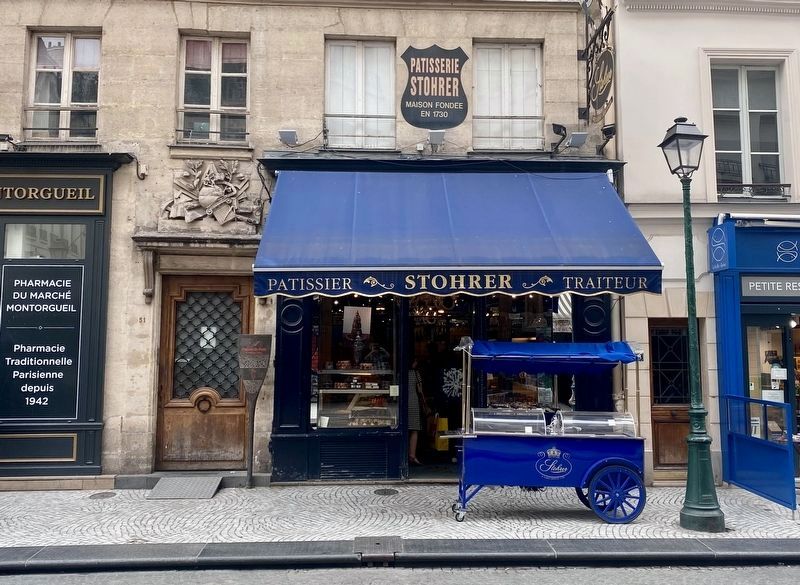
On Nicolas Stohrer and the invention of the rum baba: Nicolas Stohrer was pastry chef to Stanislas Leszczynski, Duke of(Submitted on February 3, 2023.)Lorraine, former King of Poland, and father of Marie Leszczynska, who married Louis XV of France. He invented the rum baba, which has since become a legendary recipe. The story goes that Stanislas once complained that his Kouglof (a brioche from Alsace) was too dry, so Nicolas doused it with Tokay or Malaga wine (according to diverging accounts), which he later replaced with rum. Nicolas Stohrer was also the creator of many other classic French pastries, such as the Chiboust cream tart, the puits d’amour and the traditional-style religieuse.Photographed by Andrew Ruppenstein, July 26, 20222. La Pâtisserie Stohrer / The Stohrer Pastry Shop Marker - wide view
Additional keywords. panneau
Credits. This page was last revised on May 2, 2025. It was originally submitted on February 3, 2023, by Andrew Ruppenstein of Lamorinda, California. This page has been viewed 397 times since then and 76 times this year. Photos: 1, 2. submitted on February 3, 2023, by Andrew Ruppenstein of Lamorinda, California.
