
Westerpark in Amsterdam, North Holland, Netherlands — Northwestern Europe
Gillis van Ledenberch
Photographed by Andrew Ruppenstein, November 2, 2022
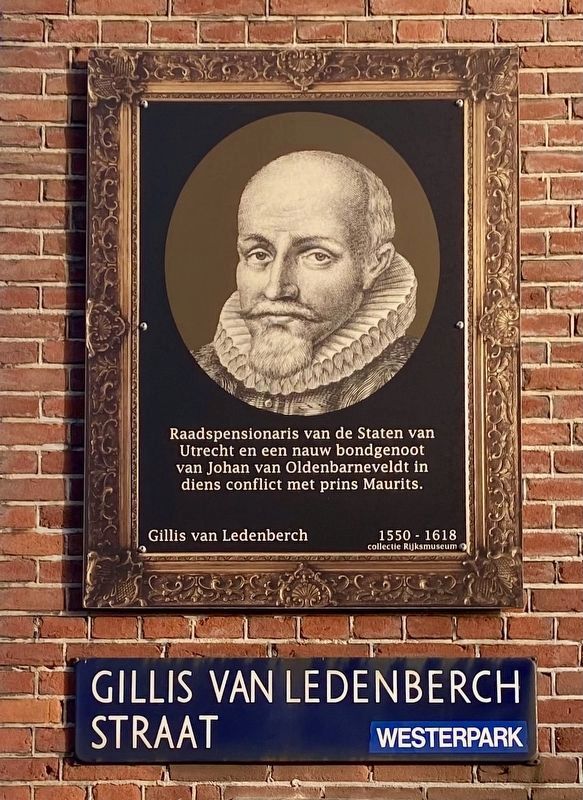
1. Gillis van Ledenberch Marker

Raadspensionaris van de Staten van Utrecht en een nauw bondgenoot van Johan van Oldenbarneveldt in diens conflict met prins Maurits.
Council pensionary of the States of Utrecht and a close ally of Johan van Oldenbarneveldt in his conflict with Prince Maurits.
Erected by Geef Straten Een Gezicht.
Topics and series. This historical marker is listed in this topic list: Government & Politics. In addition, it is included in the Give Streets a Face / Geef Straten Een Gezicht series list. A significant historical date for this entry is May 12, 1619.
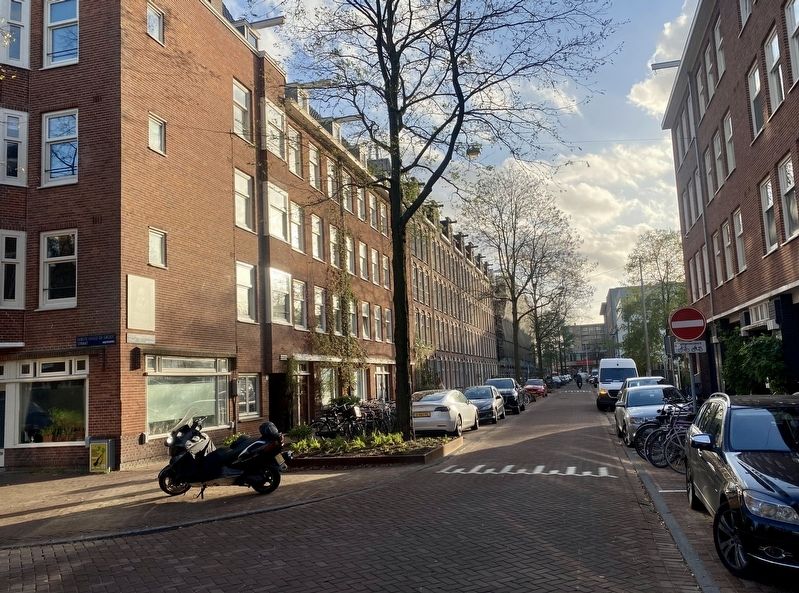
Location. 52° 22.585′ N, 4° 52.33′ E. Marker is in Amsterdam, Noord-Holland (North Holland). It is in Westerpark. It is at the intersection of Gillis van Ledenberchstraat and Eerste Hugo de Grootstraat, on the right when traveling north on Gillis van Ledenberchstraat. Touch for map. Marker is in this post office area: Amsterdam, Noord-Holland 1052 VA, Netherlands. Touch for directions.

Regionally, it is in Europe, the European Union, Atlantic Europe, the Benelux Low Countries, the Schengen Area, Western
this page online
Other nearby markers. At least 8 other markers are within walking distance of this marker: Molen De Otter (The Otter Windmill) (within shouting distance of this marker); Hugo de Groot (within shouting distance of this marker); Frederik Hendrik van Oranje (about 180 meters away, measured in a direct line); Zaagmolens / Sawmills (about 210 meters away); Rombout Hogerbeets (about 210 meters away); a different marker also named Hugo de Groot (about 240 meters away); Johan van Oldenbarneveldt (approx. 0.2 kilometers away); a different marker also named Hugo de Groot (approx. 0.3 kilometers away). Touch for a list and map of all markers in Amsterdam.
Also see . . . Gilles van Ledenberg (Wikipedia).
Overview: Gilles van Ledenberg (c. 1550 – 28 September 1618) was a Dutch statesman. He was secretary of the States of Utrecht from 1588 until his arrest for treason in 1618, together with Johan van Oldenbarnevelt. He committed suicide to prevent forfeiture of his assets, but he was sentenced to death posthumously and posthumously(Submitted on February 27, 2023.)executed.Photographed by Andrew Ruppenstein, November 2, 20222. Gillis van Ledenberch Marker - wide view
Claes Janszoon Visscher (courtesy of the Peace Palace Library via Wikimedia Commons), 1619
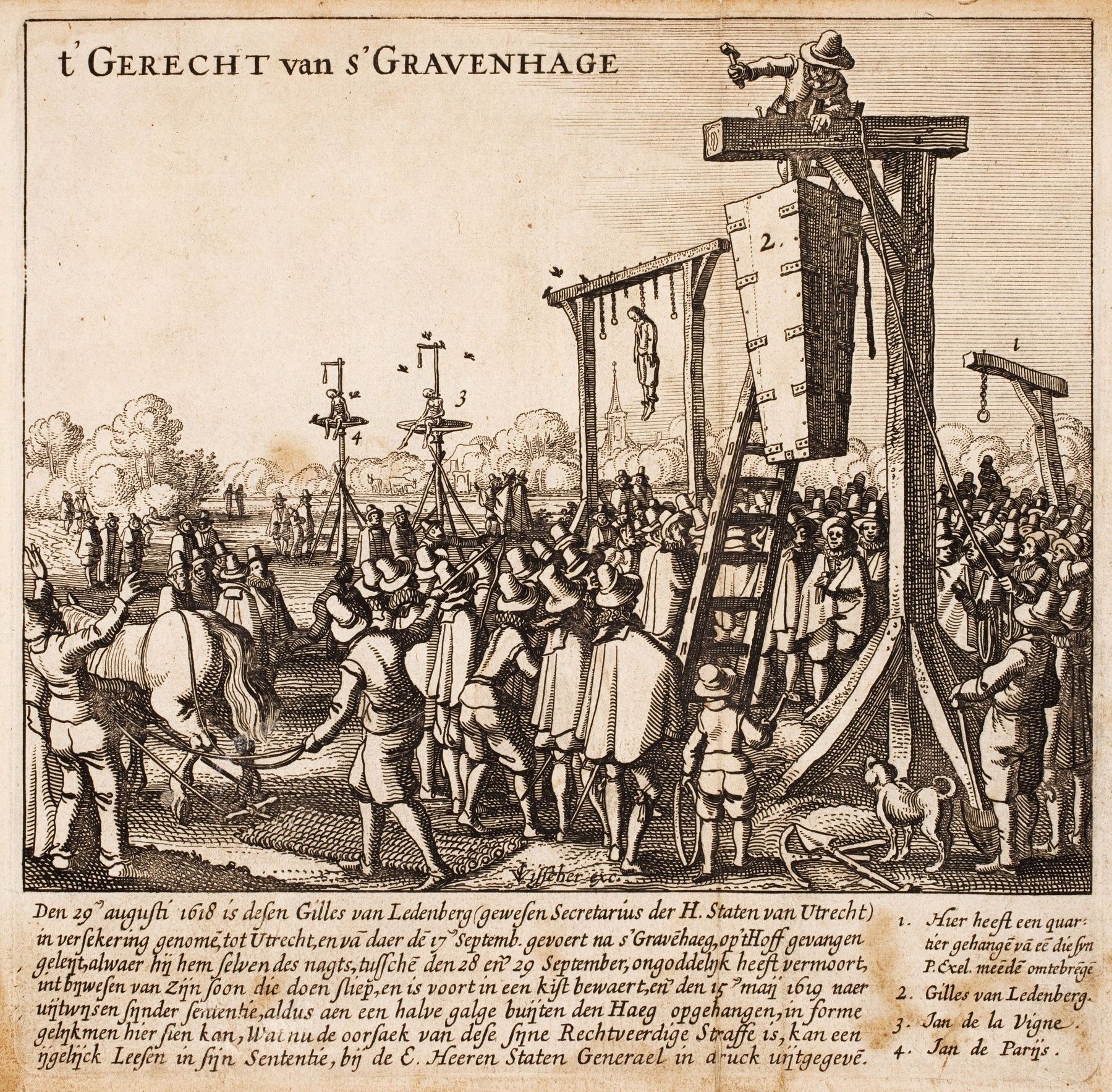
3. Posthumous hanging of Gillis van Leedenberg, secretary of the States of Utrecht
On his trial and execution: The preliminary investigation in his trial was conducted by the fiscal (prosecutor) Van Leeuwen, who was a personal enemy (Ledenberg had engineered his dismissal a few years earlier). Van Leeuwen apparently threatened him with the rack and this may have driven Ledenberg to despair. He committed suicide by cutting his throat in the night of 28/29 September. He had left a suicide note in French with his son which indicated that he hoped to prevent forfeiture of his possessions in this way, because he expected his trial to end with his death… However, his death did not prevent the judicial commission that tried the other "conspirators" to convict him, together with Oldenbarnevelt, on 12 May 1619. Like Oldenbarnevelt he was sentenced to death, and forfeiture, and the sentence was executed posthumously by hanging his embalmed body, in its coffin, from a gibbet. It was left hanging for 21 days, and after it was taken down, it was buried in the churchyard of the church at Voorburg... - Wikipedia
Credits. This page was last revised on December 24, 2023. It was originally submitted on February 27, 2023, by Andrew Ruppenstein of Lamorinda, California. This page has been viewed 334 times since then and 49 times this year. Photos: 1, 2. submitted on February 27, 2023, by Andrew Ruppenstein of Lamorinda, California. 3. submitted on February 27, 2023.
