Weesp in Amsterdam, North Holland, Netherlands — Northwestern Europe
Fort aan de Ossenmarkt
Photographed by Andrew Ruppenstein, July 23, 2022
1. Fort aan de Ossenmarkt Marker

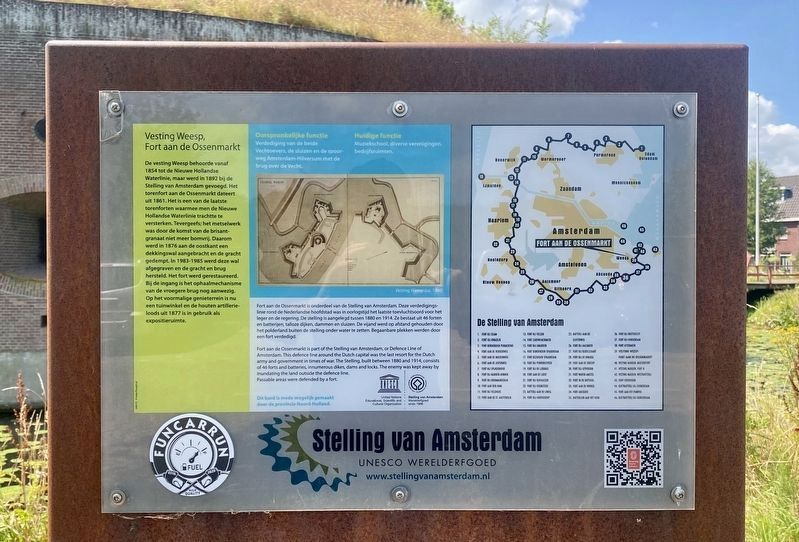
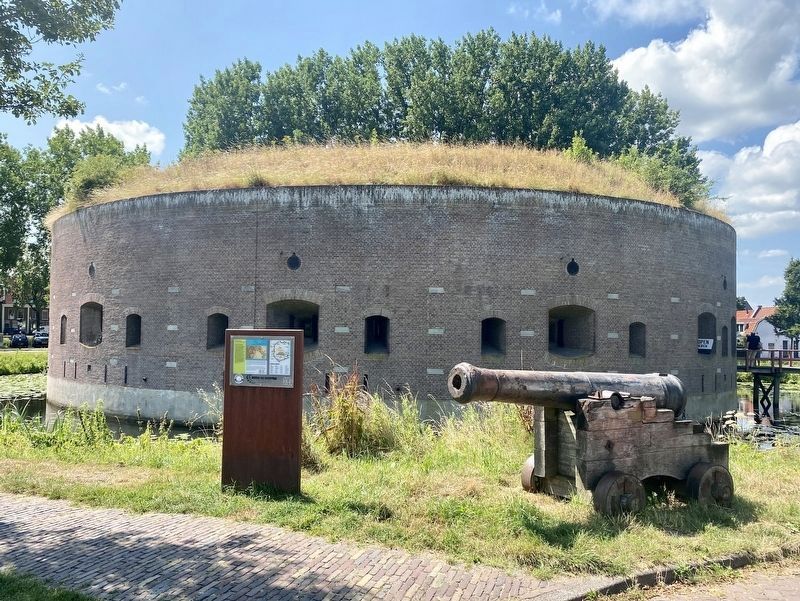
De vesting Weesp behoorde vanaf 1854 tot de Nieuwe Hollandse Waterlinie, maar werd in 1892 bij de Stelling van Amsterdam gevoegd. Het torenfort aan de Ossenmarkt dateert uit 1861. Het is een van de laatste torenforten waarmee men de Nieuwe Hollandse Waterlinie trachtte te versterken. Tevergeefs; het metselwerk was door de komst van de brisant- granaat niet meer bomvrij. Daarom werd in 1876 aan de oostkant een dekkingswal aangebracht en de gracht gedempt. In 1983-1985 werd deze wal afgegraven en de gracht en brug hersteld. Het fort werd gerestaureerd. Bij de ingang is het ophaalmechanisme van de vroegere brug nog aanwezig. Op het voormalige genieterrein is nu een tuinwinkel en de houten artillerieloods uit 1877 is in gebruik als expositieruimte.
Fortress Weesp, Fort on the Ossenmarkt
The Weesp fortress belonged to the New Dutch Waterline defense system from 1854, and was incorporated into the Defense Line of Amsterdam in 1892. The tower fort on the Ossenmarkt dates from 1861. It is one of the last tower forts that were used
this page online
Stelling van Amsterdam / Defence Line of Amsterdam
Photographed by Andrew Ruppenstein, July 23, 2022
2. Fort aan de Ossenmarkt and Marker
Erected by Stelling van Amsterdam, Provincie Noord-Holland, UNESCO.
Topics. This historical marker is listed in this topic list: Forts and Castles. A significant historical year for this entry is 1854.
Location. 52° 18.469′ N, 5° 2.779′ E. Marker is in Weesp, Noord-Holland (North Holland), in Amsterdam. It is on Ossenmarkt, on the left when traveling north. Touch for map. Marker is at or near this postal address: Ossenmarkt 32, Weesp, Noord-Holland 1381 LW, Netherlands. Touch for directions.

Regionally, it is in Europe, the European Union, Atlantic Europe, the Benelux Low Countries, the Schengen Area, Western Europe, and the Western World. Historically, it finds itself in what was once the Holy Roman Empire.
Other nearby markers. At least 8 other markers are within walking
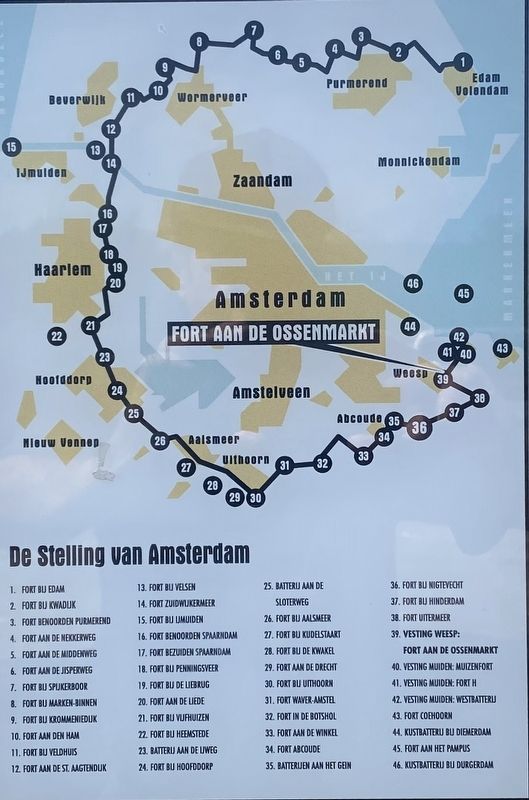
3. Marker inset: map of defensive system surrounding Amsterdam
Also see . . . Stelling van Amsterdam (Stelling van Amsterdam). A website providing an overview of the Amsterdam defense system, mostly oriented to those wishing to visit parts of the system.
Excerpt: A remarkable defensive ring made up of 46 forts and batteries as well as a multitude of dikes and sluices encircles the Dutch capital of Amsterdam. It’s the Defence Line (or ‘Stelling’) of Amsterdam. A Dutch historical monument, the Defence Line is listed as a UNESCO World Heritage site since 1996. A large portion of this monument is open to the public and makes for a great day out for people young and old.(Submitted on March 4, 2023.)
Credits. This page was last revised on December 6, 2025. It was originally submitted on March 4, 2023, by Andrew Ruppenstein of Lamorinda, California. This page has been viewed 195 times since then and 25 times this year. Photos: 1, 2, 3. submitted on March 4, 2023, by Andrew Ruppenstein of Lamorinda, California.