Camp Hughes in North Cypress – Langford Municipality, Manitoba — Canada’s Prairie Region (North America)
The Parade Ground
⎯⎯⎯
La terrain de parade
Photographed by Cosmos Mariner, June 17, 2022
1. The Parade Ground / La terrain de parade Marker

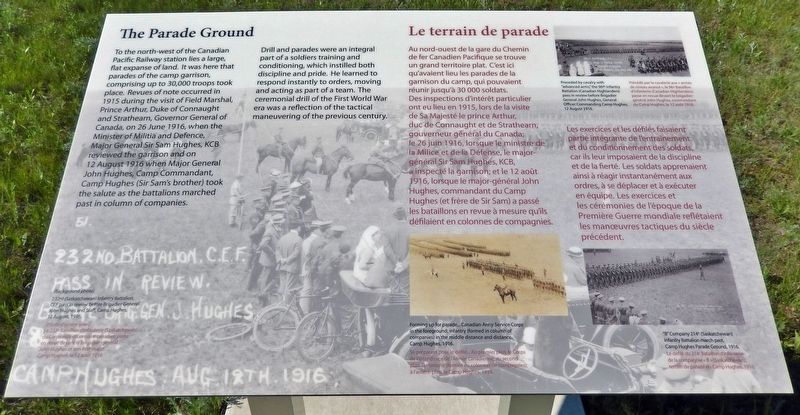
To the north-west of the Canadian Pacific Railway station lies a large, flat expanse of land. It was here that parades of the camp garrison, comprising up to 30,000 troops took place. Revues of note occurred in 1915 during the visit of Field Marshal, Prince Arthur, Duke of Connaught and Strathearn, Governor General of Canada, on 26 June 1916, when the Minister of Militia and Defence, Major General Sir Sam Hughes, KCB reviewed the garrison and on 12 August 1916 when Major General John Hughes, Camp Commandant, Camp Hughes (Sir Sam's brother) took the salute as the battalions marched past in column of companies.
Drill and parades were an integral part of a soldiers training and conditioning, which instilled both discipline and pride. He learned to respond instantly to orders, moving and acting as part of a team. The ceremonial drill of the First World War era was a reflection of the tactical maneuvering of the previous century.
(Background photo) 232nd (Saskatchewan) Infantry Battalion, CEF pass in review before Brigadier General John Hughes and Staff, Camp Hughes, 12 August, 1916.
Au nord-ouest
this page online
Les exercices et les défilés faisaient partie intégrante de l'entraînement et du conditionnement des soldats, car ils leur imposaient de la discipline et de la fierté. Les soldats apprenaient ainsi à réagir instantanément aux ordres, à se déplacer et à exécuter en équipe. Les exercices et les cérémonies de l'époque de la Première Guerre mondiale reflétaient les manœuvres tactiques du siècle précédent.
(Photo d'arrière-plan) Le 232e Bataillon d'infanterie (Saskatchewan) du Corps expéditionnaire canadien passe en revue devant le brigadier-général John Hughes et son état-major, Camp Hughes, le 12 août 1916.
Topics.
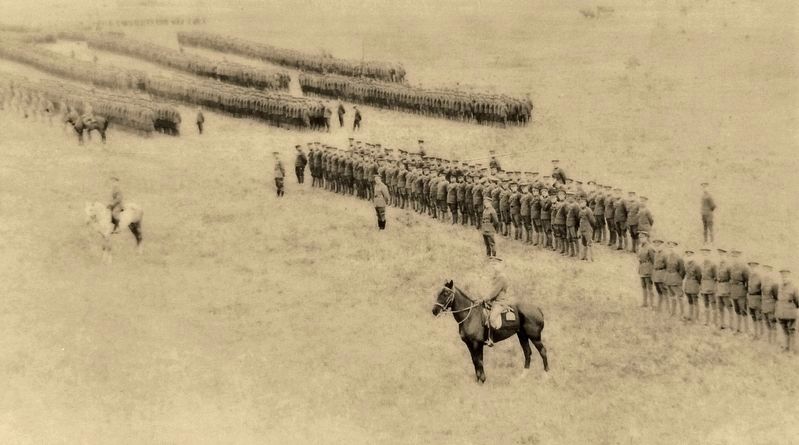
2. Marker detail: Forming up for parade / Se préparant pour le défilé
—————
Au premier plan, le Corps de l'intendance de l'Armée canadienne; au second plan, l’infanterie (formée en colonnes de compagnies); à l'arrière-plan, le Camp Hughes, 1916.
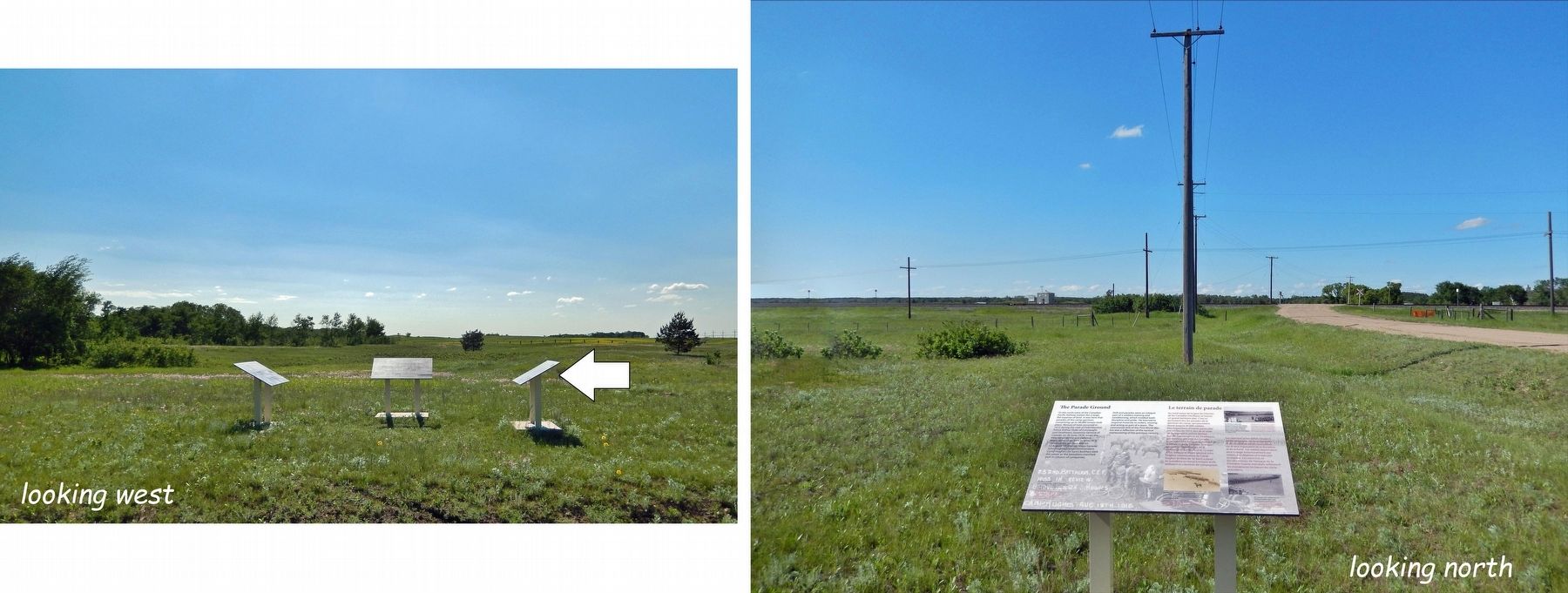
Location. 49° 53.096′ N, 99° 33.198′ W. Marker is in Camp Hughes, Manitoba, in North Cypress – Langford Municipality. It is on Camp Hughes Road (Road 91 W) one kilometer south of Provincial Road 351, on the right when traveling south. Northmost of three Camp Hughes National Historic Site interpretive panels at this location. Touch for map. Marker is in this post office area: Camp Hughes MB R0K 2A0, Canada. Touch for directions.

Regionally, this marker is in Southwest Manitoba. It is also in the Prairies. Globally, it is in North America, the Western Hemisphere, the Western World, and the Anglosphere. Historically, it finds itself in what was once a British colony, the Viceroyalty of New France, and Rupert’s Land.
Other nearby markers. At least 8 other markers are within walking distance of this marker: The Soldier's Recreation / Les moments de loisir des soldats (here, next to this marker); Camp Hughes — Overview / Tour d'horizon du Camp Hughes (here, next to this marker); Camp Hughes Railway Station / Depot / Railhead Area
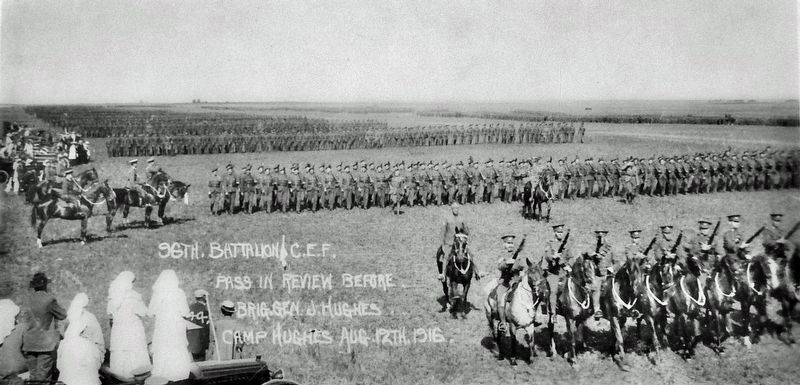
3. Marker detail: Canadian Highlanders
—————
Précédé par la cavalerie aux « armes de niveau avancé », le 96e Bataillon d'infanterie (Canadian Highlanders) passe en revue devant le brigadier-général John Hughes, commandant du Camp Hughes, le 12 août 1916.
Related markers. Click here for a list of markers that are related to this marker. Camp Hughes National Historic Site
Also see . . . Camp Hughes National Historic Site of Canada. Camp Hughes National Historic Site of Canada is located south of the Trans-Canada Highway 10 kilometres west of Carberry, Manitoba. Formerly a First World War military training camp, it is one of the most intact simulated battlefield terrains in Canada. The site consists of rolling open grassy fields, remnants of the military camp consisting of administration and training areas, a cemetery and archaeological vestiges. Official
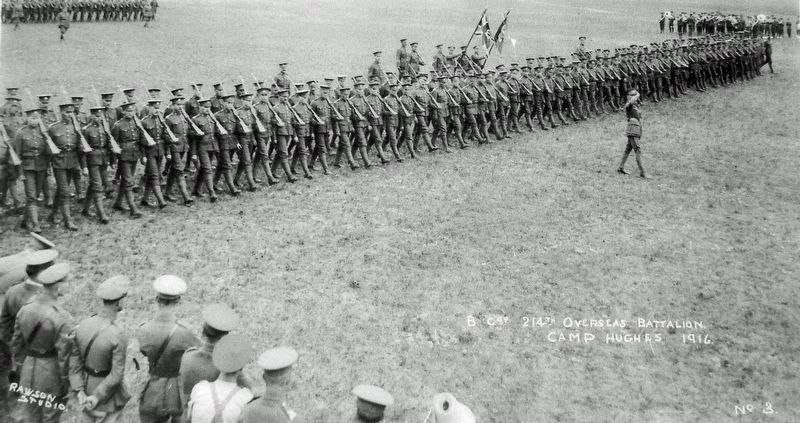
4. Marker detail: "B" Company 214th (Saskatchewan) Infantry Battalion
—————
Le défilé du 214e Bataillon d'infanterie de la compagnie « B » (Saskatchewan), terrain de parade du Camp Hughes 1916.
Photographed by Cosmos Mariner, June 17, 2022
5. The Parade Ground / La terrain de parade Marker
Credits. This page was last revised on June 6, 2024. It was originally submitted on March 23, 2023, by Cosmos Mariner of Cape Canaveral, Florida. This page has been viewed 162 times since then and 14 times this year. Photos: 1, 2, 3, 4, 5. submitted on March 26, 2023, by Cosmos Mariner of Cape Canaveral, Florida.
