Peoria in Peoria County, Illinois — The American Midwest (Great Lakes)
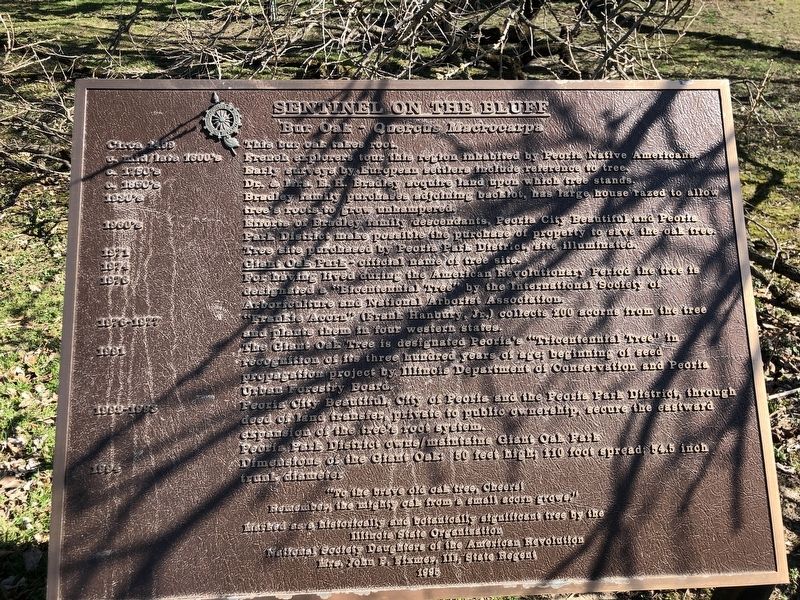
Sentinel on the Bluff
Bur Oak - Querous Macrocarpa
Photographed by Duane and Tracy Marsteller, April 8, 2023
1. Sentinel on the Bluff Marker
c. mid/late 1600's - French explorers tour this region inhabited by Peoria Native Americans.
c. 1750's - Early surveys by European setters include reference to this tree.
c. 1850's - Dr. & Mrs. E. H. Bradley acquire land upon which tree stands.
c. 1930's - Bradley family purchases adjoining backlot, has large house razed to allow tree's roots to grow unhampered.
1960's - Efforts of Bradley family descendants, Peoria City Beautiful and Peoria Park District make possible the purchase of the property to save the oak tree. 1971 - Tree site purchased by Peoria Park District, site illuminated.
1974 - Giant Oak Park - official name of tree site.
1976 - For having lived during the American Revolutionary Period the tree is designated a “Bicentennial Tree” by the International Society of Arboriculture and Nation Arborist Association.
1976-1977 - “Frankie Acorn” (Frank Hanbury, Jr.) collects 200 acorns from the tree and plants them in four western states.
1991 - The Giant Oak Tee is designated Peoria's “Tricentennial Tree” in recognition of its three hundred years of age; beginning of
this page online
1992-1993 - Peoria City Beautiful, City of Peoria, and the Peoria Park District, through deed of land transfer, private to public ownership, secure the eastward expansion of the tree's root system. Peoria Park District owns/maintains Gian Oak Park.
1994 - Dimensions of Giant Oak: 50 feet high; 110 foot spread; 54.5 inch trunk diameter.
Remember, the mighty oak from a small acorn grows.”
Marked as a historically and botanically significant tree by the
Illinois State Organization
National Society Daughters of the American Revolution
Mrs. John P. Fixmer, III, State Regent
1995
Erected 1995 by Illinois State Organization, National Society Daughters of the American Revolution.
Topics and series. This historical marker is listed in this topic list: Horticulture & Forestry. In addition, it is included in the Daughters of the American Revolution (DAR), and the Historic Trees series lists. A significant historical year for this entry is 1499.
Location. 40° 41.929′ N, 89° 35.992′ W. Marker is in Peoria,
Photographed by Duane and Tracy Marsteller, April 8, 2023
2. Secondary Marker
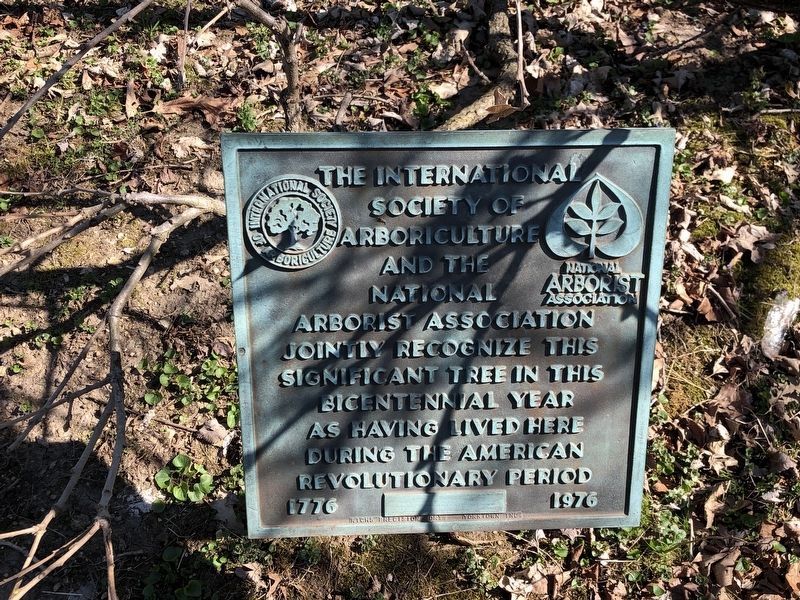
Marker reads: The International Society of Arboriculture and the National Arborist Association jointly recognize this significant tree in this Bicentennial year as having lived here during the American Revolutionary period 1776 1976.

Regionally, this marker is in the Illinois River Valley. It is also in the American Midwest and in the Corn Belt. Globally, it is in North America, the Western Hemisphere, the Western World, and the Anglosphere. Historically, it finds itself in what was once the Viceroyalty of New France, the territory of the Mississippian Culture, and the Northwest Territory.
Other nearby markers. At least 8 other markers are within walking distance of this marker: The Easton Fountain (within shouting distance of this marker); Erastus D. Hardin House (about 600 feet away, measured in a direct line); Moss-High Historic District / Bush House (approx. ¼ mile away); Julia Ballance House/Roanoke-Randolph Historic District (approx. 0.3 miles away); Pulsifer's Grove/John C. Wynd Residence (approx. 0.3 miles away); The Bradley Homestead (approx. 0.3 miles away); The Gipps Brewing Co. / The Ballance-Herschel House
Photographed by Duane and Tracy Marsteller, April 8, 2023
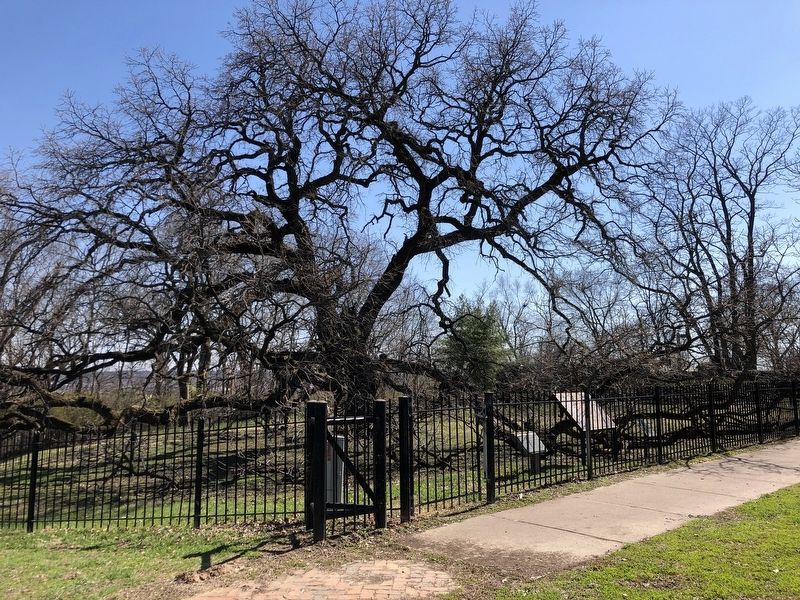
3. Sentinel on the Bluff Marker
Credits. This page was last revised on April 11, 2023. It was originally submitted on April 11, 2023, by Duane and Tracy Marsteller of Murfreesboro, Tennessee. This page has been viewed 1,025 times since then and 84 times this year. Photos: 1, 2, 3. submitted on April 11, 2023, by Duane and Tracy Marsteller of Murfreesboro, Tennessee.
