Kalya, West Bank, Palestinian Territories — The Middle East (West Asia)
Qumran
⎯⎯⎯
קומראן
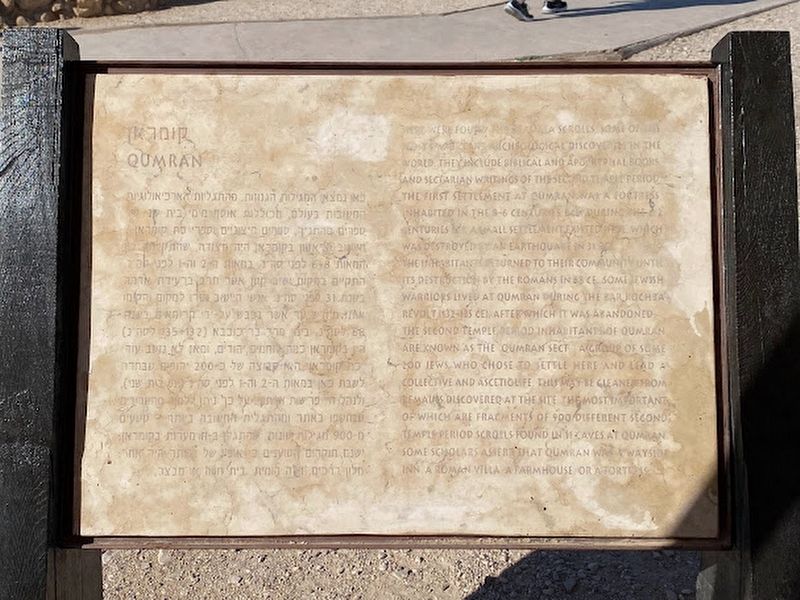
Photographed by Darren Jefferson Clay, March 10, 2023
1. Qumran Marker
The inhabitants returned to their community until its destruction by the Romans in 68 CE. Some Jewish warriors lived at Qumran during the Bar Kochba Revolt (132-135 CE) after which it was abandoned. The Second Temple period inhabitants of Qumran are known as the Qumran Sect. A group of some 200 Jews who chose to settle here and lead a collective and ascetic life. This may be gleaned from remains discovered at the site. The most important of which are fragments of 900 different Second Temple period scrolls found in 11 caves at Qumran. Some scholars assert that Qumran was a wayside inn, a Roman villa, a farmhouse, or a fortress.
(Hebrew not transcribed)
Topics. This historical marker is listed in these topic lists: Religion & Religious Structures
this page online
Location. 31° 44.498′ N, 35° 27.539′ E. Marker is in Kalya, West Bank. It can be reached from West Bank Route 90. Touch for map. Touch for directions.

Regionally, it is in Asia, West Asia, the Middle East, The Levant, and in a coastal Mediterranean country. Historically, it finds itself in what was once the Byzantine Empire, the Ottoman Empire, a British Mandate, and the Roman Empire.
Other nearby markers. At least 8 other markers are within walking distance of this marker: The Community Rule (here, next to this marker); Cave 1 / מערת 1 (here, next to this marker); Ritual Bath (within shouting distance of this marker); Kiln (within shouting distance of this marker); The Bursar of the Congregation (within shouting distance of this marker); The Refectory (within shouting distance of this marker); Pottery Storeroom (within shouting distance of this marker); Kitchen (within shouting distance of this marker). Touch for a list and map of all markers in Kalya.
Also see . . . Dead Sea Scrolls (Wikipedia).
Overview: The(Submitted on April 19, 2023.)Dead Sea Scrolls (also the Qumran Caves Scrolls) are ancient Jewish and Hebrew religious manuscripts discovered between 1946 and 1956 at the Qumran Caves in what was then Mandatory Palestine, near Ein Feshkha in the West Bank, on the northern shore of the Dead Sea. Dating from the 3rd century BCE to the 1st century CE, the Dead Sea Scrolls are considered to be a keystone in the history of archaeology with great historical, religious, and linguistic significance because they include the oldest surviving manuscripts of entire books later included in the biblical canons, along with deuterocanonical and extra-biblical manuscripts which preserve evidence of the diversity of religious thought in late Second Temple Judaism. At the same time they cast new light on the emergence of Christianity and of Rabbinic Judaism...Photographed by Darren Jefferson Clay, March 10, 20232. Suggested reconstruction of Qumran in the Second Temple Period Panel

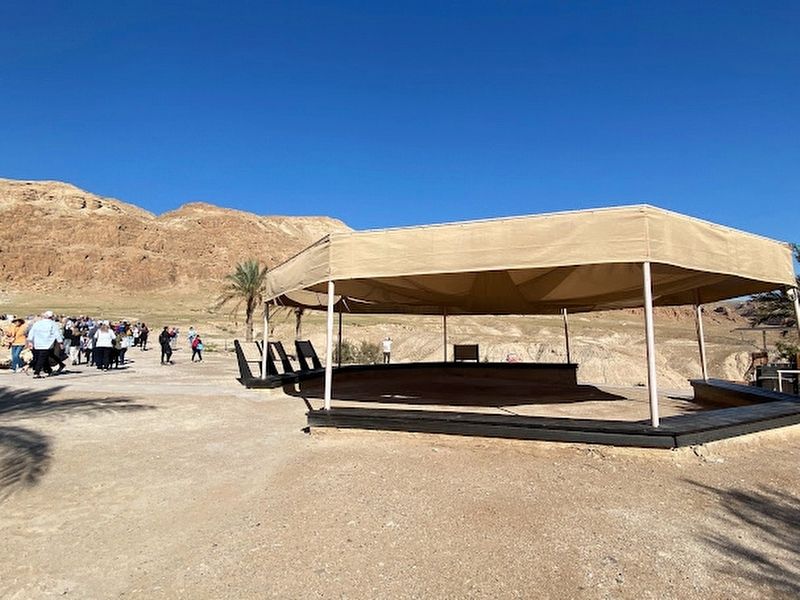
Photographed by Darren Jefferson Clay, March 10, 2023
3. Qumran Marker
Credits. This page was last revised on January 9, 2025. It was originally submitted on April 13, 2023, by Darren Jefferson Clay of Duluth, Georgia. This page has been viewed 342 times since then and 152 times this year. Photos: 1, 2, 3. submitted on April 13, 2023, by Darren Jefferson Clay of Duluth, Georgia. • Andrew Ruppenstein was the editor who published this page.
