Brownsville in Cameron County, Texas — The American South (West South Central)
Fort Brown Commissary
⎯⎯⎯
Guardhouse Comisaria y Casa de la Guardia del Fuerte Brown
Photographed by James Hulse, April 19, 2023
1. Fort Brown Commissary / Guardhouse Comisaria y Casa de la Guardia del Fuerte Brown Marker
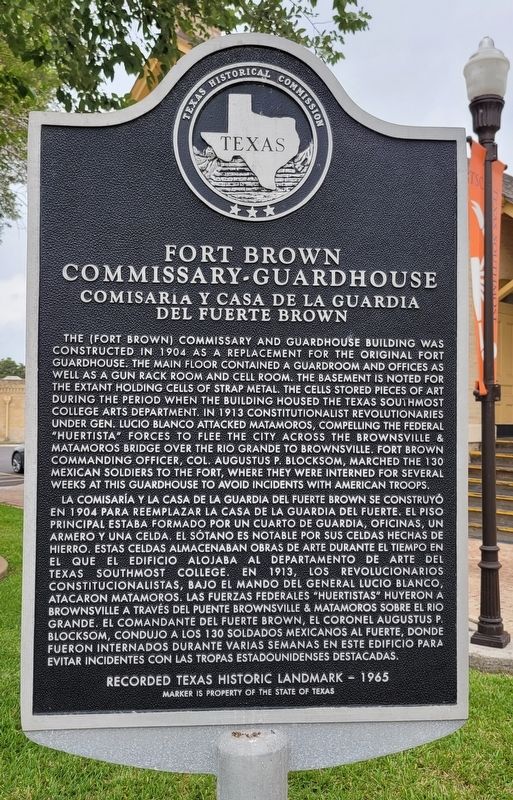
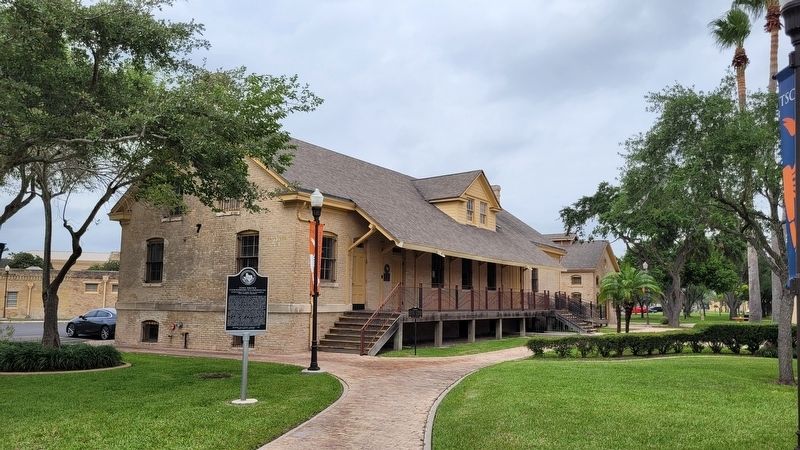
 The (Fort Brown) Commissary and Guardhouse building was constructed in 1904 as a replacement for the original Fort guardhouse. The main floor contained a guardroom and offices as well as a gun rack room and cell room. The basement is noted for the extant holding cells of strap metal. The cells stored pieces of art during the period when the building housed the Texas Southmost College Arts Department. In 1913 constitutionalist revolutionaries under Gen. Lucio Blanco attacked Matamoros, compelling the Federal "Huertista" forces to flee the city across the Brownsville & Matamoros bridge over the Rio Grande to Brownsville. Fort Brown commanding officer, Col. Augustus P. Blocksom, marched the 130 Mexican soldiers to the fort, where they were interned for several weeks at this guardhouse to avoid incidents with American troops.
Spanish:
Erected 1965 by State Historical Survey Committee.
this page online
Topics. This historical marker is listed in this topic list: Forts and Castles. A significant historical year for this entry is 1904.
Location. 25° 53.881′ N, 97° 29.486′ W. Marker is in Brownsville, Texas, in Cameron County. It can be reached from Gorgas Drive 0.1 miles east of May Street. The marker is located on the south side of the Commissary building on the campus of Texas Southmost College. Touch for map. Marker is at or near this postal address: 1851 Gorgas Dr, Brownsville TX 78520, United States of America. Touch for directions.

Regionally, this marker is in South Texas. It is also in the American Borderlands, in the South, and on the Gulf Coast. Globally, it is in North America, a Gulf of Mexico state, the Western Hemisphere, the Western World, and the Anglosphere. Historically, it finds itself in what was once New Spain, the Republic of Texas, and one of the Confederate States of America.
Other nearby markers. At least 8 other markers are within walking distance of this marker: Commissary (here, next to this marker); Fort Brown Commissary/Guardhouse (a few steps from this marker); Fort Brown Buildings 85 and 86
Photographed by James Hulse, April 19, 2023
2. Fort Brown Commissary / Guardhouse Comisaria y Casa de la Guardia del Fuerte Brown Marker
More about this marker. The historic Fort Brown buildings are located around the campus of the Texas Southmost College.
Also see . . . Fort Brown. Texas State Historical Association (TSHA)
Fort Brown, originally called Fort Texas, was established when Zachary Taylor and the United States forces of occupation arrived on the Rio Grande on March 26, 1846, to establish the river as the southern boundary of Texas. In April 1846 Taylor built an earthen fort of 800 yards perimeter, with six bastions, walls more than nine feet high, a parapet of fifteen feet, and the whole surrounded by a ditch fifteen feet deep and twenty feet wide. Armament was four eighteen-pound guns. The Seventh Infantry, with Company I of the Second Artillery and Company E, Third Artillery, commanded by Maj. Jacob Brown, garrisoned the fort. Mexican troops led by Mariano Arista intercepted United States troops as they brought supplies from Fort Polk at Point Isabel to Fort Brown, leading to the opening battles of the war, Palo Alto and Resaca de la Palma, fought on May 8 and 9, 1846. On May 9 Major Brown died from injuries received during the bombardment of the fort by Mexican forces in Matamoros. Shortly after his death he was buried within the fortifications, and the post was named in his honor.(Submitted on May 13, 2023, by James Hulse of Medina, Texas.)
Credits. This page was last revised on May 13, 2023. It was originally submitted on May 13, 2023, by James Hulse of Medina, Texas. This page has been viewed 303 times since then and 25 times this year. Photos: 1, 2. submitted on May 13, 2023, by James Hulse of Medina, Texas.
