
Menands in Albany County, New York — The American Northeast (Mid-Atlantic)
Troy Steel & Iron Co.
Photographed by Steve Stoessel, June 19, 2023
1. Troy Steel & Iron Co. Marker
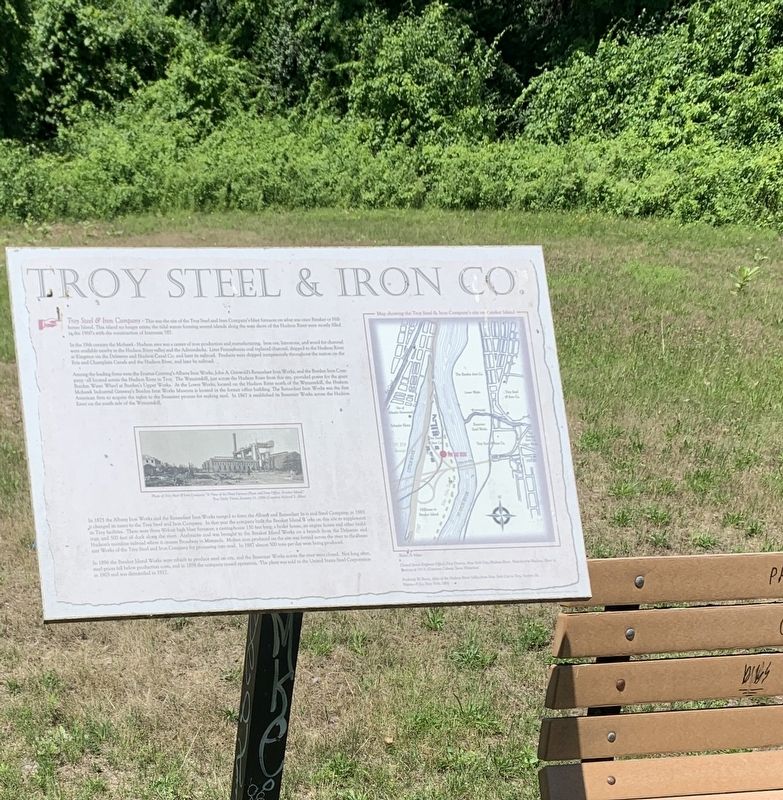
This was once the site of Troy Steel and Iron Company's blast furnace on Beeaker or Hillhouse Island. This island no longer exists; the tidal waters forming several islands on the west shore of the Hudson River were mostly filled in the 1960's with the construction of Interstate 787.
In the 19th century the Mohawk-Hudson area was a center of iron production and manufacturing. Iron ore, limestone, and wood for charcoal were available nearby in the Hudson River valley and the Adirondacks. Later, Pennsylvania coal replaced charcoal, shipped to the Hudson River at Kingston via the Delaware and Hudson Canal Co. and later its railroad. Products were shipped inexpensively throughout the nation on the Erie and Champlain Canals and the Hudson River, and later by railroad.
Among the leading firms were Eratus Corning’s Albany Iron Works, John A. Griswold’s Rensselaer Iron Works, and the Burden Iron Company – all located across the Hudson River in Troy. The Wynantskill, just across the Hudson River at this site, provided power for the giant Burden Water Wheel at Burden’s Upper Works. At the Lower Works, located on the Hudson
this page online
In 1875, the Albany Iron Works and the Rensselaer Iron Works merged to form the Albany and Rensselaer Iron and Steel Company. In 1885, it changed its name to the Troy Steel and Iron Company. In that year, the company built the Breaker Island Works on this site to supplement its Troy facilities. There were three 80-foot high blast furnaces, a casting-house 150 feet long, a boiler house, an engine house, and other buildings, and 500 feet of dock along the river. Anthracite coal was brought to the Breaker Island Works on a branch from the Delaware and Hudson’s mainline railroad where it crosses Broadway in Menands. Molten iron produced on the site was ferried across the river to the Bessemer Works of the Troy Steel and Iron Company for processing into steel. In 1887 almost 500 tons
Photographed by Steve Stoessel, June 19, 2023
2. Troy Steel & Iron Co. Marker
In 1896 the Breaker Island Works were rebuilt to produce steel on site, and the Bessemer Works across the river were closed. Not long after, steel prices fell below production costs, and in 1898 the company ceased operation. The plant was sold to the United States Steel Corporation in 1903 and dismantled in 1917.
(photo) Photo of the Troy Steel & Iron Company “A View of the Blast Furnace Plant and New Office, Breaker Island.” Troy Daily-Times, January 11, 1896 (Courtesy Richard S. Allen)
Topics. This historical marker is listed in this topic list: Industry & Commerce. A significant historical date for this entry is January 11, 1896.
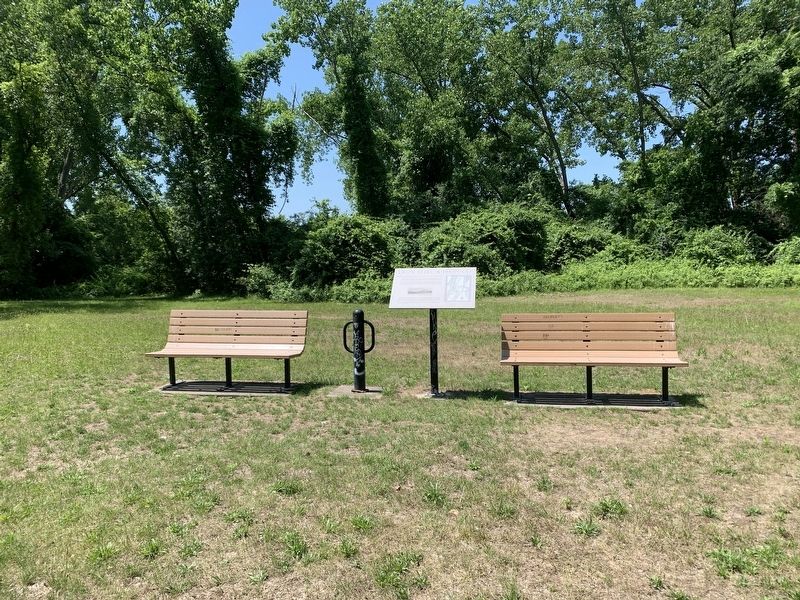
Location. 42° 42.151′ N, 73° 42.32′ W. Marker is in Menands, New York, in Albany County. It is on Empire State Trail, on the right when traveling south. Marker is on the Empire State Trail, and not accessible by car. The marker is located approximately one-half mile south of the trailhead at Broadway and Fourth Street in Watervliet. Touch for map. Marker is at or near this postal address: Empire State Trail, Watervliet NY 12189, United States of America. Touch for directions.

Regionally, this marker is in Upstate New York, in the Capital District, and in the Albany Metropolitan Area. It is also in the American Northeast and in the Mid-Atlantic. Globally, it is in North America, the Western Hemisphere, the Western World, and the Anglosphere. Historically, it finds itself in what was once New Netherland and also one of the original Thirteen Colonies.
Other nearby markers. At least 8 other markers are within walking distance of this marker: The Native People (approx. ¼ mile away); Arent van Curler & Fr. Isaac Jogues at the Flatts in 1643 (approx. 0.3 miles away); The Colonial & Revolutionary Wars (approx. 0.3 miles away); The Old Schuyler Burying Ground (approx. 0.3 miles away); Schuyler Flatts in the French & Indian War (approx. 0.4 miles away); Schuyler Flatts Cultural Park (approx. 0.4 miles away); Schuyler Flatts (approx. 0.4 miles away); The Erie Canal (approx. 0.4 miles away). Touch for a list and map of all markers in Menands.
Credits. This page was last revised on June 27, 2023. It was originally submitted on June 19, 2023, by Steve Stoessel of Niskayuna, New York. This page has been viewed 1,723 times since then and 136 times this year. Photos: 1. submitted on June 19, 2023, by Steve Stoessel of Niskayuna, New York. 2. submitted on June 20, 2023, by Steve Stoessel of Niskayuna, New York. • Michael Herrick was the editor who published this page.
