University in Blacksburg in Montgomery County, Virginia — The American South (Mid-Atlantic)
The Early Years
⎯⎯⎯
Campus Over Time
Photographed by Duane and Tracy Marsteller, June 17, 2023
1. The Early Years side of marker
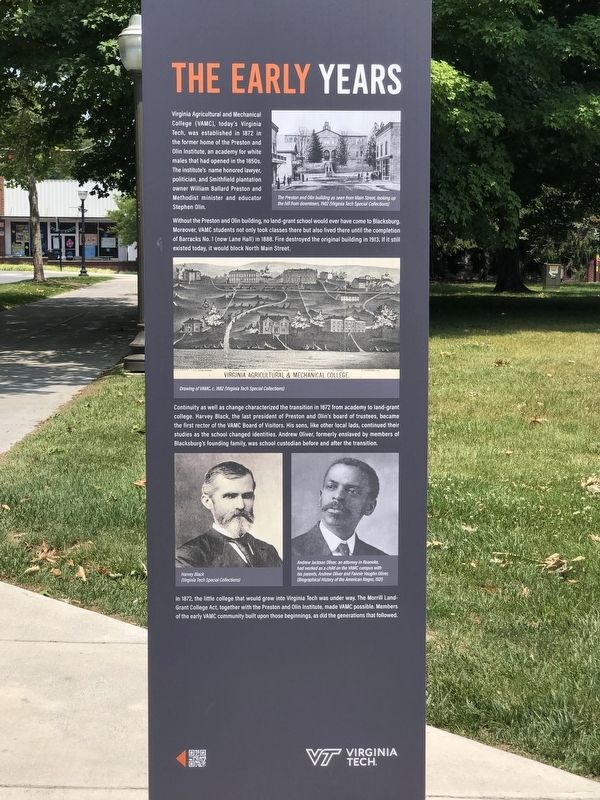
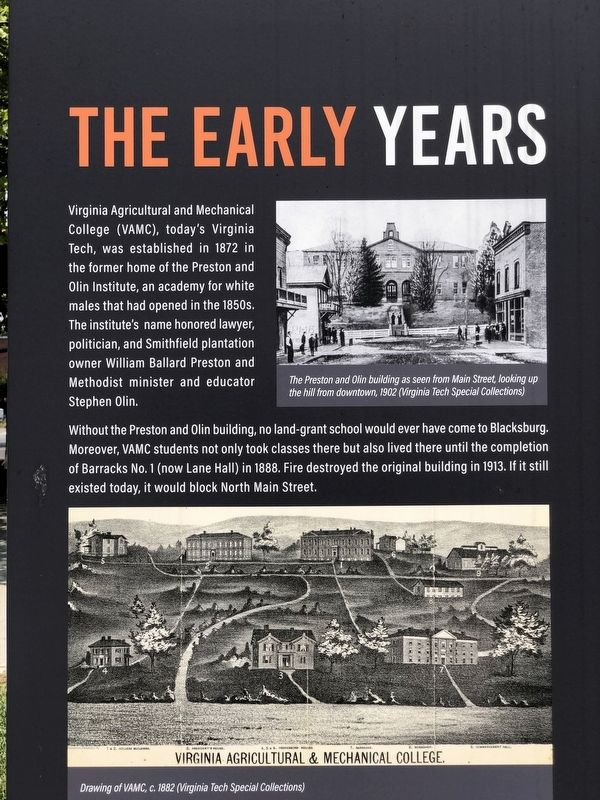
Without the Preston and Olin building, no land-grant school would ever have come to Blacksburg. Moreover, VAMC students not only took classes there but lived there until the completion of Barracks No. 1 (now Lane Hall) in 1888. Fire destroyed the original building in 1913. If it still existed today, it would block North Main Street.
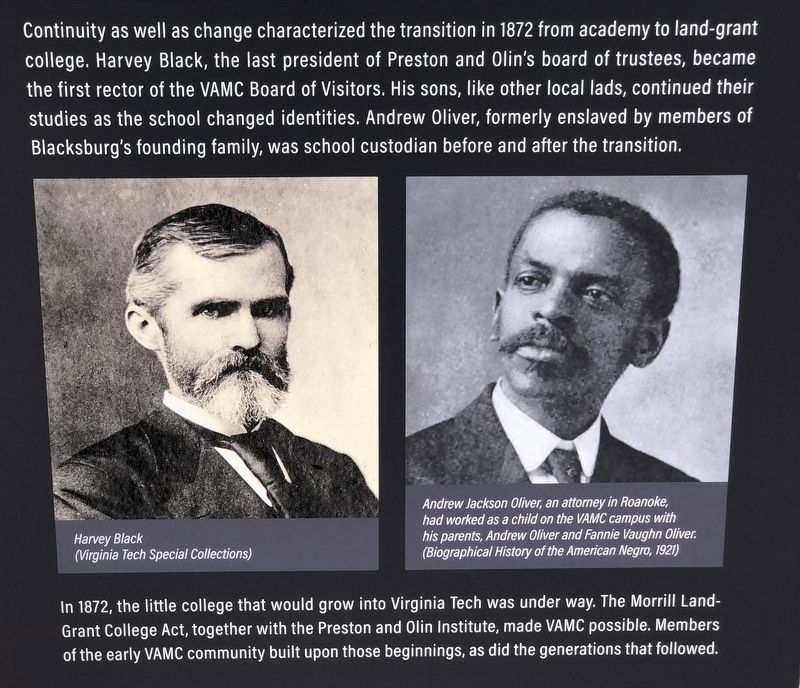
Continuity as well as change characterized the transition in 1872 from academy to land-grant college. Harvey Black, the last president of Preston and Olin's board of trustees, became the first rector of the VAMC Board of Visitors. His sons, like other local lads, continued their studies as the school changed identities. Andrew Oliver, formerly enslaved by members of Blacksburg's founding family, was school custodian
this page online
In 1872, the little college that would grow into Virginia Tech was under way. The Morrill Land-Grant College Act, together with the Preston and Olin Institute, made VAMC possible. Members of the early VAMC community built upon those beginnings, as did the generations that followed.
[Captions (top to bottom)]
• The Preston and Olin building as seen from Main Street, looking up the hill from downtown, 1902 (Virginia Tech Special Collections)
• Drawing of VAMC, c. 1882 (Virginia Tech Special Collections)
• Left: Harvey Black (Virginia Tech Special Collections); Right: Andrew Jackson Oliver, an attorney in Roanoke, had worked as a child on the VAMC campus with his parents, Andrew Oliver and Fannie Vaughn Oliver. (Biographical History of the American Negro, 1921)
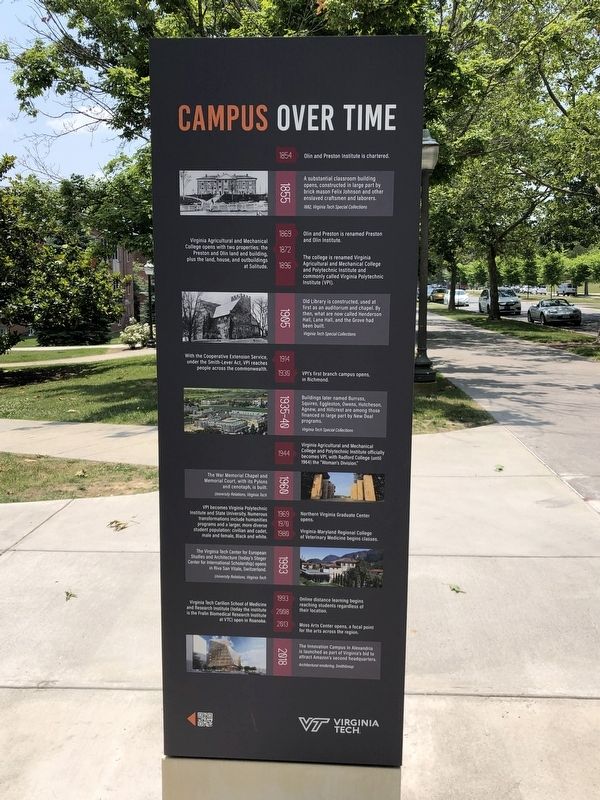
Campus Over Time
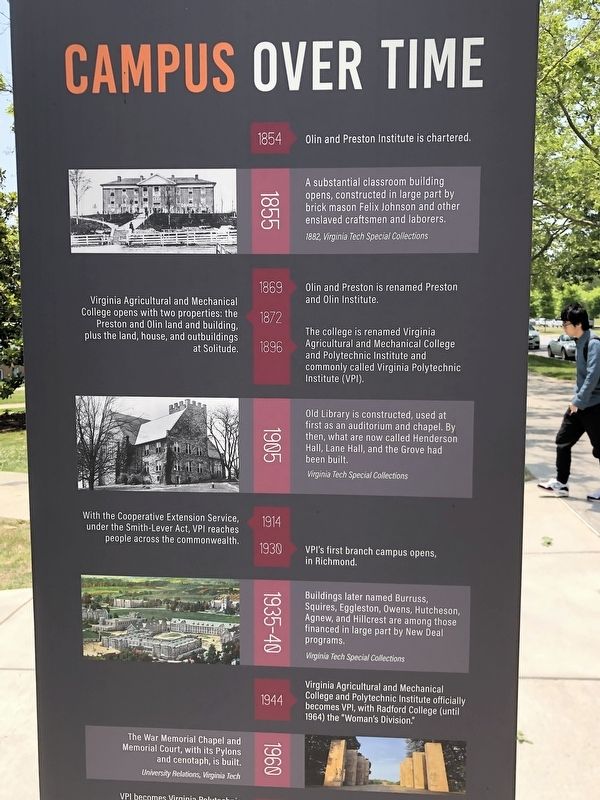
• 1854 – Olin and Preston Institute is chartered.
• 1855 – A substantial classroom building opens, constructed in large part by Black mason Felix Johnson and other enslaved craftsmen and laborers. (1882, Virginia Tech Special Collections)
• 1869 – Olin and Preston is renamed Preston and Olin Institute.
• 1872 – Virginia
Photographed by Duane and Tracy Marsteller, June 17, 2023
2. Campus Over Time side of marker
• 1896 – The college is renamed Virginia Agricultural and Mechanical College and Polytechnic Institute and commonly called Virginia Polytechnic Institute (VPI).
• 1905 – Old Library is constructed, used at first as an auditorium and chapel. By then, what are now called Henderson Hall, Lane Hall, and the Grove had been built.
• 1914 – With the Cooperative Extension Service, under the Smith-Lever Act, VPI reaches people across the commonwealth.
• 1930 – VPI's first branch campus opens, in Richmond.
• 1935-40 – Buildings later named Burress, Squires, Eggleston, Owens, Hutcheson, Agnew, and Hillcrest are among those financed in large part by New Deal programs. (Virginia Tech Special Collections)
• 1944 – Virginia Agricultural and Mechanical College and Polytechnic Institute officially becomes VPI, with Radford College (until 1964) the “Woman's Division”.
• 1960 – The War Memorial Chapel and Memorial Court, with its Pylons and cenotaph, is built. (University Relations, Virginia Tech)
• 1969
Photographed by Duane and Tracy Marsteller, June 17, 2023
3. The Early Years Marker closeup
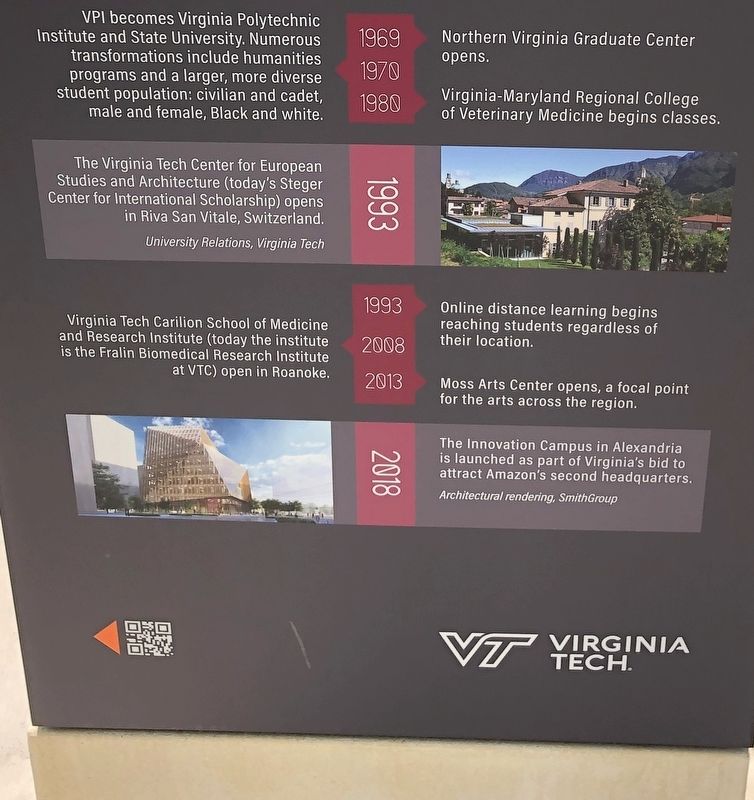
• 1970 – VPI becomes Virginia Polytechnic Institute and State University. Numerous transformations include humanities programs and a larger, more diverse student population: civilian and cadet, male and female, Black and white.
• 1980 – Virginia-Maryland Regional College of Veterinary Medicine begins classes.
• 1993 – The Virginia Tech Center for European Studies and Architecture (today's Steger Center for International Scholarship) opens in Riva San Vitale, Switzerland. (University Relations, Virginia Tech)
• 1993 – Online distance learning begins reaching students regardless of their location.
• 2008 – Virginia Tech Carillion School of Medicine and Research Institute (today the institute is the Fralin Biomedical Research Institute at VTC) opens in Roanoke.
• 2013 – Moss Arts Center opens, a focal point for the arts across the region.
• 2018 – The Innovation Campus in Alexandria is launched as part of Virginia's bid to attract Amazon's second headquarters. (Architectural rendering, SmithGroup)
Erected by Virginia Tech.
Topics. This historical marker is listed in this topic
Photographed by Duane and Tracy Marsteller, June 17, 2023
4. The Early Years Marker closeup
Location. 37° 13.859′ N, 80° 24.998′ W. Marker is in Blacksburg, Virginia, in Montgomery County. It is in University. It is on Alumni Mall west of North Main Street (Business U.S. 460), on the right when traveling east. Touch for map. Marker is at or near this postal address: 125 Alumni Mall, Blacksburg VA 24061, United States of America. Touch for directions.

Regionally, this marker is in Southwest Virginia, in the Blue Ridge Highlands, and in the New River Gorge. It is also in the American South, specifically in the Upper South, in Appalachia, and specifically in Southern Appalachia. Globally, it is in North America, the Western Hemisphere, the Western World, and the Anglosphere. Historically, it finds itself in what was once the territory of the Mississippian Culture, one of the original Thirteen Colonies, one of the Confederate States of America, and the Antebellum South.
Other nearby markers. At least 8 other markers are within walking distance of this marker: People and Place / Land Grant College (within shouting distance of this marker); Virginia Polytechnic Institute and State University
Photographed by Duane and Tracy Marsteller, June 17, 2023
5. Campus Over Time Marker closeup
Photographed by Duane and Tracy Marsteller, June 17, 2023
6. Campus Over Time Marker closeup
Photographed by Duane and Tracy Marsteller, June 17, 2023
7. The Early Years / Campus Over Time Marker
Credits. This page was last revised on July 16, 2023. It was originally submitted on July 13, 2023, by Duane and Tracy Marsteller of Murfreesboro, Tennessee. This page has been viewed 499 times since then and 58 times this year. Photos: 1, 2, 3, 4, 5, 6, 7. submitted on July 13, 2023, by Duane and Tracy Marsteller of Murfreesboro, Tennessee.
