Boyne City in Charlevoix County, Michigan — The American Midwest (Great Lakes)
Downtown Boyne City
Photographed by Joel Seewald, July 6, 2023
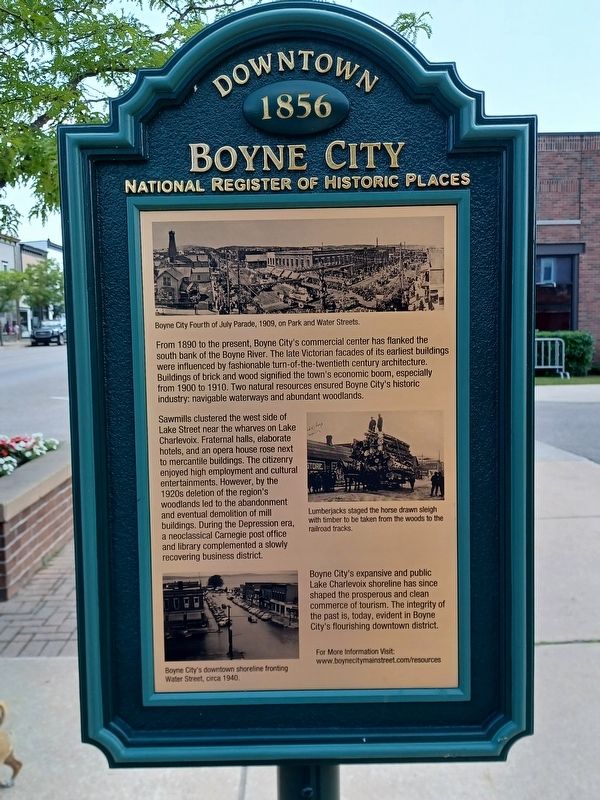
1. Downtown Boyne City Marker, Side One
From 1890 to the present, Boyne City's commercial center has flanked the south bank of the Boyne River. The late Victorian facades of its earliest buildings were influenced by fashionable turn-of-the-twentieth century architecture. Buildings of brick and wood signified the town's economic boom, especially from 1900 to 1910. Two natural resources ensured Boyne City's historic industry: navigable waterways and abundant woodlands.
Sawmills clustered the west side of Lake Street near the wharves on Lake Charlevoix. Fraternal halls, elaborate hotels, and an opera house rose next to mercantile buildings. The citizenry enjoyed high employment and cultural entertainments. However, by the 1920s deletion of the region's woodlands led to the abandonment and eventual demolition of mill buildings. During the Depression era, a neoclassical Carnegie post office and library complemented a slowly recovering business district.
Boyne City's expansive and public Lake Charlevoix shoreline has since shaped the prosperous and clean commerce of tourism. The integrity of the past is, today, evident in Boyne City's flourishing downtown district.
Topics.
this page online
Location. 45° 12.776′ N, 85° 0.899′ W. Marker is in Boyne City, Michigan, in Charlevoix County. It is at the intersection of South Lake Street and Ray Street, on the right when traveling south on South Lake Street. Touch for map. Marker is at or near this postal address: 118 South Lake Street, Boyne City MI 49712, United States of America. Touch for directions.

Regionally, this marker is in Northern Michigan Lower Peninsula, in the Grand Traverse Bay Region, and in one of the Lake Michigan Shore counties. It is also in the American Midwest. Globally, it is in North America, on the Great Lakes, in the Western Hemisphere, in the Western World, and in the Anglosphere. Historically, it finds itself in what was once the Northwest Territory.
Other nearby markers. At least 8 other markers are within walking distance of this marker: The Railroad Round House (about 300 feet away, measured in a direct line); Schaub Meat Market (about 300 feet away); Bellamy Opera House (about 300 feet away); S. Dosie Clothing Furnishings & Shoes
Photographed by Joel Seewald, July 6, 2023
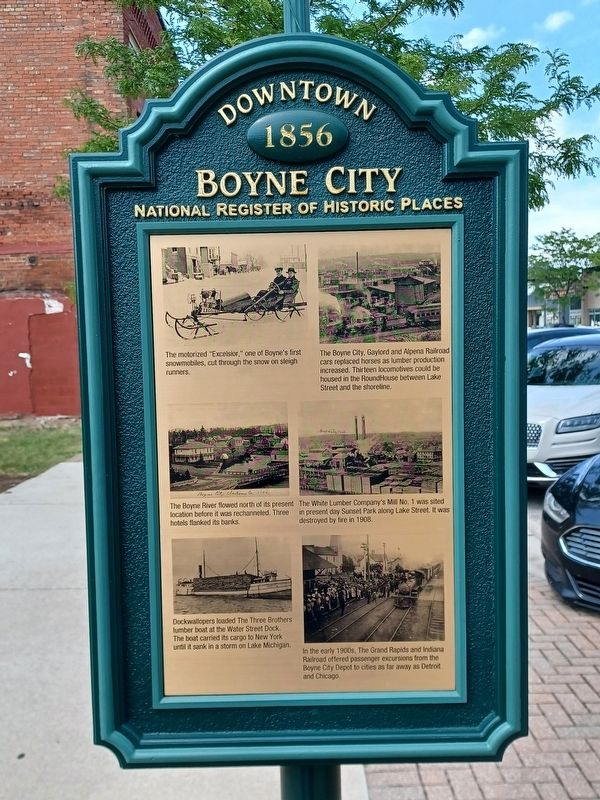
2. Downtown Boyne City Marker, Side Two
Also see . . . Michigan SP Boyne City Central Historic District. The National Register of Historic Places Registration Form indicates that "The Boyne City Central Historic District...incorporates...all or portions of 14 blocks encompassing the historic core of the city. It includes blocks comprising the central business district from Front Street eastward along Water and Ray Streets and continues east across East Street to include historic residential blocks associated with the city's founding fathers and businessmen." (Submitted on August 10, 2023, by Joel Seewald of Madison Heights, Michigan.)
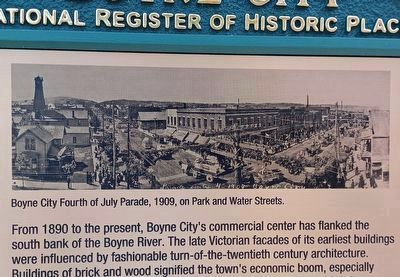
3. Downtown Boyne City Marker, Side One, top image
Boyne City Fourth of July Parade, 1909, on Park and Water Streets.
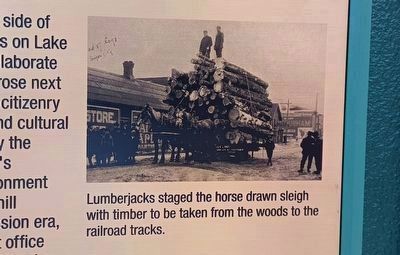
4. Downtown Boyne City Marker, Side One, middle image
Lumberjacks staged the horse drawn sleigh with timber to be taken from the woods to the railroad tracks.
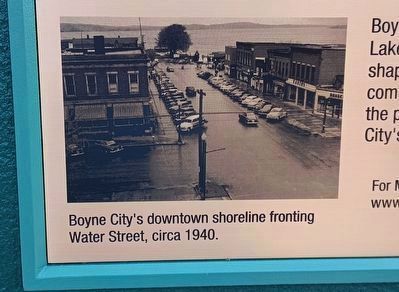
5. Downtown Boyne City Marker, Side One, bottom image
Boyne City's downtown shoreline fronting Water Street, circa 1940.
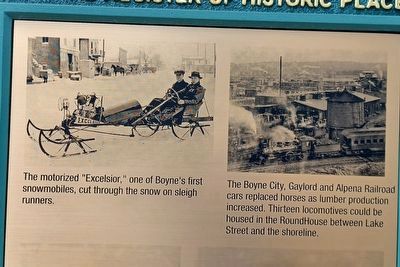
6. Downtown Boyne City Marker, Side Two, top images
Left: The motorized "Excelsior," one of Boyne's first snowmobiles, cut through the snow on sleigh runners. Right: The Boyne City, Gaylord and Alpena Railroad cars replaced horses as lumber production increased. Thirteen locomotives could be housed in the RoundHouse between Lake Street and the shoreline.
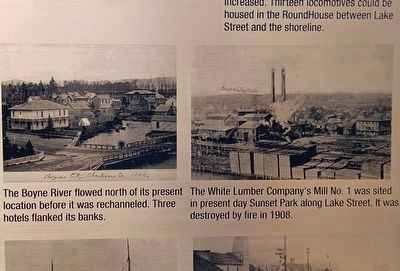
7. Downtown Boyne City Marker, Side Two, middle images
Left: The Boyne River flowed north of its present location before it was rechanneled. Three hotels flanked its banks. Right: The White Lumber Company's Mill No. 1 was sited in present day Sunset Park along Lake Street. It was destroyed by fire in 1908.
Photographed by Joel Seewald
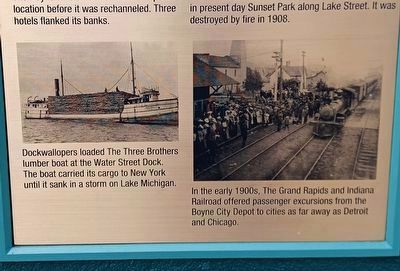
8. Downtown Boyne City Marker, Side Two, bottom images
Left: Dockwallopers loaded The Three Brothers lumber boat as the Water Street Dock. The boat carried its cargo to New York until it sank in a storm on Lake Michigan. Right: In the early 1900s, The Grand Rapids and Indiana Railroad offered passenger excursions from the Boyne City Depot to cities as far away as Detroit and Chicago.
Photographed by Joel Seewald, July 6, 2023
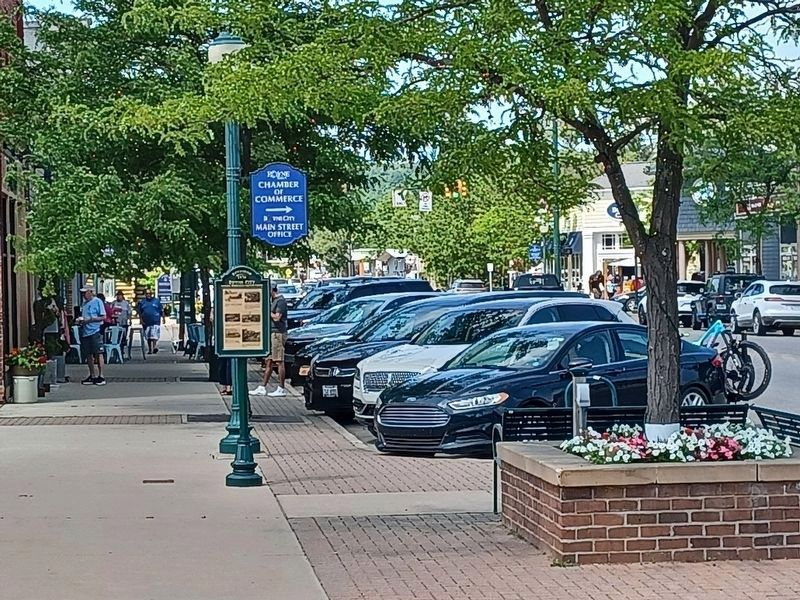
9. Downtown Boyne City Marker
View looking to the north on South Lake Street.
Credits. This page was last revised on August 10, 2023. It was originally submitted on August 10, 2023, by Joel Seewald of Madison Heights, Michigan. This page has been viewed 638 times since then and 60 times this year. Photos: 1, 2, 3, 4, 5, 6, 7, 8, 9. submitted on August 10, 2023, by Joel Seewald of Madison Heights, Michigan.
