Little Tokyo in Los Angeles in Los Angeles County, California — The American West (Pacific Coastal)
Azusa Street Mission
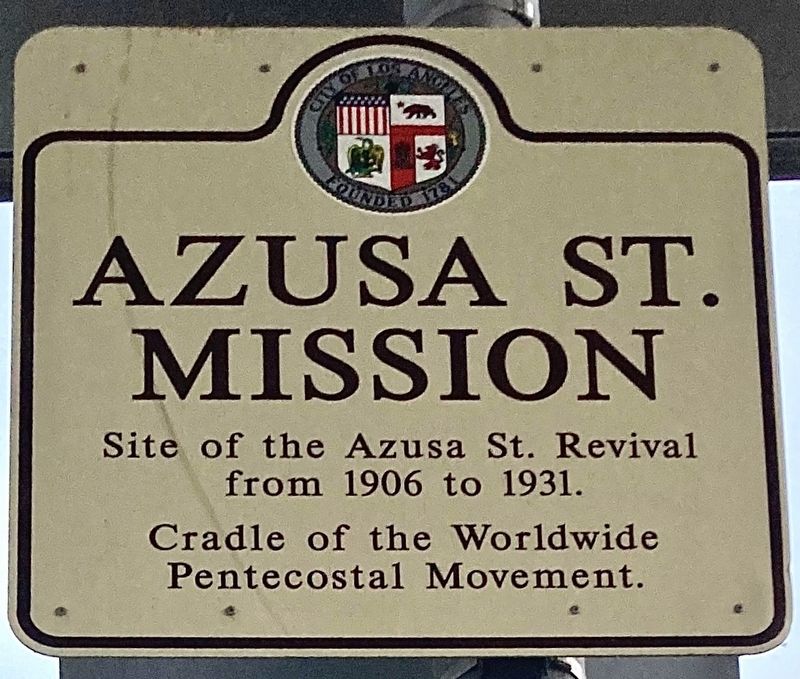
Photographed by Craig Baker, August 13, 2023
1. Azusa Street Mission Marker
Site of the Azusa St. Revival from 1906 to 1931.
Cradle of the Worldwide Pentecostal Movement.
Erected by City of Los Angeles.
Topics. This historical marker is listed in this topic list: Religion & Religious Structures. A significant historical year for this entry is 1906.
Location. 34° 2.911′ N, 118° 14.528′ W. Marker is in Los Angeles, California, in Los Angeles County. It is in Little Tokyo. It is at the intersection of San Pedro Street and Azusa Street, on the right when traveling north on San Pedro Street. Touch for map. Marker is at or near this postal address: 239 San Pedro St, Los Angeles CA 90012, United States of America. Touch for directions.

Regionally, this marker is in the Transverse Ranges. It is also on the American Pacific Coast. Globally, it is in North America, on the Ring of Fire, on the Pacific Rim, in the Western Hemisphere, in the Western World, and in the Anglosphere. Historically, it finds itself in what was once New Spain and also Mexico’s Alta California.
Other nearby markers. At least 8 other markers are within walking distance of this marker: Japanese American War Memorial
this page online
Regarding Azusa Street Mission. The Azusa Street Revival was a historic series of revival meetings led by William J. Seymour, an African-American preacher. The revival began on April 9, 1906. An old dilapidated two-story frame building at 312 Azusa Street in the industrial section of the city was secured. This building, originally built for an African Methodist Episcopal (AME) church, had more recently been used as a livery stable, storage building and tenement house. In this humble Azusa Street mission, a continuous three-year revival occurred and became known around the world. The revival was characterized by spiritual experiences accompanied with testimonies of physical healing miracles, worship services, and speaking in tongues. The participants
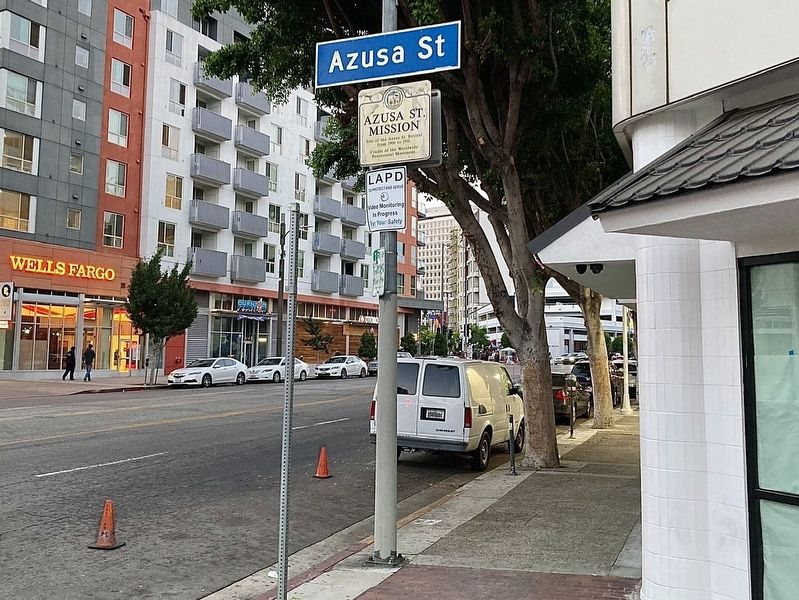
Photographed by Craig Baker
2. Azusa Street Mission Marker
Credits. This page was last revised on October 15, 2026. It was originally submitted on August 14, 2023, by Craig Baker of Sylmar, California. This page has been viewed 1,507 times since then and 348 times this year. Photos: 1, 2. submitted on August 14, 2023, by Craig Baker of Sylmar, California.
