United States Air Force Academy in El Paso County, Colorado — The American Mountains (Southwest)
The Interwar Period
1918-1941
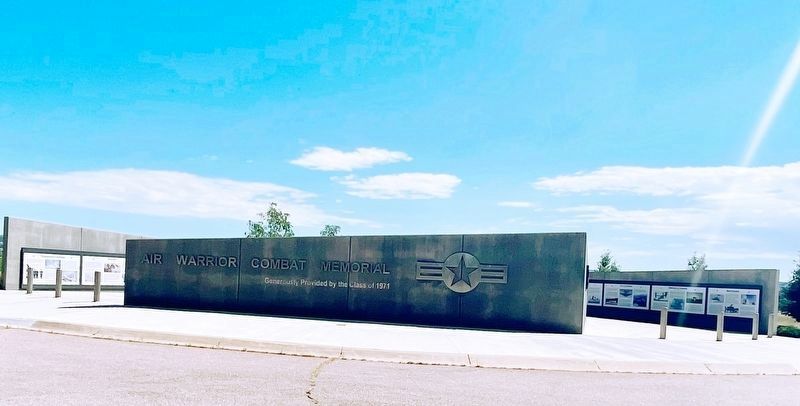
Air Warrior Combat Memorial
Photographed by Mark Hilton, September 3, 2023
1. The Interwar Period Marker
Inscription.
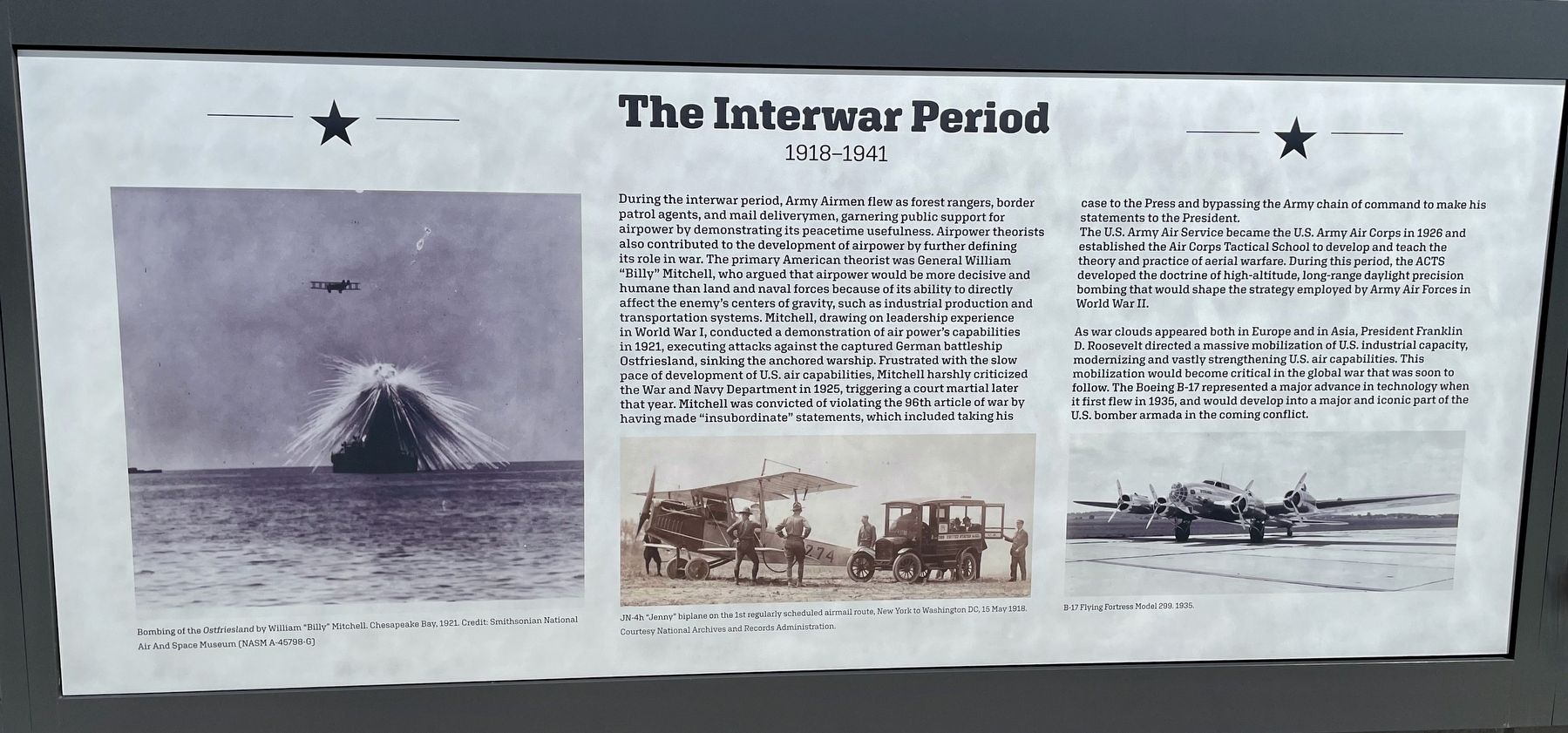
The Interwar Period. During the interwar period, Army Airmen flew as forest rangers, border patrol agents, and mail deliverymen, garnering public support for airpower by demonstrating its peacetime usefulness. Airpower theorists also contributed to the development of airpower by further defining its role in war. The primary American theorist was General William "Billy" Mitchell, who argued that airpower would be more decisive and humane than land and naval forces because of its ability to directly affect the enemy's centers of gravity, such as industrial production and transportation systems. Mitchell, drawing on leadership experience in World War I, conducted a demonstration of air power's capabilities in 1921, executing attacks against the captured German battleship Ostfriesland, sinking the anchored warship. Frustrated with the slow pace of development of U.S. air capabilities, Mitchell harshly criticized the War and Navy Department in 1925, triggering a court martial later that year. Mitchell was convicted of violating the 96th article of war by having made "insubordinate" statements, which included taking his case to the Press and bypassing the Army chain of command to make his statements to the President., The U.S. Army Air Service became the U.S. Army Air Corps in 1926 and established the Air Corps Tactical School to develop and teach the theory and practice of aerial warfare. During this period, the ACTS developed the doctrine of high-altitude, long-range daylight precision bombing that would shape the strategy employed by Army Air Forces in World War II., As war clouds appeared both in Europe and in Asia, President Franklin D. Roosevelt directed a massive mobilization of U.S. industrial capacity, modernizing and vastly strengthening U.S. air capabilities. This mobilization would become critical in the global war that was soon to follow. The Boeing B-17 represented a major advance in technology when it first flew in 1935, and would develop into a major and iconic part of the U.S. bomber armada in the coming conflict.
During the interwar period, Army Airmen flew as forest rangers, border
patrol agents, and mail deliverymen, garnering public support for
airpower by demonstrating its peacetime usefulness. Airpower theorists
also contributed to the development of airpower by further defining
its role in war. The primary American theorist was General William
"Billy" Mitchell, who argued that airpower would be more decisive and
humane than land and naval forces because of its ability to directly
affect the enemy's centers of gravity, such as industrial production and
transportation systems. Mitchell, drawing on leadership experience
in World War I, conducted a demonstration of air power's capabilities
in 1921, executing attacks against the captured German battleship
Ostfriesland, sinking the anchored warship. Frustrated with the slow
pace of development of U.S. air capabilities, Mitchell harshly criticized
the War and Navy Department in 1925, triggering a court martial later
that year. Mitchell was convicted of violating the 96th article of war by
having made "insubordinate" statements, which included taking his case to the
Click or scan to see this page online
Press and bypassing the Army chain of command to make his
statements to the President.
The U.S. Army Air Service became the U.S. Army Air Corps in 1926 and
established the Air Corps Tactical School to develop and teach the
theory and practice of aerial warfare. During this period, the ACTS
developed the doctrine of high-altitude, long-range daylight precision
bombing that would shape the strategy employed by Army Air Forces in
World War II.
As war clouds appeared both in Europe and in Asia, President Franklin
D. Roosevelt directed a massive mobilization of U.S. industrial capacity,
modernizing and vastly strengthening U.S. air capabilities. This
mobilization would become critical in the global war that was soon to
follow. The Boeing B-17 represented a major advance in technology when
it first flew in 1935, and would develop into a major and iconic part of the
U.S. bomber armada in the coming conflict.
Erected by USAFA Class of 1971.
Topics. This historical marker is listed in this topic list: Air & Space. A significant historical year for this entry is 1921.
Location. 39° 1.272′ N, 104° 50.956′ W. Marker is in United
Photographed by Mark Hilton, September 3, 2023
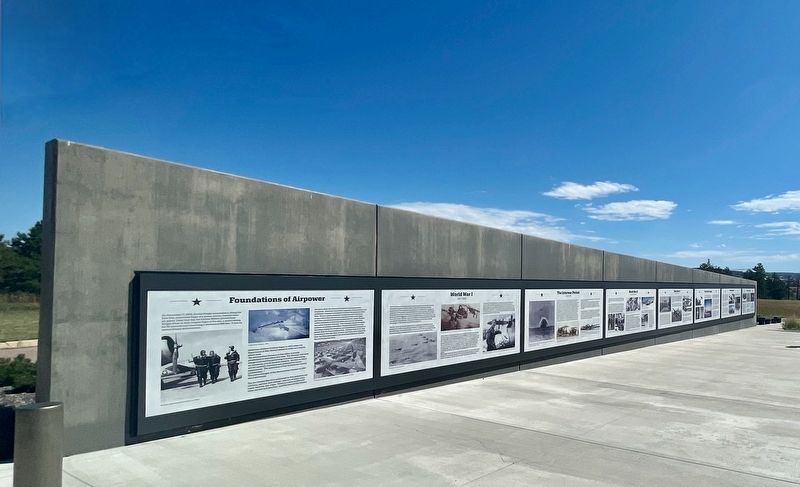
2. The Interwar Period Marker (3rd from left)

States Air Force Academy, Colorado, in El Paso County. It can be reached from the intersection of Stadium Boulevard and North Gate Boulevard, on the right when traveling north. Touch for map. Marker is in this post office area: USAF Academy CO 80840, United States of America. Touch for directions.
Regionally, this marker is in Colorado’s Front Range and in Pikes Peak Region. It is also in the American Mountain West. Globally, it is in North America, the Rocky Mountains, the Western Hemisphere, the Western World, and the Anglosphere. Historically, it finds itself in what was once the Comancherνa.
of all markers in United States Air Force Academy.
More about this marker. Must have a valid ID to enter the USAF Academy grounds.
Credits. This page was last revised on September 3, 2023. It was originally submitted on September 3, 2023, by Mark Hilton of Montgomery, Alabama. This page has been viewed 143 times since then and 10 times this year. Photos:1, 2, 3. submitted on September 3, 2023, by Mark Hilton of Montgomery, Alabama.