Natchez in Natchitoches Parish, Louisiana — The American South (West South Central)
Oakland Plantation
Photographed by Cajun Scrambler, July 2, 2023
1. Oakland Plantation Marker
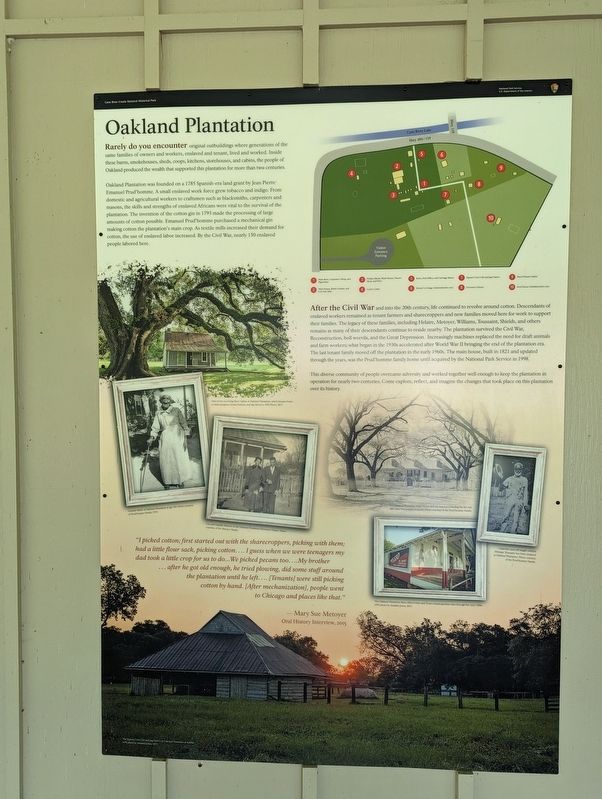
Rarely do you encounter original outbuildings where generations of the same families of owners and workers, enslaved and tenant, lived and worked. Inside these barns, smokehouses, sheds, coops, kitchens, storehouses, and cabins, the people of Oakland produced the wealth that supported this plantation for more than two centuries. Oakland Plantation was founded on a 1785 Spanish-era land grant by Jean Pierre Emanuel Prud'homme. A small enslaved work force grew tobacco and indigo. From domestic and agricultural workers to craftsmen such as blacksmiths, carpenters and masons, the skills and strengths of enslaved Africans were vital to the survival of the plantation. The invention of the cotton gin in 1793 made the processing of large amounts of cotton possible. Emanuel Prud'homme purchased a mechanical gin making cotton the plantation's main crop. As textile mills increased their demand for cotton, the use of enslaved labor increased. By the Civil War, nearly 150 enslaved people labored here.
After the Civil War and into the 20th century, life continued to revolve around cotton. Descendants of enslaved workers remained
this page online
Erected by National Park Service.
Topics. This historical marker is listed in this topic list: Settlements & Settlers. A significant historical year for this entry is 1785.
Location. 31° 39.94′ N,
Photographed by Cajun Scrambler, July 2, 2023
2. Oakland Plantation Marker

Regionally, this marker is in Central Louisiana. It is also in the American South, specifically in the Deep South, and in the Piney Woods. Globally, it is in North America, a Gulf of Mexico state, the Western Hemisphere, the Western World, and the Anglosphere. Historically, it finds itself in what was once New Spain, the Viceroyalty of New France, the territory of the Mississippian Culture, the Louisiana Purchase, one of the Confederate States of America, and the Antebellum South.
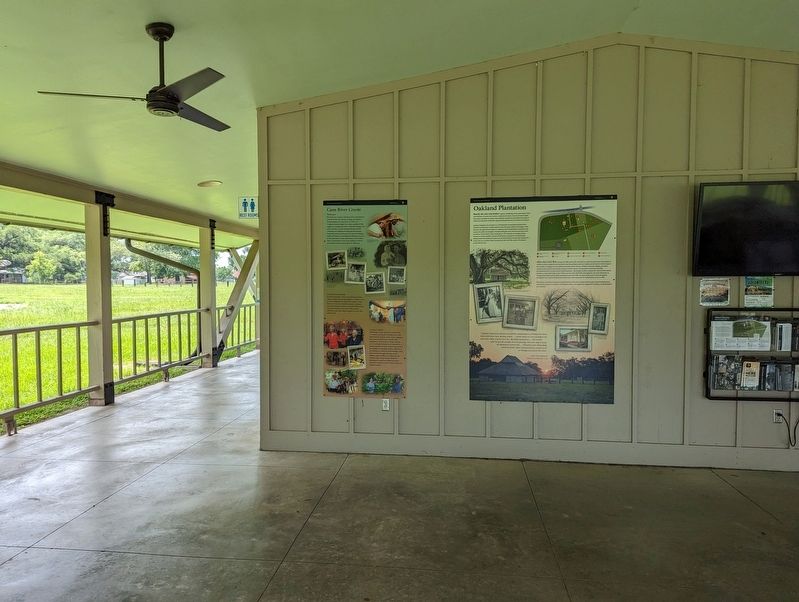
Other nearby markers. At least 8 other markers are within walking distance of this marker: Cane River Creole (here, next to this marker); Magnolia Plantation (here, next to this marker); Hollywood Comes to Oakland Plantation (a few steps from this marker); Meet "Natchez" the Oakland Mule (about 300 feet away, measured in a direct line); A French Connection (about 300 feet away); Maker of Most Things Wood (about 300 feet away); Oakland Grist Mill (about 300 feet away); Creole Architecture (about 300 feet away). Touch for a list and map of all markers in Natchez.
Credits. This page was last revised on September 4, 2023. It was originally submitted on September 4, 2023, by Cajun Scrambler of Assumption, Louisiana. This page has been viewed 353 times since then and 45 times this year. Photos: 1, 2. submitted on September 4, 2023, by Cajun Scrambler of Assumption, Louisiana.
