Dover Air Force Base in Kent County, Delaware — The American Northeast (Mid-Atlantic)
C-119C
Flying Boxcar
| — | S/N 48-0352 | — |
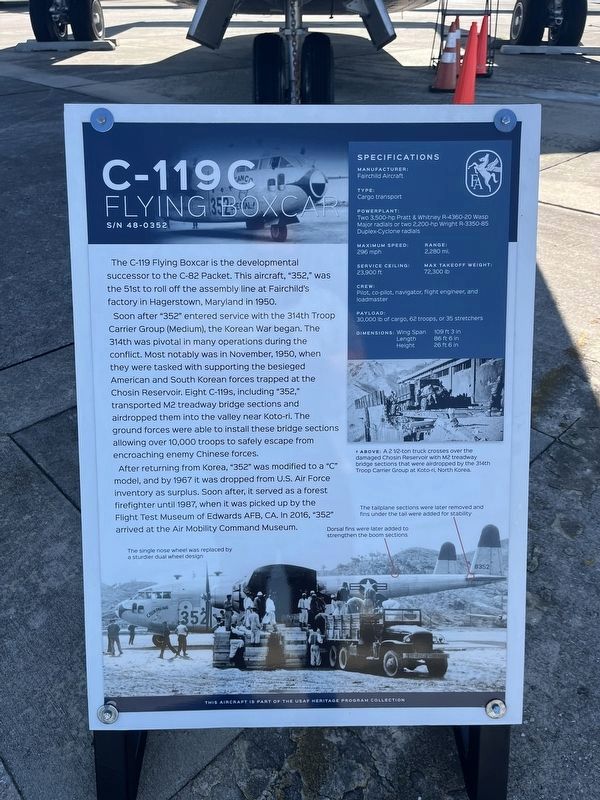
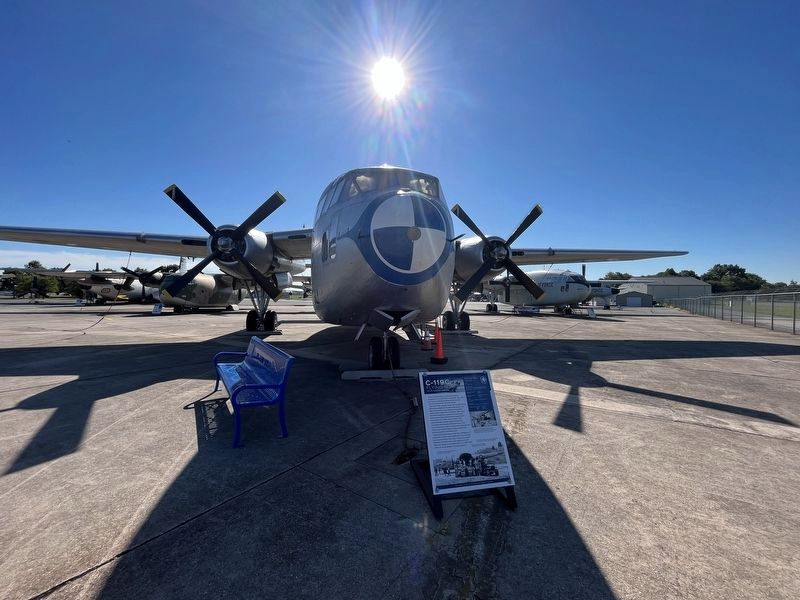
The C-119 Flying Boxcar is the developmental successor to the C-82 Packet. This aircraft, "352," was the 51st to roll off the assembly line at Fairchild's factory in Hagerstown, Maryland in 1950.
Soon after "352" entered service with the 314th Troop Carrier Group (Medium), the Korean War began. The 314th was pivotal in many operations during the conflict. Most notably was in November, 1950, when they were tasked with supporting the besieged American and South Korean forces trapped at the Chosin Reservoir. Eight C-119s, including "352," transported M2 treadway bridge sections and airdropped them into the valley near Koto-ri. The ground forces were able to install these bridge sections allowing over 10,000 troops to safely escape from encroaching enemy Chinese forces.
After returning from Korea, "352" was modified to a "C" model, and by 1967 it was dropped from U.S. Air Force inventory as surplus. Soon after, it served as a forest firefighter until 1987, when it was picked up by the Flight Test Museum of Edwards AFB, CA. In 2016, "352" arrived at the Air Mobility Command Museum.
Specifications
Manufacturer:Fairchild Aircraft
Click or scan to see
this page online
Type: Cargo transport
Powerplant: Two 3,500-hp Pratt & Whitney R-4360-20 Wasp Major radials or two 2,200-hp Wright R-3350-85 Duplex-Cyclone radials.
Maximum speed: 296 mph
Range: 2,280 mi.
Service ceiling: 23,900 ft
Max takeoff weight: 72,300 lb
Crew: Pilot, co-pilot, navigator, flight engineer, and loadmaster
Payload: 30,000 lb of cargo, 62 troops, or 35 stretchers
Dimensions:
Wing Span: 109 ft 3 in
Length: 89 ft 6 in
Height: 26 ft 6 in
[Captions:]
Above: A 2 1/2-ton truck crosses over the damaged Chosin Reservoir with M2 treadway bridge sections that were airdropped by the 314th Troop Carrier Group at Koto-ri, North Korea.
The single nose wheel was replaced by a sturdier dual wheel design.
The tailplane sections were later removed and fins under the tail were added for stability.
Dorsal fins were later added to strengthen the boom sections.
This aircraft is part of the USAF Heritage Program Collection.
Topics. This historical marker is listed in these topic lists: Air & Space • War, Korean. A significant historical month for this entry is November 1950.
Location. 39° 7.078′ N, 75° 27.473′ W.

Regionally, this marker is in the American Mid-Atlantic, on the Delmarva Peninsula, and on the Eastern Seaboard. Globally, it is in the North Atlantic Region, North America, the Western Hemisphere, the Western World, and the Anglosphere. Historically, it finds itself in what was once New Netherland, one of the original Thirteen Colonies, and the Antebellum South.
Other nearby markers. At least 8 other markers are within walking distance of this marker: C-119G (a few steps from this marker); C-123K (within shouting distance of this marker); A-26C (within shouting distance of this marker); C-130E (within shouting distance of this marker); Special Ops Memorial (within shouting distance of this marker); C-124A (within shouting distance of this marker); C-7A (within shouting distance of this marker); C-133B (within shouting distance of this marker). Touch for a list and map of all markers in Dover.
Credits. This page was last revised on March 27, 2024. It was originally submitted on September 17, 2023, by Devry Becker Jones of Washington, District of Columbia. This page has been viewed 170 times since then and 13 times this year. Photos: 1, 2. submitted on September 17, 2023, by Devry Becker Jones of Washington, District of Columbia.
