Rogers City in Presque Isle County, Michigan — The American Midwest (Great Lakes)
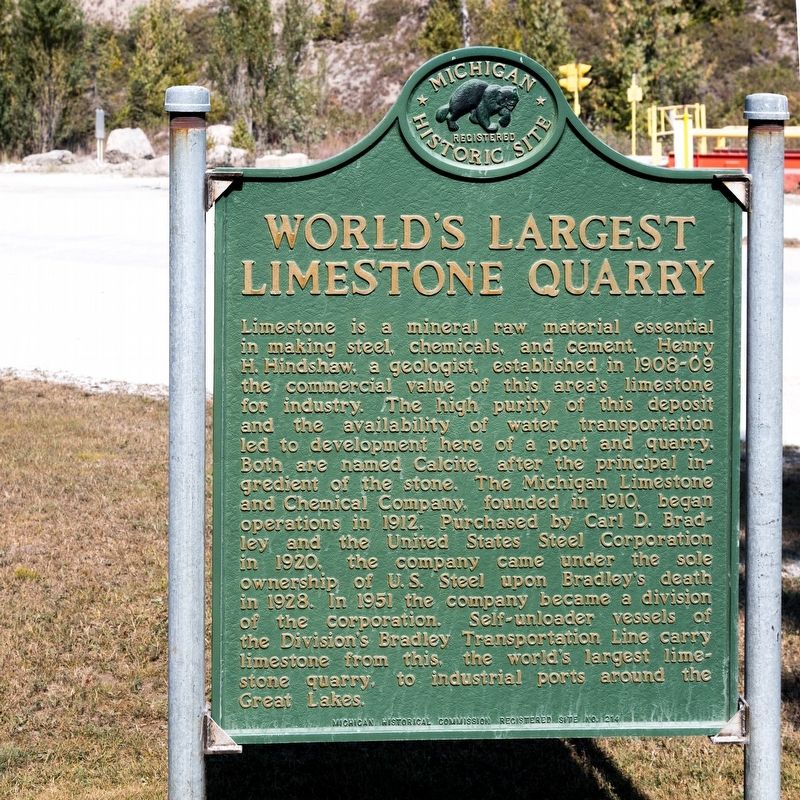
World’s Largest Limestone Quarry
Photographed by J. J. Prats, September 23, 2023
1. World’s Largest Limestone Quarry Marker
Erected 1960 by Michigan Historical Commission. (Marker Number 214.)
Topics. This historical marker is listed in these topic lists: Industry & Commerce • Natural Resources. A significant historical year for this entry is 1910.
Location. 45° 24.668′ N, 83° 47.488′ W.
this page online

Regionally, this marker is in Northern Michigan Lower Peninsula and in one of the Lake Huron Shore counties. It is also in the American Midwest. Globally, it is in North America, in the Great North Woods, on the Great Lakes, in the Western Hemisphere, in the Western World, and in the Anglosphere. Historically, it finds itself in what was once the Northwest Territory.
Other nearby markers. At least 8 other markers are within 2 miles of this marker, measured as the crow flies: Calcite Employee Housing (approx. 1.1 miles away); The Rogers City Shoreline During the Lumber Era (approx. 1.2 miles away); Calcite - The World's Largest Limestone Quarry (approx. 1.2 miles away); Site of Gumm Furniture Store (approx. 1.3 miles away); Schooners (approx. 1.3
Photographed by J. J. Prats, September 23, 2023
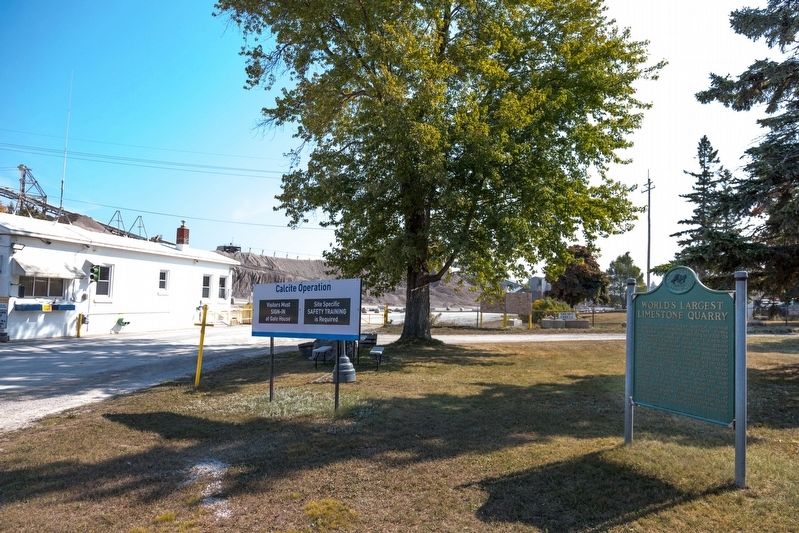
2. World’s Largest Limestone Quarry Marker
Regarding World’s Largest Limestone Quarry. It is now owned and operated by Carmeuse Lime and Stone, a Belgian company.
Also see . . . Wikipedia entry for Michigan Limestone and Chemical Company. Excerpts:
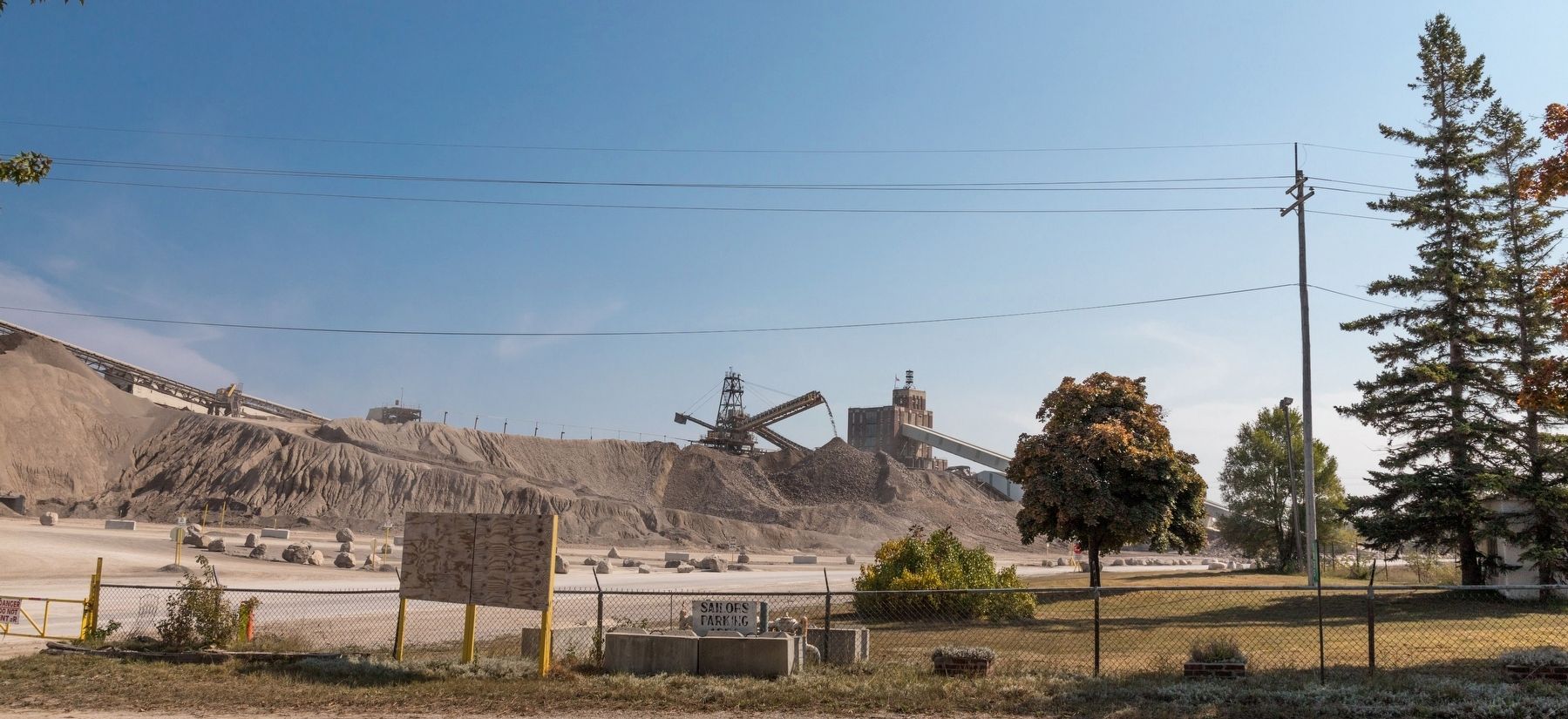
It is the largest limestone quarry in the world, measuring 4 miles (6.4 km) long by 1.5 miles (2.4 km) wide, amounting to 8,924 acres. It features mega loader vehicles that haul up to 195 tonnes (192 long tons; 215 short tons), that is 390,000 pounds (180,000 kg), in single trucks that have tires measuring 13 feet (4.0 m) in height.(Submitted on September 30, 2023.)
The quarry and plant are currently owned and operated by Carmeuse Lime and Stone, with 115 employees. It has been described as a “man made Grand Canyon,” as it is more than 150 feet (46 m) deep. ...
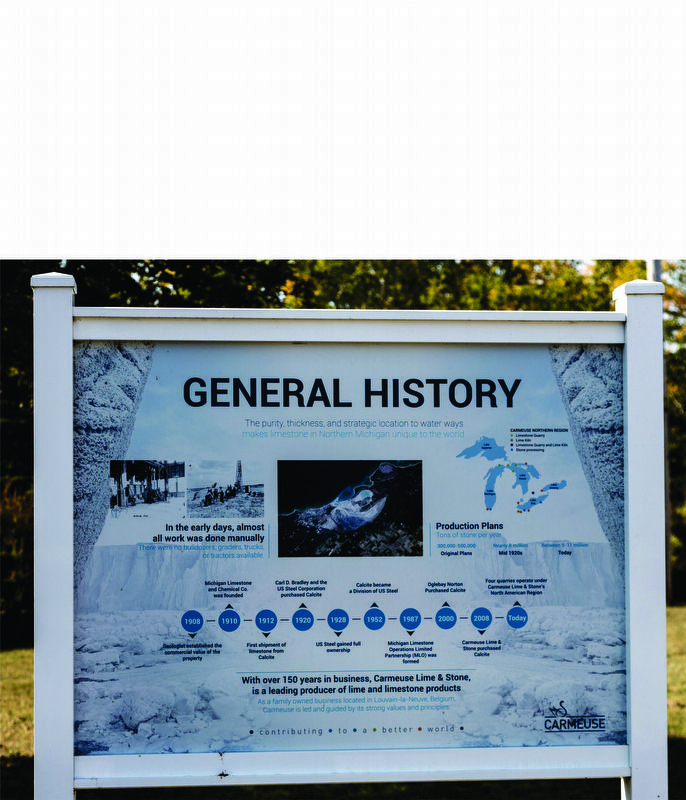
This open pit mine, operating for 111 years since 1912, was at times called “the Calcite Quarry” “Calcite Plant and Mill”and now “Carmeuse Lime and Stone,” mines 350 million year old deposits, and has shipped well over 750,000,000 tonnes (740,000,000 long tons; 830,000,000 short tons) of product to customers. It is within the Rogers City limestone, a part of the Dundee Limestone. Of the 7,000 acres on the site, about 3,000 are actively mined. The company predicts the site has reserves that can last 100 years. ...Photographed by J. J. Prats, September 23, 20233. General HistoryTranscript of text on this sign near the marker:The purity, thickness, and strategic location to waterways makes limestone in Northern Michigan unique to the world.
In the early days, almost all work was done manually. There were no bulldozers, graders, trucks or tractors available.
Production Plans in tons of stone per year. Original plans, 300,000–500,000 • Mid 1920s, nearly 8 million • Today, between 9–11 million.
Timeline: 1908 — Geologist established the commercial value of the property • 1910 — Michigan Limestone and Chemical Company was founded • 1912 — First shipment of limestone from Calcite • 1920 — Carl D. Bradley and the US Steel Corporation purchased Calcite • 1928 — US Steel gained full ownership • 1952 — Calcite became a division of US Steel • 1987 — Michigan Limestone Operations Limited Partnership was formed • 2000 — Oglebay Norton purchased Calcite • 2008 — Carmeuse Lime and Stone purchased Calcite • Today — Four quarries operate under Carmeuse Lime and Stone’s North American Division.
With over 150 years in business, Carmeuse Lime & Stone is a leading producer of lime and limestone products. As a family-owned business located iN Louvain-la-Neuve, Belgium, Carmeuse is led and guided by its strong values and principles.
• contributing • to • a • better • world • CARMEUSE
According to the Oglebay Norton, this quarry is “producing high-calcium carbonate limestone ... and shipping between 7 and 10.5 million net tons per year, depending on market demand.” The operation “produces nine base product sizes, from 5½ inches down to sand-sized particles. These products can be blended together to meet most sizing specifications.” ...
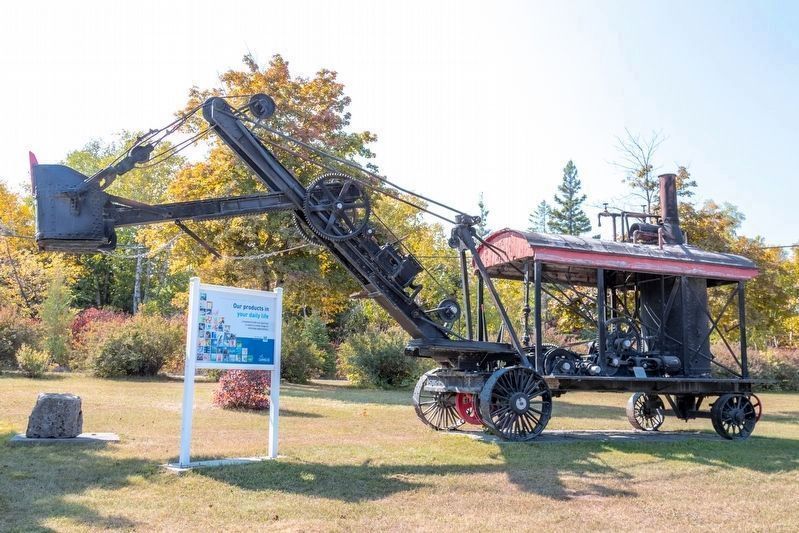
The calcite limestone produced at Michigan Limestone is the white calcium carbonate chemical. It is low in iron, alumina, sulphur, carbonate phosphorus, silica, magnesium and titanium. Steel mills added limestone to molten iron in the blast furnaces. It is used to carry away impurities in the process of making steel. The material is also in widespread use in making cement. The limestonewhen burned at a temperature up to 2300 degrees Fahrenheit (999 degrees Celsius) produces just pure lime, which is used in everything from making paints, varnishes, sugar, glass, baking powder, and ammonia. Lime is also used in making chemicals such as soda ash, caustic soda, bleaching powders, and water softening salt.Photographed by J. J. Prats, September 23, 20234. Vulcan Steam Shovel No. 1622It is on display next to the marker. Builder’s plate reads, “The Vulcan Steam Shovel Co, Builder, Toledo, O. No. 1622.”
The sign to the left of the steam shovel reads, “Our products in your daily life. Limestone from our quarries is used in a wide range of everyday applications. More information at www.carmeuse.com” and displays 45 photographs of everyday items from concrete and insulation, to flatware and lime markings on a sod soccer court.
Pulverized limestone is used to restore the lime that is needed to make plants grow. Continuous cultivation depletes lime out of the soil, making it acidic. Crops will not grow very well in that type of soil. Pulverized limestone is used to restore lime in the soil so crops grow properly. This type of soil conditioner is known as agricultural lime. Where soils are acidic crushed limestone can improve the crop yield. It does this by making the soil balanced and thereby allowing the plants to absorb more nutrients from the soil like they should through their roots. While lime is not a fertilizer itself, it can be used in combination with fertilizers. Agricultural lime can also be beneficial to soils where the land is used in raising farm animals like cows and goats. Bone growth is key to an animal’s development andbones are composed primarily of calcium. Young calves get their needed calcium through milk, which has calcium as one of its major components so dairymen frequently apply agricultural lime to their fields because it increases milk production.Photographed by J. J. Prats, September 23, 20235. View of the World’s Largest Limestone Quarry from the Marker
It is the indispensable ingredient for making calcium carbonate, which in turn is used to make white sugar from sugar beets. Michigan is a very large producer of beet sugar.
Credits. This page was last revised on October 1, 2023. It was originally submitted on September 30, 2023, by J. J. Prats of Powell, Ohio. This page has been viewed 2,477 times since then and 512 times this year. Photos: 1, 2, 3, 4, 5. submitted on September 30, 2023, by J. J. Prats of Powell, Ohio.
