Randleman in Randolph County, North Carolina — The American South (South Atlantic)
St. Paul Methodist Episcopal Church South
Built 1879
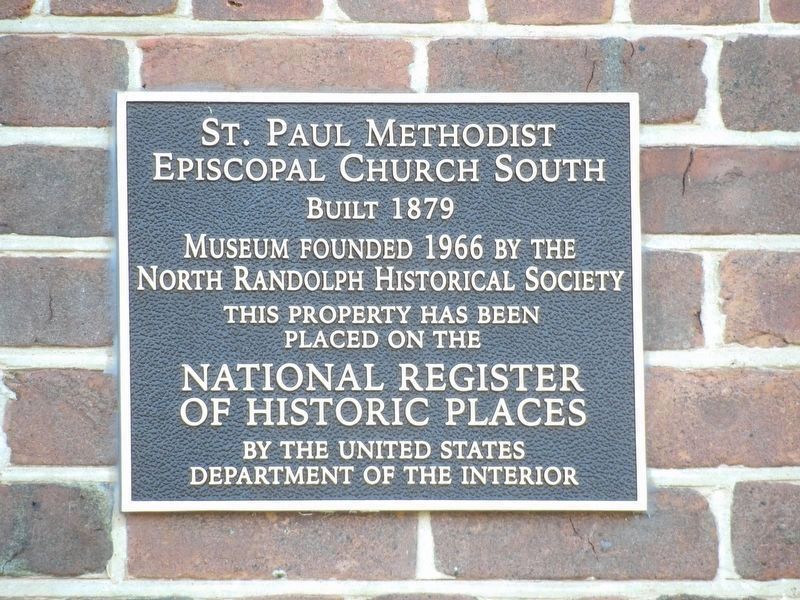
Photographed by Duane and Tracy Marsteller, September 2, 2023
1. St. Paul Methodist Episcopal Church South Marker
North Randolph Historical Society
This property has been
placed on the
National Register
of Historic Places
by the United States
Department of the Interior
Topics and series. This historical marker is listed in this topic list: Religion & Religious Structures. In addition, it is included in the National Register of Historic Places (NRHP) series list. A significant historical year for this entry is 1879.
Location. 35° 49.348′ N, 79° 48.519′ W. Marker is in Randleman, North Carolina, in Randolph County. It is at the intersection of High Point Street and North Stout Street, on the right when traveling south on High Point Street. Touch for map. Marker is at or near this postal address: 401 High Point St, Randleman NC 27317, United States of America. Touch for directions.

Regionally, this marker is in the Piedmont. It is also in the American South and specifically in the Upper South. Globally, it is in North America, the Western Hemisphere, the Western World, and the Anglosphere. Historically, it finds itself in what was once the territory of the Mississippian Culture, one of the original
this page online
Other nearby markers. At least 8 other markers are within 7 miles of this marker, measured as the crow flies: Randleman Veterans Memorial (approx. 0.4 miles away); Naomi Wise (approx. half a mile away); Historic Building (approx. half a mile away); Trading Path (approx. 1.7 miles away); William Dennis Pottery Kiln & House Site (approx. 2.1 miles away); N.C. Manumission Society (approx. 6.8 miles away); Centre Friends Meeting (approx. 6.8 miles away); Edward R. Murrow (approx. 6.9 miles away). Touch for a list and map of all markers in Randleman.
Regarding St. Paul Methodist Episcopal Church South. Excerpts from the National Register nomination:
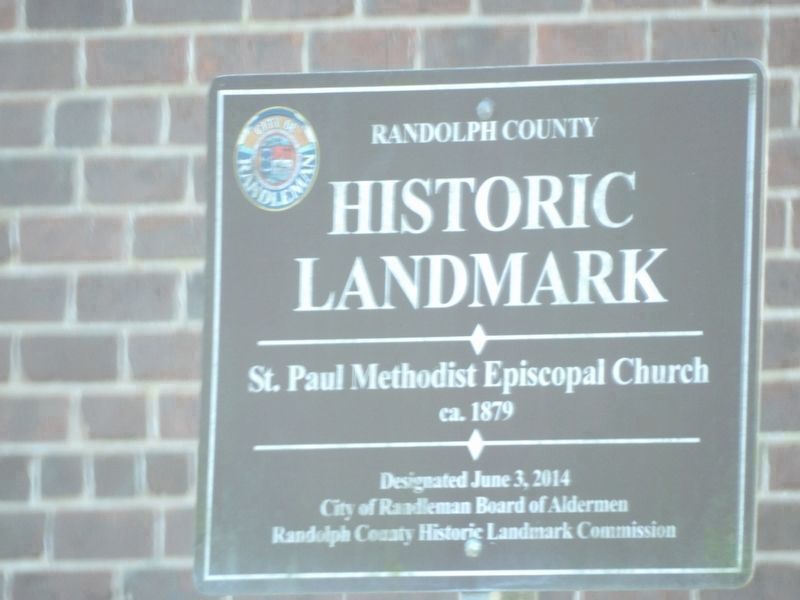
Local industrialists John B. Randleman and John H. Ferree, owners of the Randleman Manufacturing Company on the Deep River in Randleman, North Carolina, funded the construction of St. Paul's Methodist Episcopal Church South that replaced the congregation's ca.1855 frame church on the site. Costing $4,000 to build in 1879, the new church was a bold, refined, brick structure whose exterior was influencedprimarily by both the mid-nineteenth century Greek Revival style and the later nineteenth-century Romanesque Revival style.…Photographed by Duane and Tracy Marsteller, September 2, 20232. Local Landmark MarkerInscription reads:Randolph County
Historic
Landmark
St. Paul Methodist Episcopal Church
ca. 1879
Designated June 3, 2014
City of Randleman Board of Aldermen
Randolph County Historic Landmark Commission
Irish-born Peter Clark was the head mason of the 1879 church, and Allen Redding was the head carpenter. The interior painted decoration was executed by the Reuben Rink firm of Kernersville in nearby Forsyth County. Reuben Rink was the business name taken by noted painter, advertiser, and decorator Jule Gilmer Körner (1851-1924).
When completed, St. Paul's was the first brick church in Randolph County, whose tradition of frame church construction dominated throughout the nineteenth and first quarter of the twentieth century.
Also see . . .
1. St. Paul's Methodist Episcopal Church South (PDF). National Register nomination submitted for the former chuch, which was listed in 2015. (Prepared by Laura A. W . Phillips; via National Park Service) (Submitted on October 4, 2023, by Duane and Tracy Marsteller of Murfreesboro, Tennessee.)
2. History of St. Paul Methodist Episcopal Church. In 1855, a Methodist Episcopal Church was organized and was called St. Paul. James Dicks, son of Peter Dicks
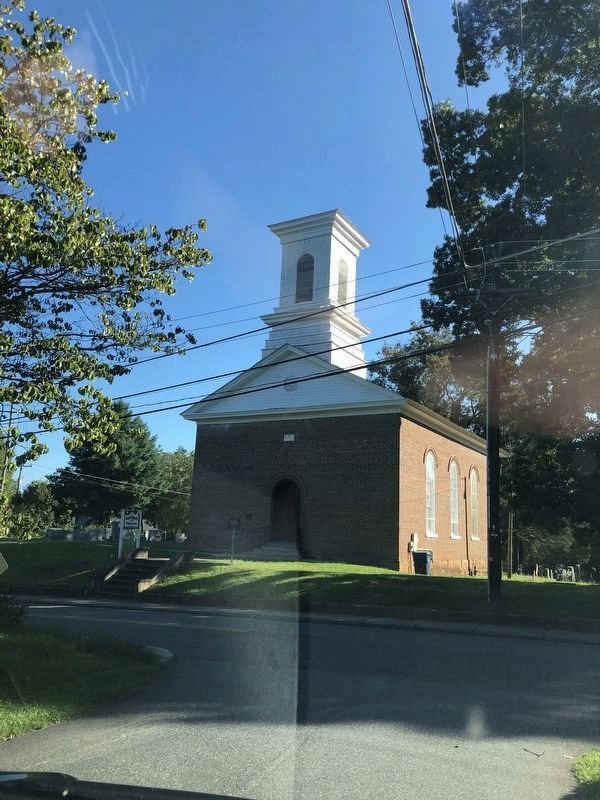
Photographed by Duane and Tracy Marsteller, September 2, 2023
3. St. Paul Methodist Episcopal Church South Marker
The congregation moved out in 1948 after merging with another church. The building sat vacant until the newly organized North Randolph Historical Society bought it in 1966, began rehabilitating it and converted it into a historical museum.
Credits. This page was last revised on October 4, 2023. It was originally submitted on October 4, 2023, by Duane and Tracy Marsteller of Murfreesboro, Tennessee. This page has been viewed 335 times since then and 102 times this year. Photos: 1, 2, 3. submitted on October 4, 2023, by Duane and Tracy Marsteller of Murfreesboro, Tennessee.
