Oldtown in Winston-Salem in Forsyth County, North Carolina — The American South (South Atlantic)
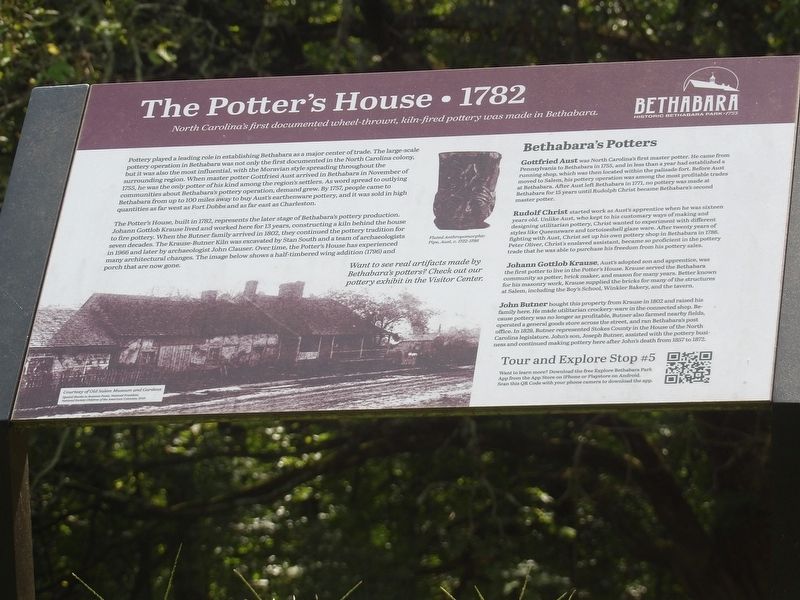
The Potter's House • 1782
North Carolina's first documented wheel-thrown, kiln-fired pottery was made in Bethabara.
Photographed by Duane and Tracy Marsteller, September 3, 2023
1. The Potter's House • 1782 Marker
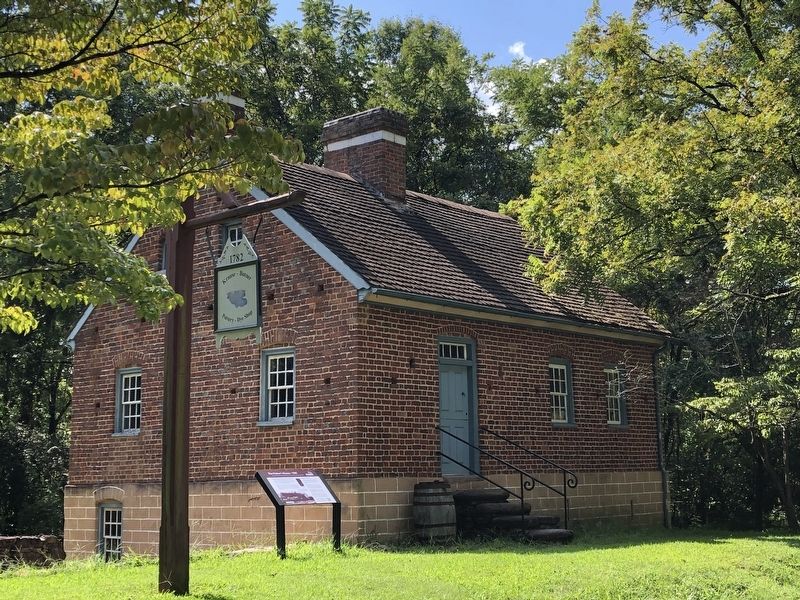
The Potter's House, built in 1782, represents the later stage of Bethabara's pottery production. Johann Gottlob Krause lived and worked here for 13 years, constructing a kiln behind the house to fire pottery. When the Butner family arrived in 1802, they continued the pottery tradition for seven decades. The Krause Butner Kiln was excavated by Stan South and a team of archaeologists in 1966 and later by archaeologist
this page online
Bethabara's Potters
Gottfried Aust was North Carolina first master potter. He came from Pennsylvania to Bethebara in 1755, and in less than a year had established a running shop, which was then located within the palisade fort. Before Aust moved to Salem, his pottery operation was among the most profitable trades at Bethabara. After Aust left Bethabera in 1771, no pottery was made at Bethabara for 15 years until Rudolph Christ became Bethabara's second master potter.
Rudolf Christ started work as Aust's apprentice when he was sixteen years old. Unlike Aust, who kept to his customary ways of making and designing utilitarian pottery, Christ wanted to experiment with different styles like Queensware and tortoisesbell glaze ware. After twenty years of fighting with Aust, Christ set up his own pottery shop in Bethabara in 1786. Peter Oliver, Christ's enslaved assistant, became so proficient in the pottery trade that he was able to purchase his freedom from his
Photographed by Duane and Tracy Marsteller, September 3, 2023
2. The Potter's House • 1782 Marker
Johann Gottlob Krause, Aust's adopted son and apprentice, was the first potter to live in the Potter's House. Krause served the Bethabara community as potter, brick maker, and mason for many years. Better known for his masonry work, Krause supplied the bricks for many of the structures at Salem, including the Boy's School, Winkler Bakery, and the tavern.
John Butner bought this property from Krause in 1800 and raised his family here. He made utilitarian crockery ware in the connected shop. Because pottery was no longer as profitable, Butner also farmed nearby fields, operated a general goods store across the street, and ran Bethabara's post office. In 1829 Butner represented Stokes County in the House of the North Carolina legislature. John's son, Joseph Butner, assisted with the pottery business and continued making pottery here after John's death from 1857 to 1872.
[Captions]
Bottom left: Courtesy of Old Salem Museum and Gardens Special thanks to Suzanne Panei, National President, National Society Children of the American Colonists, 2018
Top center: Fluted Anthropomorphic Pipe, Aust, c. 1722-1788.
Erected by Historic Bethabara Park, Inc. (Marker Number 5.)
Topics. This historical marker is listed in these topic lists: Arts, Letters, Music • Industry & Commerce. A significant historical month for this entry is November 1755.
Location. 36° 9.236′ N, 80° 17.737′ W. Marker is in Winston-Salem, North Carolina, in Forsyth County. It is in Oldtown. It is on Bethabara Road 0.1 miles north of Indiana Avenue/Old Town Road, on the left when traveling north. Touch for map. Marker is at or near this postal address: 2126 Bethabara Rd, Winston Salem NC 27106, United States of America. Touch for directions.

Regionally, this marker is in North Carolina’s Piedmont and specifically in Piedmont Triad. It is also in the American South and specifically in the Upper South. Globally, it is in North America, the Western Hemisphere, the Western World, and the Anglosphere. Historically, it finds itself in what was once the territory of the Mississippian Culture, one of the original Thirteen Colonies, one of the Confederate States of America, and the Antebellum South.
Other nearby markers. At least 8 other markers are within walking distance of this marker: Krause-Butner Pottery Shop (a few steps from this marker); The Dyer's and Potter's House 1782 (a few steps from this marker); The Distiller's House • 1802 (about 300 feet away, measured in a direct line); Herman Buttner House (about 300 feet away); Well 1807 (about 500 feet away); Wachovia Settlement (about 500 feet away); Memorial Marker 1806 (about 500 feet away); Gemeinhaus (about 500 feet away). Touch for a list and map of all markers in Winston-Salem.
Another marker is no longer nearby. Distiller's House 1803 (was about 300 feet away but has been confirmed missing).
Also see . . . The Potter's House. Built in 1782, the Potter’s House is the oldest brick house in Forsyth County. It was built by Johannes Schaub, the town’s dyer. (Historic Bethabara Park, Inc.) (Submitted on October 22, 2023, by Duane and Tracy Marsteller of Murfreesboro, Tennessee.)
Credits. This page was last revised on October 22, 2023. It was originally submitted on October 6, 2023, by Duane and Tracy Marsteller of Murfreesboro, Tennessee. This page has been viewed 375 times since then and 35 times this year. Photos: 1, 2. submitted on October 6, 2023, by Duane and Tracy Marsteller of Murfreesboro, Tennessee.
