Ravenswood in Chicago in Cook County, Illinois — The American Midwest (Great Lakes)
Carl Sandburg
Writer and Poet (1878-1967)
| — | Chicago Tribute | — |
Photographed by Sean Flynn
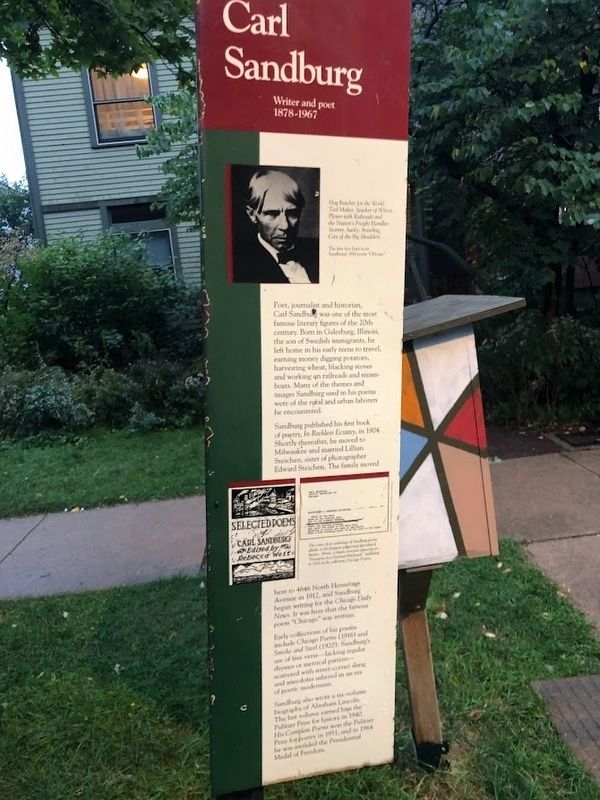
1. Carl Sandburg Marker
The first five lines from Sandburg's 1914 poem "Chicago"
Poet, journalist and historian, Carl Sandburg was one of the most famous literary figures of the 20th century. Born in Galesburg, Illinois, the son of Swedish immigrants, he left home in his early teens to travel, earning money digging potatoes, harvesting wheat, blacking stoves and working on railroads and steamboats. Many of the themes and images Sandburg used in his poems were of the rural and urban laborers he encountered.
Sandburg published his first book of poetry, In Reckless Ecstasy, in 1904. Shortly thereafter, he moved to Milwaukee and married Lillian Steichen, sister of photographer Edward Steichen. The family moved here to 4646 North Hermitage Avenue in 1912, and Sandburg began writing for the Chicago Daily News. It was here that the famous poem "Chicago" was written.
Early collections of his poems include Chicago Poems (1916) and Smoke and Steel (1920). Sandburg's use of free verse—lacking
this page online
Sandburg also wrote a six-volume biography of Abraham Lincoln. The last volume earned him the Pulitzer Prize for history in 1940. His Complete Poems won the Pulitzer Prize for poetry in 1951, and in 1964 he was awarded the Presidential Medal of Freedom.
[Caption with photos in the middle:] The cover of an anthology of Sandburg poems alludes to his frequent urban and agricultural themes. Above, a hand-corrected typescript for "Nocturne in a Deserted Brickyard," published in 1916 in the collection Chicago Poems.
Erected 1997 by City of Chicago.
Topics and series. This historical marker is listed in these topic lists: Agriculture • Arts, Letters, Music • Immigration • Railroads & Streetcars. In addition, it is included in the Chicago Tribute, and the Former U.S. Presidents: #16 Abraham Lincoln series lists. A significant historical year for this entry is 1912.
Location. 41° 57.996′ N, 87° 40.359′ W. Marker is in Chicago, Illinois, in Cook County. It is in Ravenswood. It is on North Hermitage
Photographed by Sean Flynn, October 13, 2023
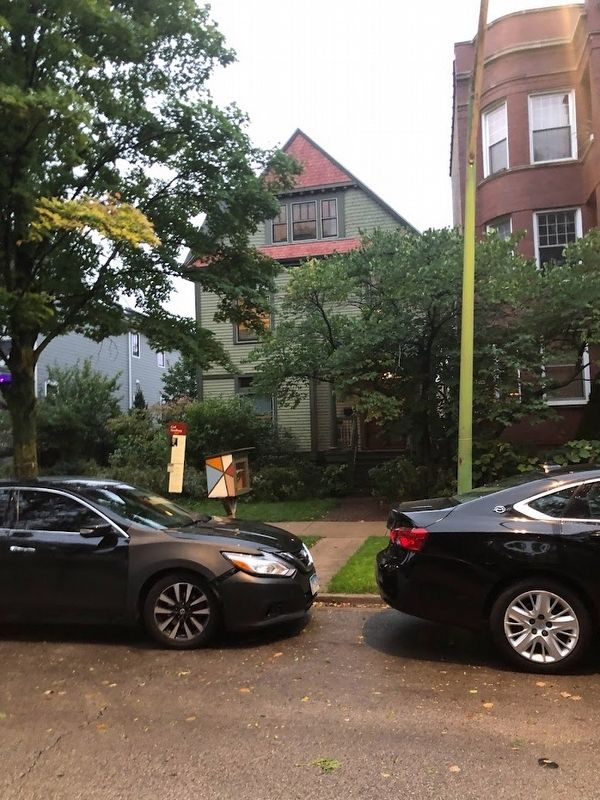
2. Carl Sandburg house and Chicago Tribute marker
Sandburg's house at 4646 N. Hermitage, in Chicago's Ravenswood neighborhood, was renovated in 2015.

Regionally, this marker is on Chicago’s North Side. It is also in the American Midwest. Globally, it is in North America, on the Great Lakes, in the Western Hemisphere, in the Western World, and in the Anglosphere. Historically, it finds itself in what was once the Viceroyalty of New France, the territory of the Mississippian Culture, and the Northwest Territory.
Other nearby markers. At least 8 other markers are within walking distance of this marker: First Telephone System (approx. 0.3 miles away); St. Boniface Union Soldiers Monument (approx. 0.4 miles away); St. Boniface Cemetery (approx. half a mile away); Essanay Studios (approx. 0.6 miles away); Andersonville (approx. 0.7 miles away); Andersonville School (approx. 0.7 miles away); Getty Tomb (approx. 0.7 miles away); Burnham Island Bridge (approx. 0.7 miles away). Touch for a list and map
Chicago Public Library, Sulzer Regional Library, Ravenswood Lake View Historical Collection
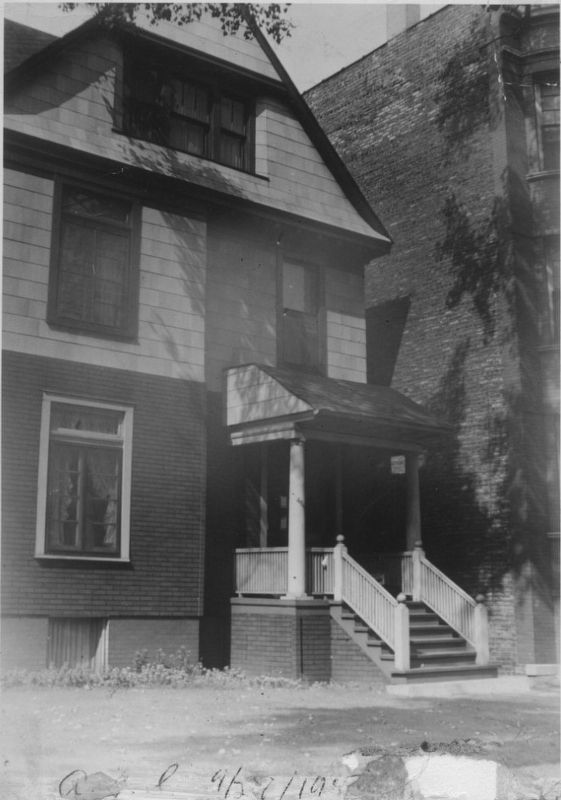
3. Carl Sandburg's Chicago home, historic photograph
A later photograph of the Sandburg home; the hand-written caption at the bottom indicates it could be from sometime in the 1950s.
More about this marker. The marker shows some signs of wear but is readable and in good shape.
Regarding Carl Sandburg. In 1912, Carl Sandburg and his wife Lillian rented an apartment in this three-story home at 4646 N. Hermitage on Chicago's north side. According to the house's Redfin listing, the 5,500-square-foot home was built in 1898 (a Chicago Landmark report from 2005 said 1886), has six bedrooms and 4½ baths, was renovated in 2015 and sold in July 2023 for $2.25 million.
Sandburg wrote his poem "Chicago" while living in this home. Later that year, Sandburg and his family left the city and bought a house that still stands today in the western suburb of Maywood, about 10½ miles southwest of this Hermitage Avenue home. The Sandburgs stayed in Maywood until 1919, when they moved farther west to the suburb of Elmhurst.
Also see . . .
1. Carl Sandburg House, Chicago Landmark Designation Report. A history of Carl Sandburg's life and the North Hermitage Avenue home he lived in for about two years starting in 1912. (Submitted on October 16, 2023, by Sean P. Flynn of Oak Park, Illinois.)
2. Carl Sandburg's Chicago.
Library of Congress, 1947
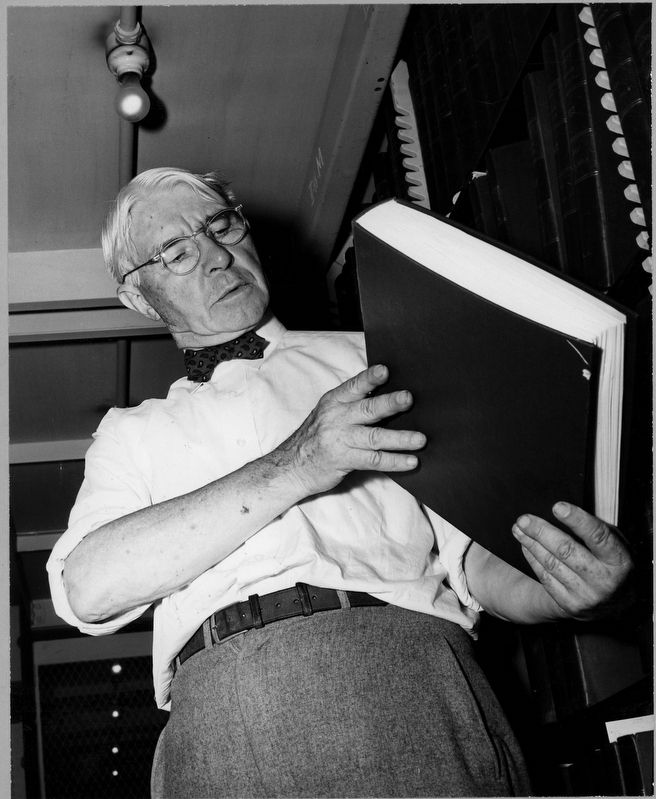
4. Carl Sandburg, circa 1947
Credits. This page was last revised on February 26, 2026. It was originally submitted on October 16, 2023, by Sean P. Flynn of Oak Park, Illinois. This page has been viewed 1,476 times since then and 103 times this year. Photos: 1, 2, 3, 4. submitted on October 16, 2023, by Sean P. Flynn of Oak Park, Illinois. • Andrew Ruppenstein was the editor who published this page.
