Near North Side in Chicago in Cook County, Illinois — The American Midwest (Great Lakes)
William Butler Ogden
Businessman (1805-1877)
| — | Chicago Tribute | — |
Photographed by Sean Flynn
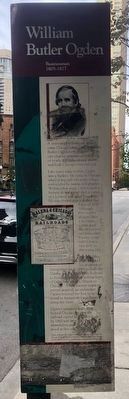
1. William Butler Ogden Marker
Like many early settlers, Ogden was a Yankee. He came to Chicago when it was still a frontier village surrounded by swamp and prairie. Within a few years, Ogden made a fortune in real estate and as owner of a brewery and other businesses. He was elected mayor during the Panic of 1837. Although the country plunged into a recession, Ogden kept the city solvent and persuaded Eastern investors to maintain faith in the young city.
Leaving office, Ogden turned his attention to transportation. In 1848 he built the Galena & Chicago Union Railroad to link the prosperous mining town of Galena in western Illinois to Chicago. When Eastern investors proved skeptical, an undeterred Ogden financed the line by selling shares to farmers and merchants along the route.
Ogden's energetic leadership helped Chicago become the railroad capital of the nation and led to the city's tremendous growth.
Erected 2002 by City of Chicago.
this page online
Topics and series. This historical marker is listed in this topic list: Settlements & Settlers. In addition, it is included in the Chicago Tribute series list. A significant historical year for this entry is 1837.
Location. 41° 53.604′ N, 87° 37.563′ W. Marker is in Chicago, Illinois, in Cook County. It is in the Near North Side. It is on Ontario Street west of Rush Street, on the right when traveling west. The marker is on a post a short distance from the entry to Trader Joe's. Touch for map. Marker is at or near this postal address: 50 East Ontario, Chicago IL 60611, United States of America. Touch for directions.

Regionally, this marker is in the American Midwest. Globally, it is in North America, on the Great Lakes, in the Western Hemisphere, in the Western World, and in the Anglosphere. Historically, it finds itself in what was once the Viceroyalty of New France, the territory of the Mississippian Culture, and the Northwest Territory.
Other nearby markers. At least 8 other markers are within walking distance of this marker: Hotel Cass (about 300 feet away, measured in a direct line); John B. Murphy Memorial (about 300

Courtesy of Chicago Historical Society
2. William Butler Ogden portrait
More about this marker. The marker is well-worn, with residue from stickers placed on it over the past 20 years making it hard to read in parts.
While it goes unsaid on this Chicago Tribute historical marker from 2002, Ogden is closely linked to this block on Chicago's near north side, not far from the Magnificent Mile. In 1836, Ogden built his home on four acres of land bounded by Wabash and Rush streets to the west and east, and Erie and Ontario streets to the north and south. Notable guests at his home included Ralph Waldo Emerson, Martin Van Buren and Daniel Webster. Ogden's home was destroyed in 1871 in the Great Chicago Fire.
Regarding William Butler Ogden. William B. Ogden was
Photographed by Sean Flynn, October 18, 2023
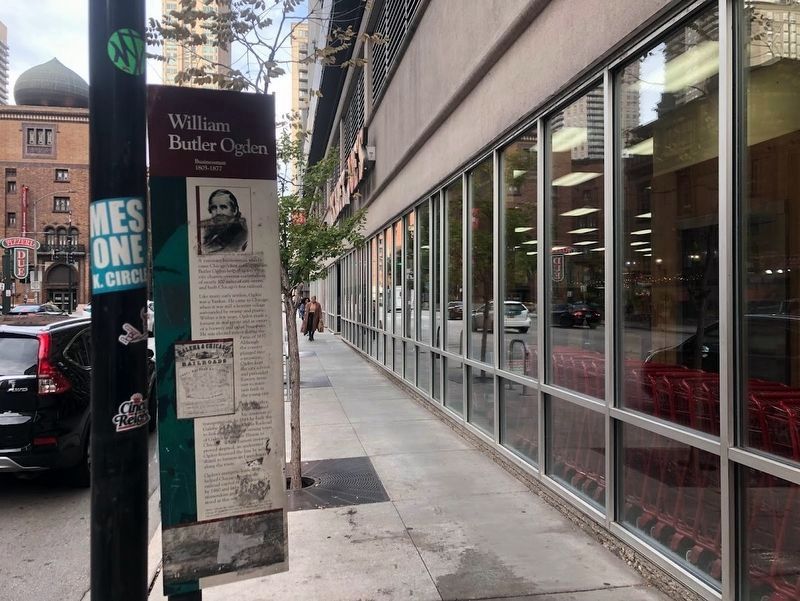
3. William Butler Ogden Marker
The entrance to Trader Joe's, west of this marker, is to the right in this photo. In the far background on the left of the photo is the landmark Medinah Temple, which in 2023 became the temporary home of the Bally's casino.
After selling some of that land for more than the original cost of the whole parcel, Ogden decided to move to Chicago to carry on his real estate career, resigning his position as a New York state senator. In 1837, when Chicago was chartered as a city, Ogden was elected as its first mayor.
Among Ogden's many notable contributions, including serving as first president of Union Pacific Railroad, Ogden was founder or co-founder of many Chicago-area institutions that still exist today, including Rush Medical College, Northwestern University and the Chicago Historical Society.
Ogden Avenue, which extends diagonally from Chicago's near west side about 40 miles west-southwest to Montgomery, Illinois, and includes a part of
Photographed by Sean Flynn
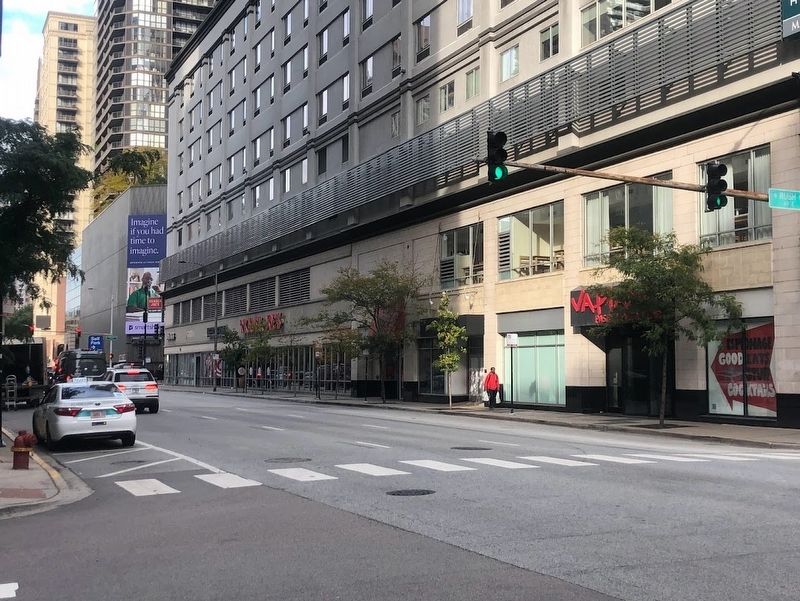
4. Ontario Street block with the Ogden marker
The marker is in the center of this photo but partially obscured.
Also see . . .
1. William Butler Ogden. Wikipedia entry (Submitted on March 4, 2026, by Larry Gertner of New York, New York.)
2. Chicago's First Mayor. WBEZ (Chicago Public Radio) looks at William Ogden's life in Chicago and his impact on the city's development. (Submitted on October 19, 2023, by Sean P. Flynn of Oak Park, Illinois.)
Credits. This page was last revised on March 4, 2026. It was originally submitted on October 19, 2023, by Sean P. Flynn of Oak Park, Illinois. This page has been viewed 787 times since then and 111 times this year. Photos: 1, 2, 3, 4. submitted on October 19, 2023, by Sean P. Flynn of Oak Park, Illinois. • Andrew Ruppenstein was the editor who published this page.
