River North in Chicago in Cook County, Illinois — The American Midwest (Great Lakes)
Chicago Varnish Company Building
Henry Ives Cobb, architect
1895
| — | Chicago Landmark | — |
Photographed by Sean Flynn
1. Chicago Varnish Company Building Marker
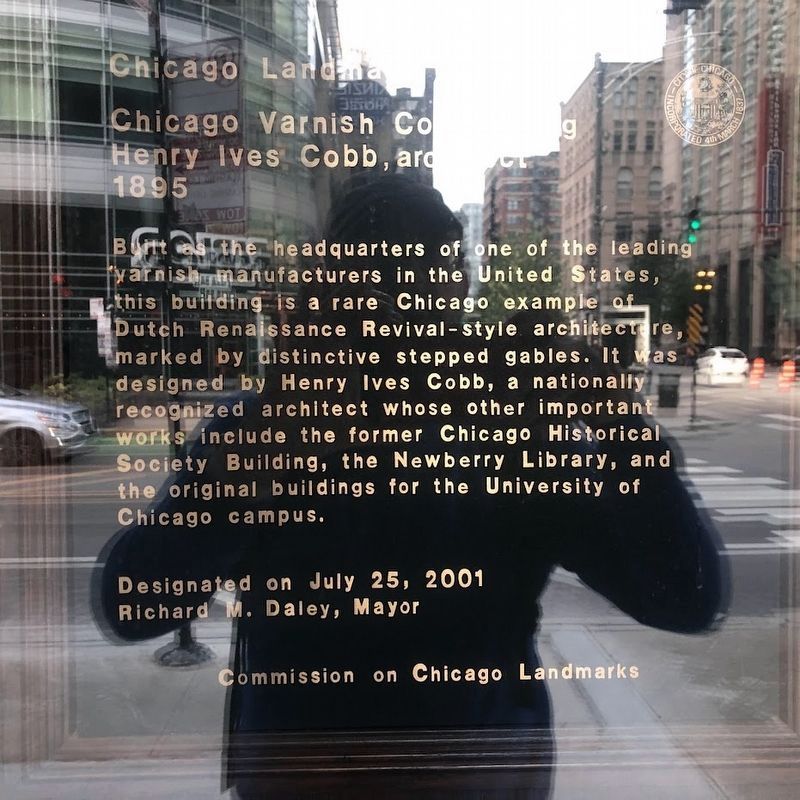
Built as the headquarters of one of the leading varnish manufacturers in the United States, this building is a rare Chicago example of Dutch Renaissance Revival-style architecture, marked by distinctive stepped gables. It was designed by Henry Ives Cobb, a nationally recognized architect whose other important works include the former Chicago Historical Society Building, the Newberry Library, and the original buildings for the University of Chicago campus.
Designated on July 25, 2001
Richard M. Daley, Mayor
Erected 2001 by Commission on Chicago Landmarks, City of Chicago.
Topics and series. This historical marker is listed in these topic lists: Architecture • Industry & Commerce • Landmarks. In addition, it is included in the Illinois, Chicago Landmarks Commission, and the National Register of Historic Places (NRHP) series lists. A significant historical year for this entry is 1895.
Location. 41° 53.348′ N, 87° 37.764′ W. Marker is in Chicago, Illinois, in Cook County. It is in River North. It is on West Kinzie Street near North Dearborn Street, on the right when traveling east. The marker, along with
this page online

Regionally, this marker is on Chicago’s North Side. It is also in the American Midwest. Globally, it is in North America, on the Great Lakes, in the Western Hemisphere, in the Western World, and in the Anglosphere. Historically, it finds itself in what was once the Viceroyalty of New France, the territory of the Mississippian Culture, and the Northwest Territory.
Other nearby markers. At least 8 other markers are within walking distance of this marker: Chicago Varnish Company Buliding (here, next to this marker); James C. "Jim" Tyree (about 400 feet away, measured in a direct line); Courthouse Plaza (about 400 feet away); Chicago's First Movable Bridge (about 400 feet away); Marina City (about 500 feet away); Trail Blazer (about 500 feet away); IBM Building (about 500 feet away); Bataan-Corregidor Memorial Bridge

Photographed by Sean Flynn, October 18, 2023
2. Chicago Varnish Company Building markers
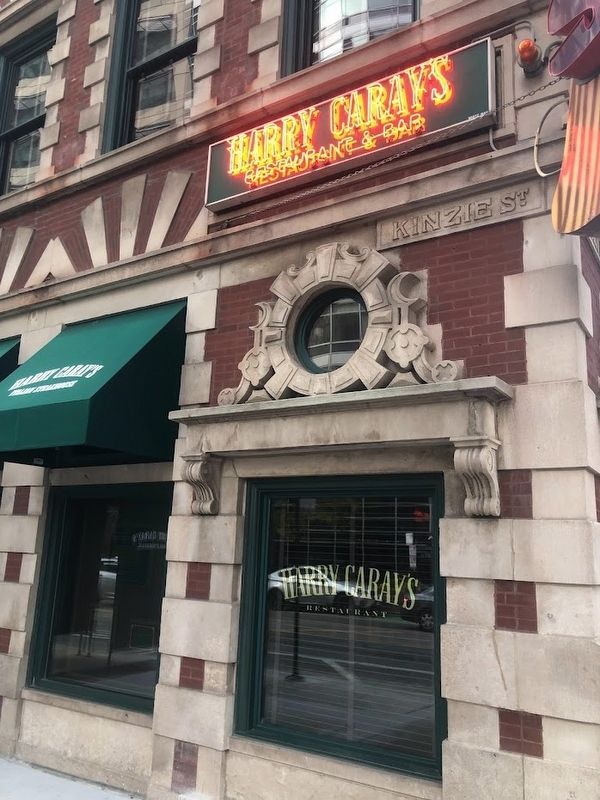
The Chicago Landmark tablet is above two others, one dedicated by the Landmarks Preservation Council of Illinois and another denoting the property as being on the National Register of Historic Places. The Landmarks Preservation Council tablet references the building's rare Dutch Revival style as well as the preservation easement for its facade.
Regarding Chicago Varnish Company Building. Harry Caray's Italian Steakhouse has occupied the building since 1987, when it was founded by its namesake, the famed baseball announcer for the Chicago Cubs, Chicago White Sox and St. Louis Cardinals.
Also see . . . Harry Caray’s: Landmark building was a mobster’s hideout, has secret rooms, is Chicago's block #1.
Chicago Tribune excerpt: "[T]his piece of land... was designated the city’s first block in 1830, seven years before it was incorporated as a city. The original owner was a man named Alexander Wolcott Jr., who had arrived here by canoe and became the area’s first doctor. He married Ellen Kinzie, the first non-Native American born here, daughter of settlers John and Eleanor Kinzie. More firsts? John Kinzie committed the first murder here in 1812 when he stabbed to death an unfortunate fellow named Jean La Lime. The Wolcott-Kinzie union was the first marriage in Chicago. The property was later purchased by William B. Ogden, the city’s first mayor and owner of the city’s first brewery. The building(Submitted on October 19, 2023, by Sean P. Flynn of Oak Park, Illinois.)there later housed the law offices of lawyer Grant Goodrich, who practiced with Abraham Lincoln, co-founded Northwestern University and was an ardent advocate for the temperance movement.Photographed by Sean Flynn3. Harry Caray'sThe tablets are behind the window on the left.
Additional keywords. harry caray's chicago
Photographed by Sean Flynn, October 18, 2023
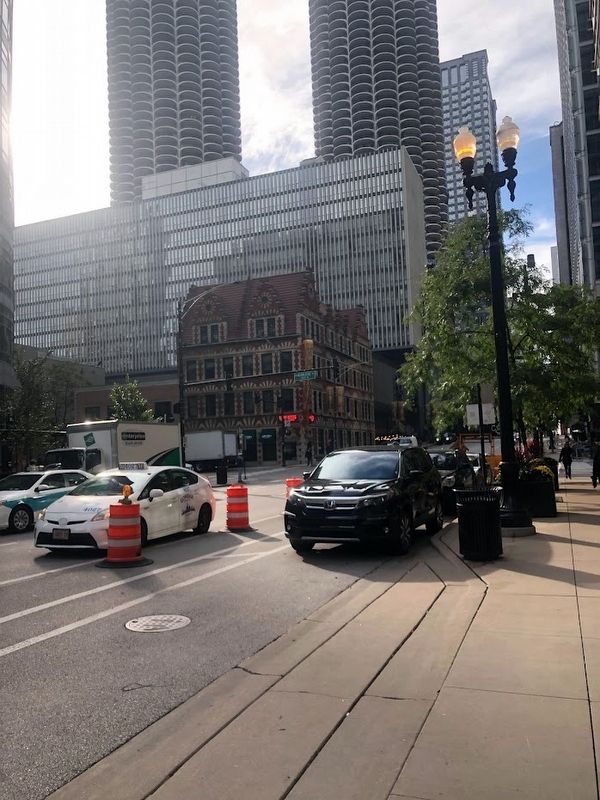
4. Chicago Varnish Company Building (Kinzie and Dearborn streets)
Directly behind the Chicago Varnish Company Building is the Marina City complex, which includes the Chicago Hotel in the rectangular building and the two towers in the background.
Photographed by Sean Flynn, October 18, 2023
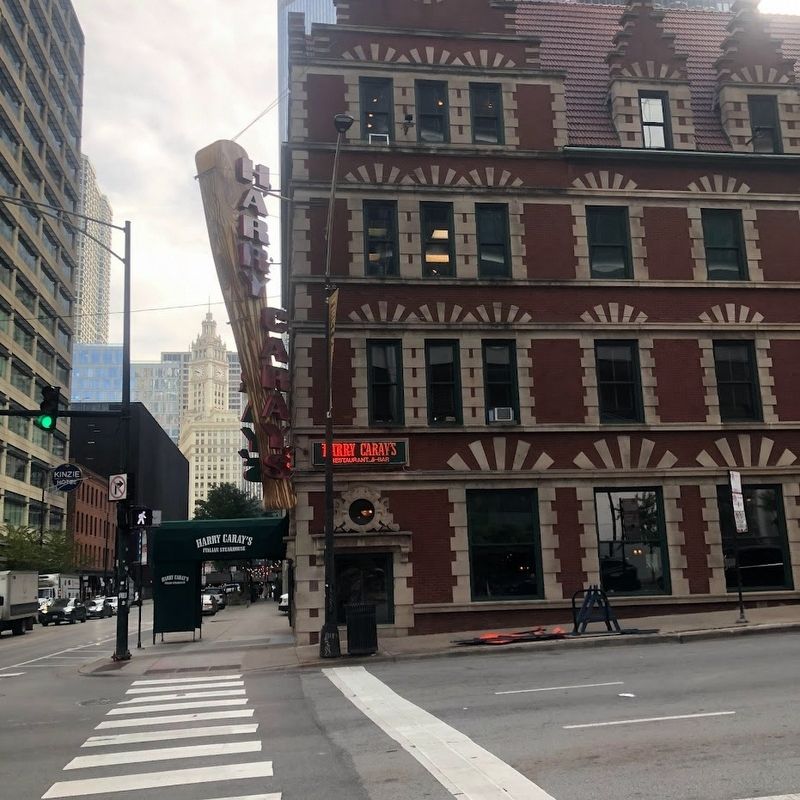
5. Chicago Varnish Company Building (Harry Caray's Italian Steakhouse)
The Wrigley Building can be seen in the far background.
Credits. This page was last revised on December 19, 2025. It was originally submitted on October 19, 2023, by Sean P. Flynn of Oak Park, Illinois. This page has been viewed 547 times since then and 72 times this year. Photos: 1, 2, 3, 4, 5. submitted on October 19, 2023, by Sean P. Flynn of Oak Park, Illinois. • Devry Becker Jones was the editor who published this page.
