Lakeview in Chicago in Cook County, Illinois — The American Midwest (Great Lakes)
Harry Caray
“Let me hear ya… a one… a two… a three…”
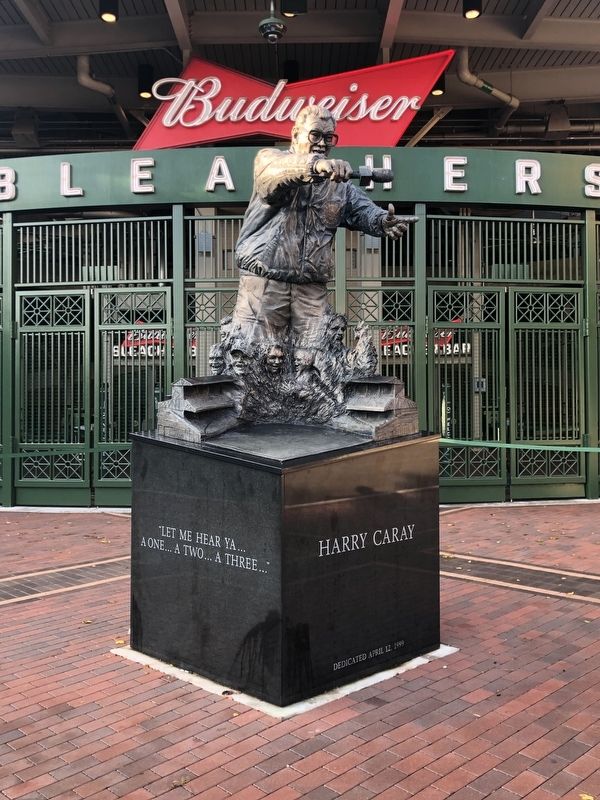
Photographed by Sean Flynn, November 4, 2023
1. Harry Caray Marker
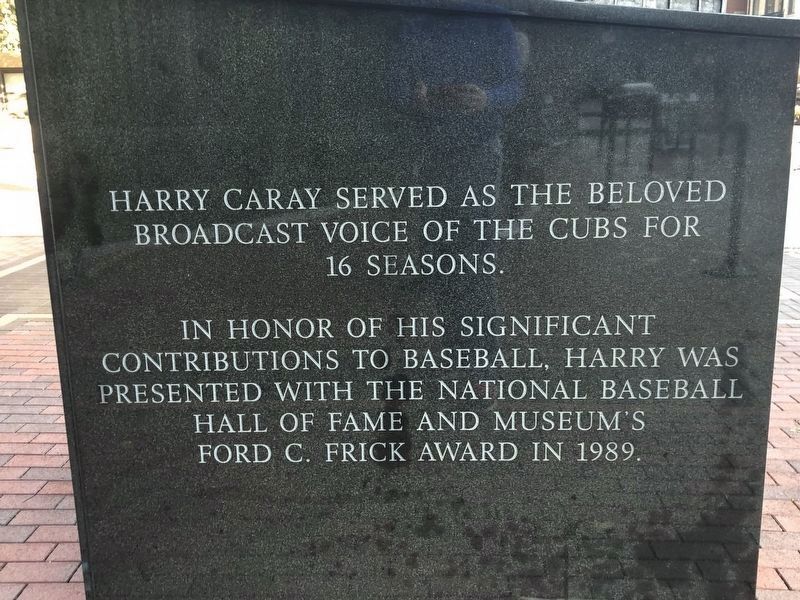
Harry Caray served as the beloved broadcast voice of the Cubs for 16 seasons.
In honor of his significant contributions to baseball, Harry was presented with the National Baseball Hall of Fame and Museum's Ford C. Frick Award in 1989.
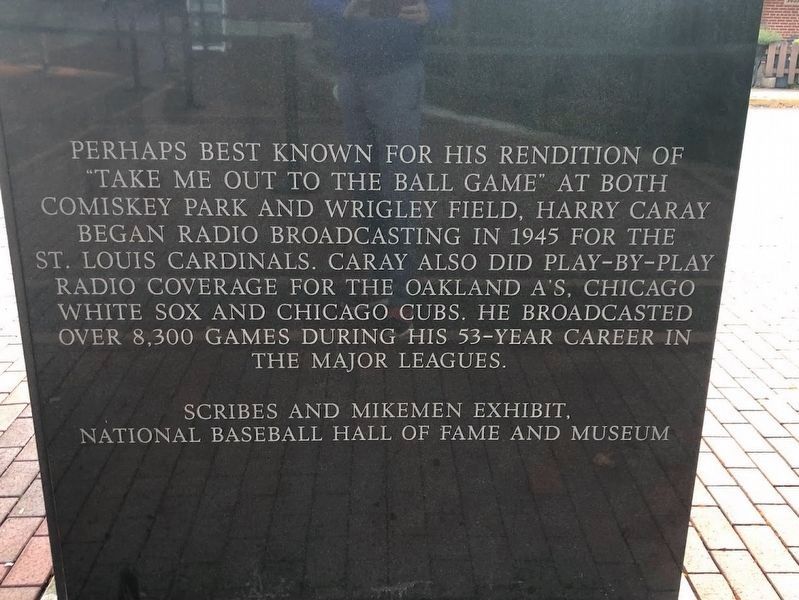
[West-facing panel:]
Perhaps best known for his rendition of "Take Me Out to the Ball Game" at both Comiskey Park and Wrigley Field, Harry Caray began radio broadcasting in 1945 for the St. Louis Cardinals. Caray also did play-by-play radio coverage for the Oakland A's, Chicago White Sox and Chicago Cubs. He broadcasted over 8,300 games during his 53-year career in the Major Leagues.
Scribes and Mikemen Exhibit, National Baseball Hall of Fame and Museum
Erected 1999 by Chicago Cubs.
Topics and series. This historical marker is listed in these topic lists: Communications • Sports. In addition, it is included in the Baseball Hall of Famers series list. A significant historical year for this entry is 1989.
Location. 41° 56.939′ N, 87° 39.269′ W. Marker is in Chicago, Illinois, in Cook County. It is in Lakeview. It is at the intersection of Sheffield
this page online

Regionally, this marker is on Chicago’s North Side. It is also in the American Midwest. Globally, it is in North America, on the Great Lakes, in the Western Hemisphere, in the Western World, and in the Anglosphere. Historically, it finds itself in what was once the Viceroyalty of New France, the territory of the Mississippian Culture, and the Northwest Territory.
Other nearby markers. At least 8 other markers are within walking distance of this marker: Into the Cubs Archives (a few steps from this marker); Ryne Sandberg (about 700 feet away, measured in a direct line); Ron Santo (about 700 feet away); "Sweet-Swinging" Billy Williams (about 700 feet away); Ernie Banks, "Mr. Cub" (about 700 feet away); Wrigley Field (about 800 feet away); Ferguson Jenkins (about 800 feet away); a different
Photographed by Sean Flynn, November 4, 2023
2. Harry Caray Statue, south-facing panel
More about this marker. The Harry Caray statue was first located near the third-base entrance into Wrigley Field, near the intersection of Addison and Sheffield, before being relocated to this spot in 2010.
Artist Omri Amrany completed this statue with Lou Cella in 1999. Amrany along with his wife and business partner Julie are responsible for several other famous sports artworks in Chicago, including the "Championship Moments" sculpture in front of Guaranteed Rate Field (home of the White Sox) and the Michael Jordan statue that sits in front of the United Center, home of the NBA's Chicago Bulls.
Regarding Harry Caray. By the time Harry Caray arrived on the North Side of Chicago in 1982 to be the Cubs’ lead announcer (calling the first and last three innings on WGN-TV and the middle three on WGN-720 AM radio), he was 68 years old and had been announcing games for almost 40 seasons, first for the Cubs’ most hated rivals, his hometown St. Louis Cardinals, and then (after one year with the Oakland A’s), for more than a
Photographed by Sean Flynn, November 4, 2023
3. Harry Caray Statue, west-facing panel
In 1981, the Sox were sold to new owners who planned to broadcast games locally on pay cable, a move that Caray opposed. The Sox—whose feathers were often ruffled by Caray's boisterous personality and his criticism of the team when it wasn't playing well—allowed him to move to the Cubs, where games were broadcast free locally on WGN (channel 9) and also available on cable around the country. As the Cubs became nationally popular—and fielded some of their best teams in decades—Caray became a beloved figure in Wrigleyville and beyond. Carrying over a tradition he started with the White Sox, he led the crowd in the 7th inning stretch from the broadcast booth at every game. He also called the occasional game from the bleachers (above where his statue sits today). And he was a famous salesman of Budweiser beer (dating to his days with the Cardinals, owned by the Busch family);
Photographed by Sean Flynn, November 4, 2023
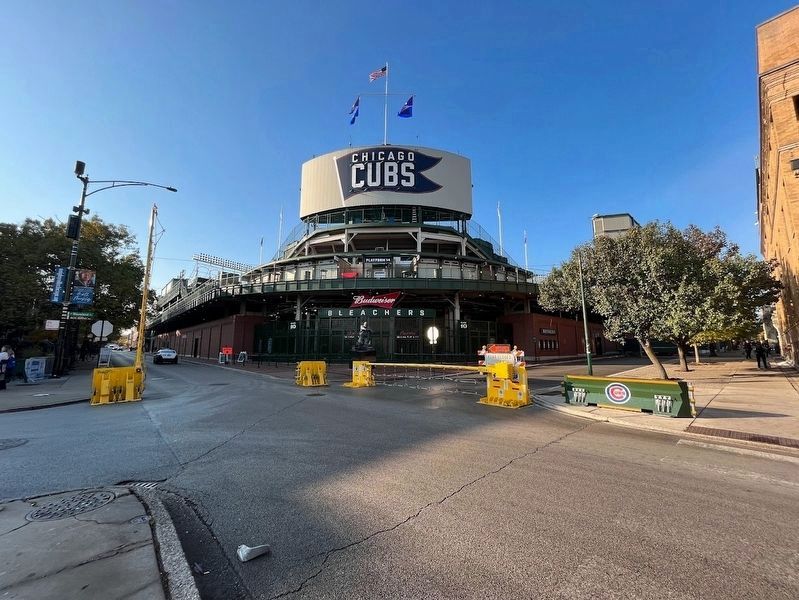
4. The Wrigley Field bleachers
The bleachers entrance and Harry Caray Statue, at the corner of Waveland and Sheffield avenues. The Chicago Cubs flag, which lights up at night in neon, is the rear of the stadium's famed manual scoreboard. On this November morning (when, incidentally, a Northwestern-Iowa college football game was to be played at Wrigley Field), the wind was blowing out to right field.
Also see . . .
1. Harry Caray sings "Take Me Out to the Ballgame". On September 21, 1997, in the final Cubs home game he would broadcast from Wrigley Field before his death, Harry Caray leads the crowd in the 7th inning stretch. (Submitted on November 5, 2023, by Sean P. Flynn of Oak Park, Illinois.)
2. Harry Caray biography (Society of American Baseball Research).
Excerpt: “'The taxi driver, the bartender, the waitress, the man in the street, those are my people,' Harry Caray once said. Caray was a larger-than-life figure who loved the game and broadcast it with enthusiasm."(Submitted on November 5, 2023, by Sean P. Flynn of Oak Park, Illinois.)
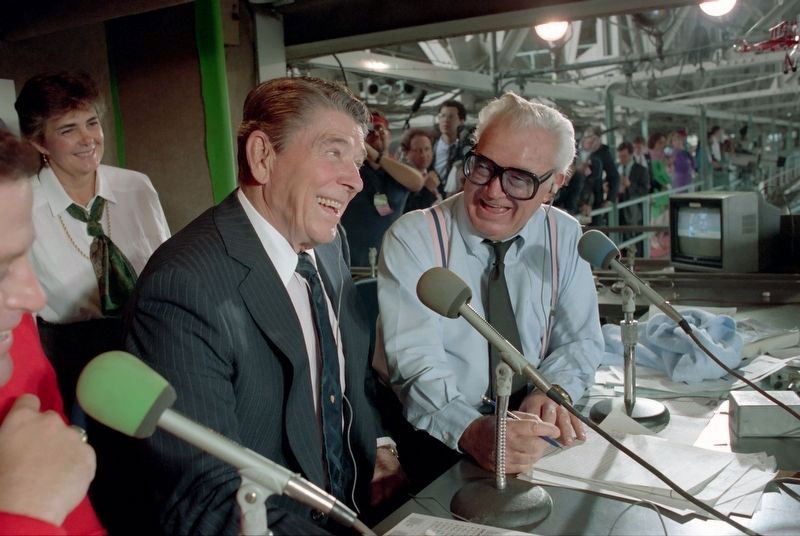
Reagan White House Photographs, National Archives, September 30, 1988
5. Harry Caray with President Reagan
Ronald Reagan visited the WGN-TV booth at Wrigley Field at the end of his term, and called a few innings with Cubs announcer Harry Caray and his partner Steve Stone. "You know in a few months I'm going to be out of work and I thought I might as well audition," Reagan said.
Credits. This page was last revised on September 25, 2025. It was originally submitted on November 5, 2023, by Sean P. Flynn of Oak Park, Illinois. This page has been viewed 1,087 times since then and 201 times this year. Photos: 1, 2, 3, 4. submitted on November 5, 2023, by Sean P. Flynn of Oak Park, Illinois. 5. submitted on September 25, 2025, by Sean P. Flynn of Oak Park, Illinois. • Andrew Ruppenstein was the editor who published this page.
