Farnham in Richmond County, Virginia — The American South (Mid-Atlantic)
Northern Neck Industrial Academy
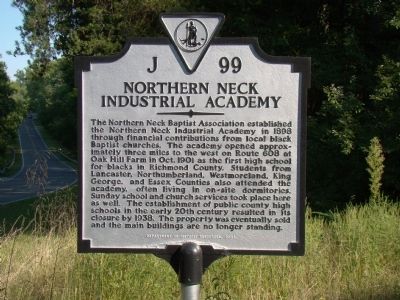
Photographed by J. J. Prats, September 5, 2009
1. Northern Neck Industrial Academy Marker
Erected 2004 by Department of Historic Resources. (Marker Number J-99.)
Topics and series. This historical marker is listed in these topic lists: African Americans • Education. In addition, it is included in the Virginia Department of Historic Resources (DHR) series list. A significant historical year for this entry is 1898.
Location. 37° 51.366′ N, 76° 36.801′ W. Marker is in Farnham, Virginia, in Richmond County.
this page online

Regionally, this marker is on the Northern Neck. It is also in the American South, specifically in the Upper South, in the Tidewater, in the Chesapeake Bay Region, and on the Eastern Seaboard. Globally, it is in the North Atlantic Region, North America, the Western Hemisphere, the Western World, and the Anglosphere. Historically, it finds itself in what was once the territory of the Mississippian Culture, one of the original Thirteen Colonies, one of the Confederate States of America, and the Antebellum South.
Other nearby markers. At least 8 other markers are within 6 miles of this marker, measured as the crow flies: Cyrus Griffin’s Birthplace (here, next to this marker); North Farnham Church (approx. 2.2 miles away); Captain Vincent Shackleford (approx. 2.2 miles away); Lancaster County / Richmond County (approx. 2.7 miles away); Veterans Memorial
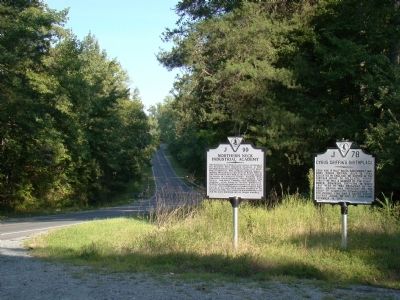
Photographed by J. J. Prats, September 5, 2009
2. This Marker is on the Left
Also see . . . Between Church and State: Religion and Public Education in a Multicultural America. 1999 book by James W. Fraser. “[Lester F.] Russell has indicated one of the reasons for the strong support for church-based schooling in the black community: ‘The impetus on the part of the Black Baptist churches towards education was based on the desire of the leaders to refute the belief generally held that blacks were incapable of the mental development known to whites.’ Thus, education of the black rate was both a test and a challenge to black ministers. But proving black intellectual equality to the white world was only a part of the story. As [James] Anderson and others have convincingly demonstrated, literacy for its own sake was deeply important in the black community. [Evelyn Brooks] Higginbotham sums up: ‘There was little doubt in their minds that education stood second only to religion in enabling their survival and salvation in America.’ And in the hardest of times, before and after emancipation, the two were linked: black-controlled and black-taught schools were embedded within the black church.” (Submitted on October 24, 2009.)
Credits. This page was last revised on November 3, 2024. It was originally submitted on October 24, 2009, by J. J. Prats of Powell, Ohio. This page has been viewed 1,524 times since then and 44 times this year. Photos: 1, 2. submitted on October 24, 2009, by J. J. Prats of Powell, Ohio.
