East Side in Chicago in Cook County, Illinois — The American Midwest (Great Lakes)
Illinois-Indiana Boundary Marker
Photographed by Sean Flynn, December 16, 2023
1. Illinois-Indiana Boundary Marker
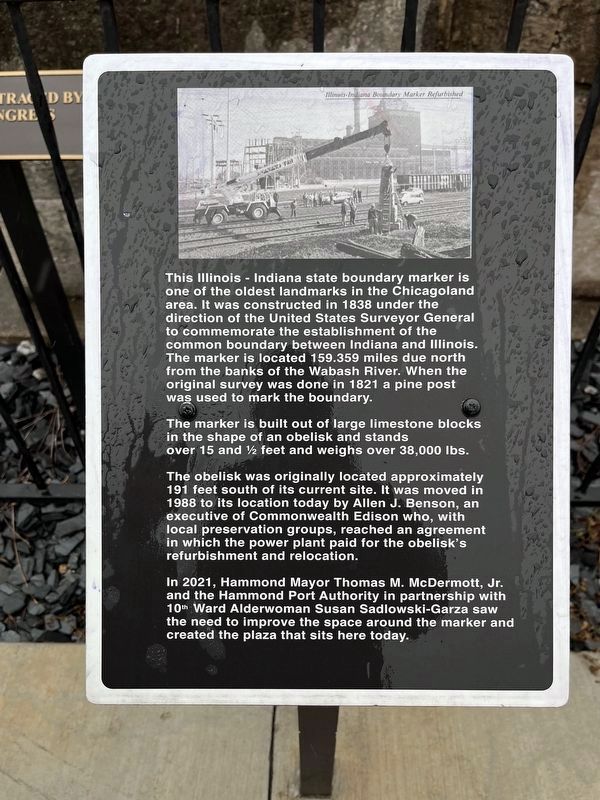
This Illinois - Indiana state boundary marker is one of the oldest landmarks in the Chicagoland area. It was constructed in 1838 under the direction of the United States Surveyor General to commemorate the establishment of the common boundary between Indiana and Illinois. The marker is located 159.359 miles due north from the banks of the Wabash River. When the original survey was done in 1821 a pine post was used to mark the boundary.
The marker is built out of large limestone blocks in the shape of an obelisk and stands over 15 and ½ feet and weighs over 38,000 lbs.
The obelisk was originally located approximately 191 feet south of its current site. It was moved in 1988 to its location today by Allen J. Benson, an executive of Commonwealth Edison who, with local preservation groups,
this page online
In 2021, Hammond Mayor Thomas M. McDermott, Jr. and the Hammond Port Authority in partnership with 10th Ward Alderwoman Susan Sadlowski-Garza saw the need to improve the space around the marker and created the plaza that sits here today.
Erected 2021.
Topics and series. This historical marker is listed in these topic lists: Arts, Letters, Music • Landmarks • Political Subdivisions. In addition, it is included in the Chicago's Surviving Pre-Fire Structures series list. A significant historical year for this entry is 1838.
Location. 41° 42.47′ N, 87° 31.47′ W. Marker is in Chicago, Illinois, in Cook County. It is in the East Side. It is on Avenue G 0.6 miles east of East 100th Street. The marker

Photographed by Sean Flynn, December 16, 2023
2. Illinois-Indiana Boundary Marker
A small marker denoting this as Allen Benson Plaza is in front of the obelisk. The brick pavers identify the border between Illinois (on the right) and Indiana (on the left).

Regionally, this marker is on Chicago’s South Side and in the Calumet Region. It is also in the American Midwest. Globally, it is in North America, on the Great Lakes, in the Western Hemisphere, in the Western World, and in the Anglosphere. Historically, it finds itself in what was once the Viceroyalty of New France, the territory of the Mississippian Culture, and the Northwest Territory.
Other nearby markers. At least 8 other markers are within 2 miles of this marker,
Photographed by Sean Flynn, December 16, 2023
3. Illinois-Indiana Boundary Marker
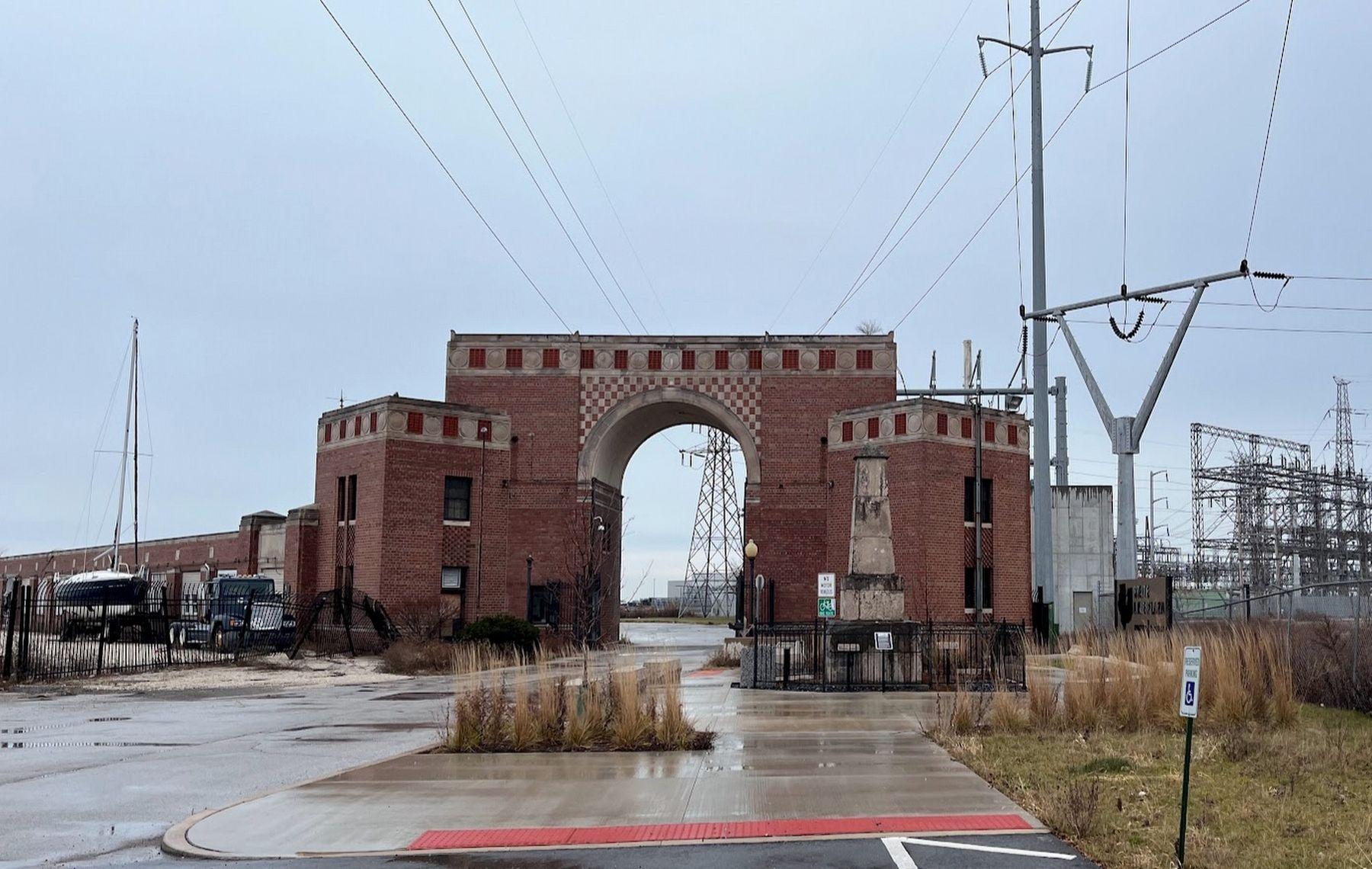
In this view from the Illinois side of the border, the boundary marker stands in front of the building that was once the entryway into the now-demolished State Line Generating Station in Hammond, Indiana.
More about this marker. The rectangular marker sits in front of a limestone obelisk that was dedicated in 1838 by the U.S. Surveyor's Office to honor the designation of the border between Illinois and Indiana. Straddling the border between the two states, the obelisk
Photographed by Sean Flynn, December 16, 2023
4. Illinois-Indiana Boundary Marker
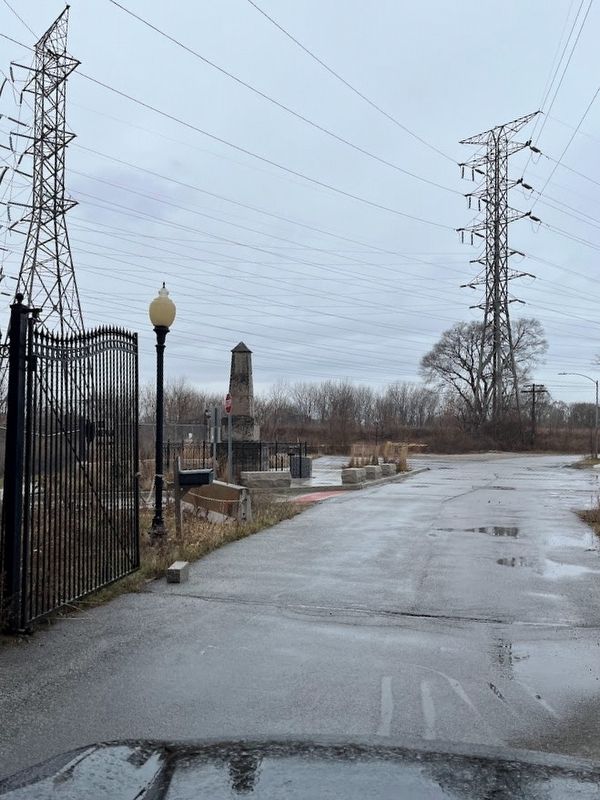
A photo from the Indiana side of the border, taken underneath the entry into the site of the old power plant.
The obelisk is believed to have originally been engraved with an inscription when erected in 1838, but those engravings (if they existed) are completely worn away.
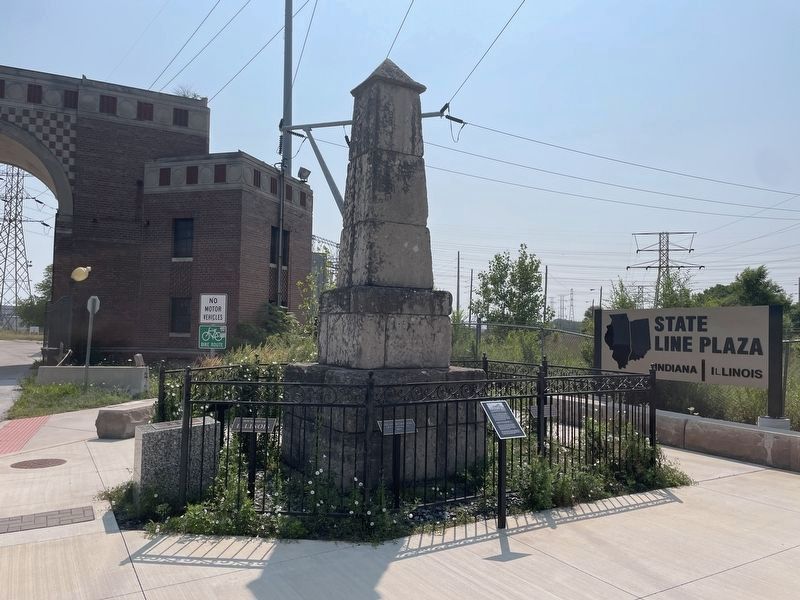
As of the summer of 2024, the obelisk is surrounded by a wrought-iron fence, with brick pavers outlining the border between Indiana and Illinois for a few yards north and south of it; the south pavers lead to a sign describing the small park as State Line Plaza.
Today the memorial
Photographed by Sean Flynn, December 16, 2023
5. Illinois-Indiana Boundary Marker plaque
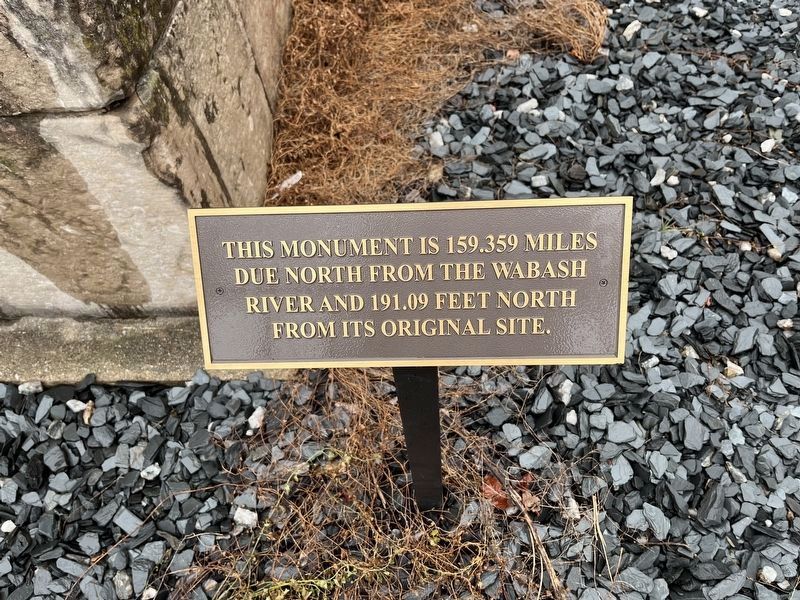
This plaque, next to the obelisk on the Illinois side, states: “This monument is 159.359 miles due north from the Wabash River and 191.09 feet north from its original site.”
The small park was created in 1988, when preservationists from Chicago's East Side neighborhood worked
Photographed by Sean Flynn, December 16, 2023
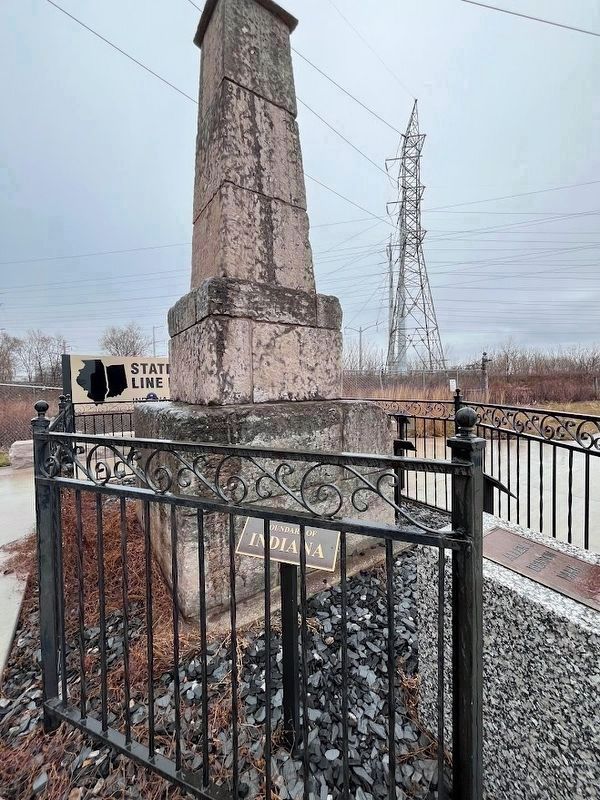
6. Illinois-Indiana Boundary Marker
In this photo taken a few steps into Indiana from Illinois, the "Boundary of Indiana" plaque is seen near the obelisk and the State Line Plaza sign is visible in the background.
Although the directions on Google Maps suggested otherwise, when this site was visited in December 2023 there appeared to be no way for the general public to access the site by automobile from Indiana. A data center occupies some of the land that once housed the State Line Generating Plant, and while it

Norah Jones; Courtesy of the Commission on Chicago Landmarks, circa 2001
7. Illinois-Indiana Boundary Marker (2001 photo)
In this circa-2001 photo of the boundary marker, the old State Line Generating Plant can be seen beyond its gatehouse. The plant was torn down in 2014.
Regarding Illinois-Indiana Boundary Marker. After the Northwest Territory was established in 1787, over the next decades it was subdivided into the state borders we know today as Ohio, Michigan, Indiana, Illinois, Wisconsin and part of Minnesota. When Illinois was awarded its own territorial government in 1809, the northern portion of its eastern border with Indiana was established as a north-south line that connected Lake Michigan with the Wabash River, with the Wabash southward forming

Photographed by Sean P. Flynn, July 27, 2024
8. Illinois-Indiana Boundary Marker with graffiti, circa 1970s
This photo, likely from the 1970s or 1980s, shows the marker graffitied with the words "East Side,” a reference to the Chicago neighborhood that abuts Illinois’s border with Indiana. The photo is on display at the Southeast Chicago Historical Museum, which is located inside Calumet Park Fieldhouse, about ¾ of a mile northwest of the boundary marker. The caption says:The Old Stateline Marker
This obelisk marked the Indiana-Illinois border. It was located behind the Commonwealth Edison plant near Calumet Park. It obviously marked a boundary of the East Side as well. (Daily Calumet Collection, 81-143-10).
Indiana was admitted as a state in 1816 and Illinois was admitted in 1818, and soon thereafter, the border was surveyed. In 1833, Congress ordered a new survey to firmly confirm this border. The straight line for the northern portion of the border was set at 87 degrees 30 minutes west longitude, and ran for 159.359 miles from Lake Michigan to a spot on the Wabash that is about 10 miles southeast of Terre Haute, Indiana. The Wabash forms the rest of Illinois' border with Indiana, until it reaches the Ohio River, which serves as a border between Illinois and Kentucky.
A pine post was originally set at the border's junction with Lake Michigan. In 1838, to commemorate this firmly defined border, an obelisk was erected at a spot that was, at that time, just
Photographed by Nathan Bierma, August 3, 2025
9. Illinois-Indiana Boundary Marker at State Line Plaza
A local historical group from Chicago's East Side neighborhood worked with Commonwealth Edison, which owned the land, to fund the restoration of the damaged obelisk and move it to a safer, more easily accessible spot next to the roadway for the coal-fired State
Photographed by Nathan Bierma, August 3, 2025
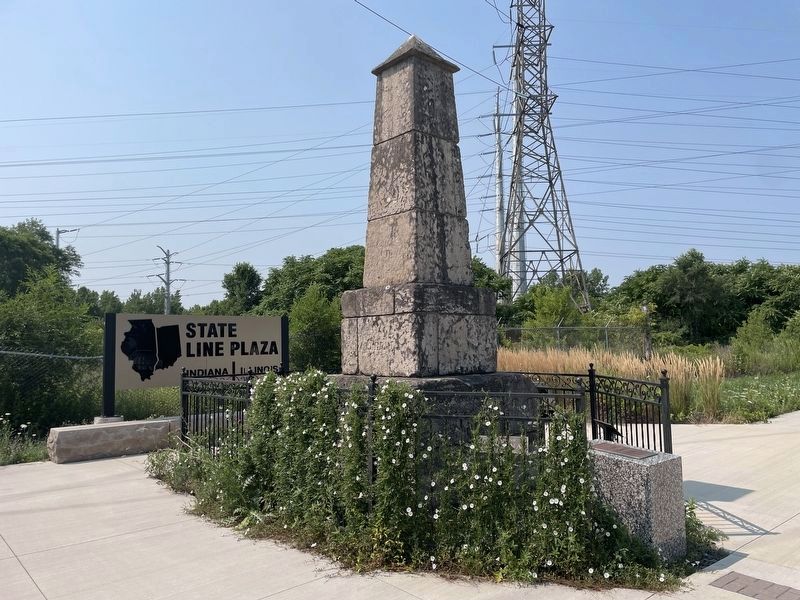
10. Illinois-Indiana Boundary Marker at State Line Plaza
However, when that power plant closed in 2012 and was demolished in 2014, it left the boundary monument once again with an uncertain future. For one thing, straddling two state jurisdictions and sitting on private property, it wasn't entirely clear who was in charge of it. And with the guardhouse no longer providing security, three of the four plaques were nabbed by scavengers within a year.
However, efforts to redevelop the power plant site had some success, bringing activity back to that area. And then in 2021, the cities of Chicago and Hammond agreed to add signage to the area around the obelisk, to bring it to its current state.
The obelisk is actually one of two commemorating the straight-line portion of the

Photographed by Nathan Bierma, August 3, 2025
11. Illinois-Indiana Boundary Marker
A close-up of the obelisk shows that text from the original 1838 inscription is visible but not legible.
Also see . . .
1. Chicago Tribune obituary: Allen J. Benson, East Side Advocate. Allen Benson, after whom the border marker plaza is named, died in 1987, just prior to the relocation of this marker. His grandfather and father worked in East Side factories and he was president of that neighborhood's Chamber of Commerce. (Submitted on December 17, 2023, by Sean P. Flynn of Oak Park, Illinois.)
2. Chicago Landmarks: Illinois-Indiana State Line Boundary Marker. The City of Chicago website page for this Chicago landmark, including some circa 2001 photos of the current marker location as it appeared before the State Line power plant was demolished. (Submitted on December 18, 2023, by Sean P. Flynn of Oak Park, Illinois.)
3. Illinois History Primer: A Note on the Boundaries of Illinois. (Submitted on December 19, 2023, by Sean P. Flynn of Oak Park, Illinois.)
4. Law taking effect July 1 has Indiana possibly acquiring parts of Illinois. The Indiana-Illinois border was in the news in 2025 when Indiana lawmakers proposed trying to acquire parts of downstate Illinois that may want to secede. (Submitted on August 26, 2025, by Sean P. Flynn of Oak Park, Illinois.)
Additional commentary.
1. About the boundary marker
The obelisk itself is believed to have been engraved with an inscription. However, that inscription has almost completely eroded after 185 years, with the evidence of etched words visible upon a close look. The text in the Inscription for this post is from a small plaque that was posted in 2021 on the Illinois (west) side of the border.
— Submitted December 24, 2023, by Sean P. Flynn of Oak Park, Illinois.
Credits. This page was last revised on March 12, 2026. It was originally submitted on December 16, 2023, by Sean P. Flynn of Oak Park, Illinois. This page has been viewed 58,141 times since then and 449 times this year. Photos: 1, 2, 3. submitted on December 16, 2023, by Sean P. Flynn of Oak Park, Illinois. 4. submitted on December 17, 2023, by Sean P. Flynn of Oak Park, Illinois. 5. submitted on December 16, 2023, by Sean P. Flynn of Oak Park, Illinois. 6. submitted on December 17, 2023, by Sean P. Flynn of Oak Park, Illinois. 7, 8. submitted on July 10, 2025, by Sean P. Flynn of Oak Park, Illinois. 9, 10, 11. submitted on August 4, 2025, by Nathan Bierma of Grand Rapids, Michigan. • Devry Becker Jones was the editor who published this page.
