Oakville in Halton Region, Ontario — Central Canada (North America)
Oakville’s Meeting Hall
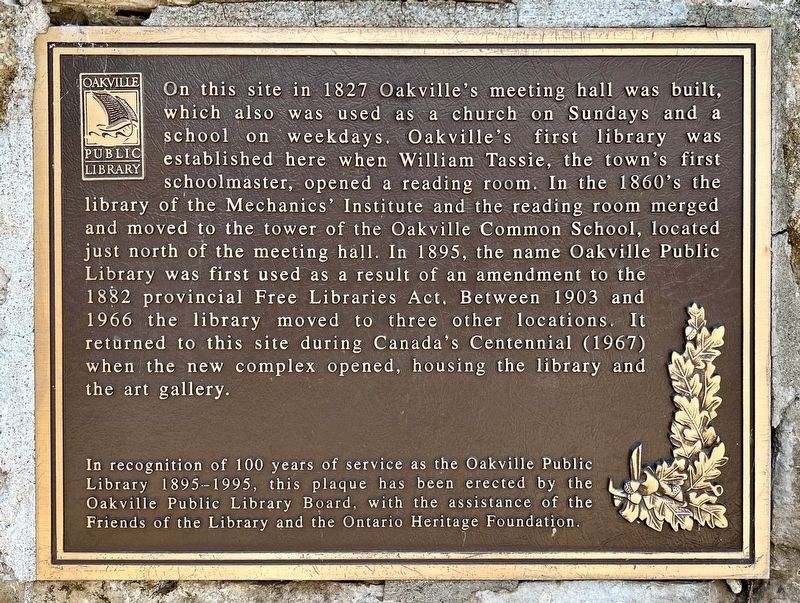
Photographed by Tim Boyd, November 30, 2023
1. Oakville’s Meeting Hall Marker
In recognition of 100 years of service as the Oakville Public Library 1895-1995, this plaque has been erected by the Oakville Public Library Board, with the assistance of the Friends of the Library and the Ontario Heritage Foundation.
Erected 1995 by The Oakville Public Library Board.
Topics. This historical marker is listed in these topic lists: Education • Settlements & Settlers. A significant historical year for this entry is 1827.
Location. 43° 26.661′ N,
this page online

Regionally, this marker is in Greater Toronto, specifically on the Golden Horseshoe, in the Hamilton-Halton-Brant Area, and specifically in the Toronto Metropolitan Area. It is also in Central Canada. Globally, it is in North America, on the Great Lakes, in the Western Hemisphere, in the Western World, and in the Anglosphere. Historically, it finds itself in what was once a British colony, the Viceroyalty of New France, the Haudenosaunee (Iroquois) Confederacy, and Rupert’s Land.
Other nearby markers. At least 8 other markers are within walking distance of this marker: Early Contact Period (1610-1700) (about 180 meters away, measured in a direct line); The Mississauga People (about 180 meters away); The Treaty Period (1801-1847) (about 180 meters away); The First Horticultural People (AD 500 to 1610)
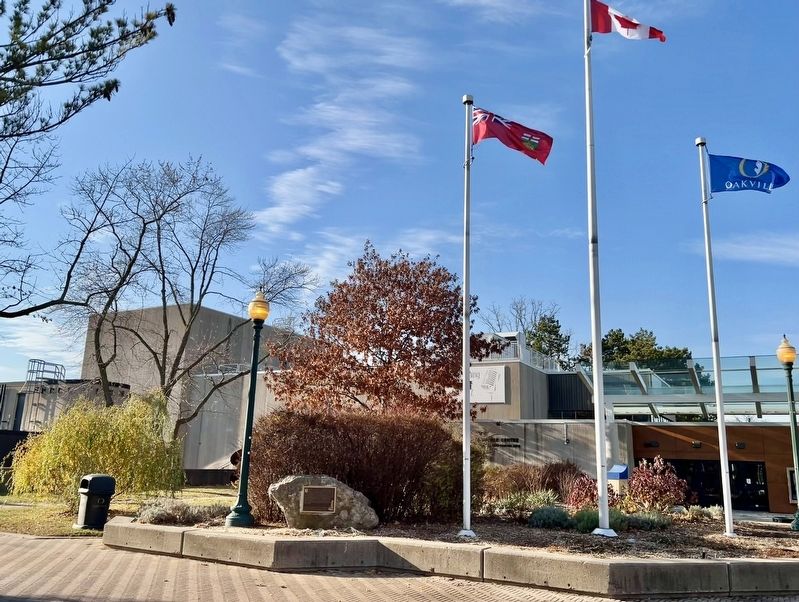
Photographed by Tim Boyd, November 30, 2023
2. Oakville’s Meeting Hall Marker
Also see . . . Early Settlers: A History of Oakville: Our Beautiful Town by the Lake.
After the Mississauga Purchase, the British government owned the majority of the land surrounding the Great Lakes, except the land at the mouth of the Sixteen Mile Creek, which was reserved by the Mississauga Indians for hunting and fishing purposes. When this land no longer lent itself well to these purposes, the Indians sold this land too, to the Crown. It was at this time that William Chisholm purchased 960 acres of Crown preserve at the mouth of the Sixteen, for $4116. This land would come to be called Oakville, after the name given to Chisholm by the Indians, "White Oak", because of his extensive dealings with this specific timber.(Submitted on December 18, 2023, by Tim Boyd of Hamilton, Ontario.)
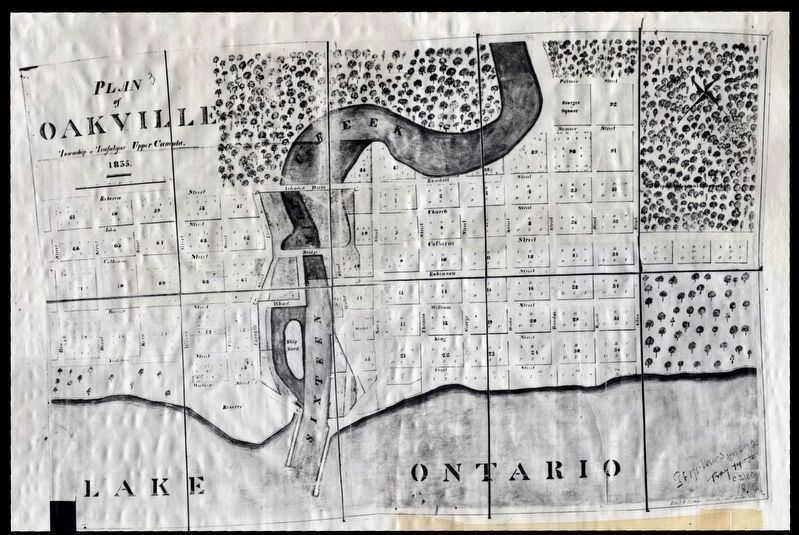
1835
3. Plan of Oakville, 1835
Credits. This page was last revised on December 19, 2023. It was originally submitted on December 18, 2023, by Tim Boyd of Hamilton, Ontario. This page has been viewed 122 times since then and 20 times this year. Photos: 1, 2, 3. submitted on December 18, 2023, by Tim Boyd of Hamilton, Ontario. • Andrew Ruppenstein was the editor who published this page.
