Burlington in Des Moines County, Iowa — The American Midwest (Upper Plains)
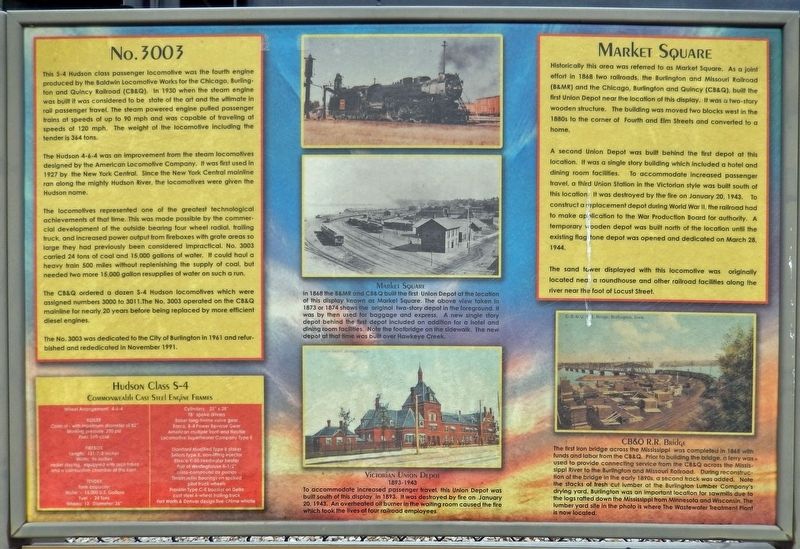
Engine No. 3003
⎯⎯⎯
Market Square
Photographed by Cosmos Mariner, June 25, 2021
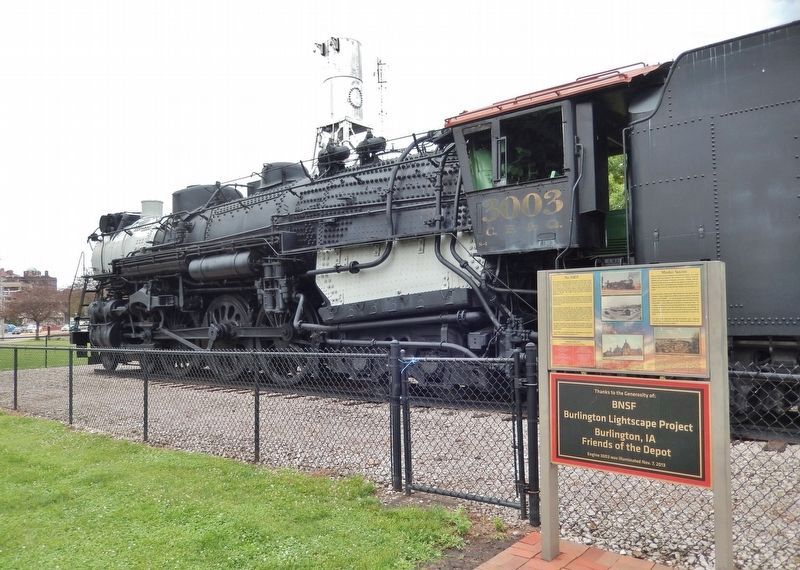
1. Engine No. 3003 / Market Square Marker
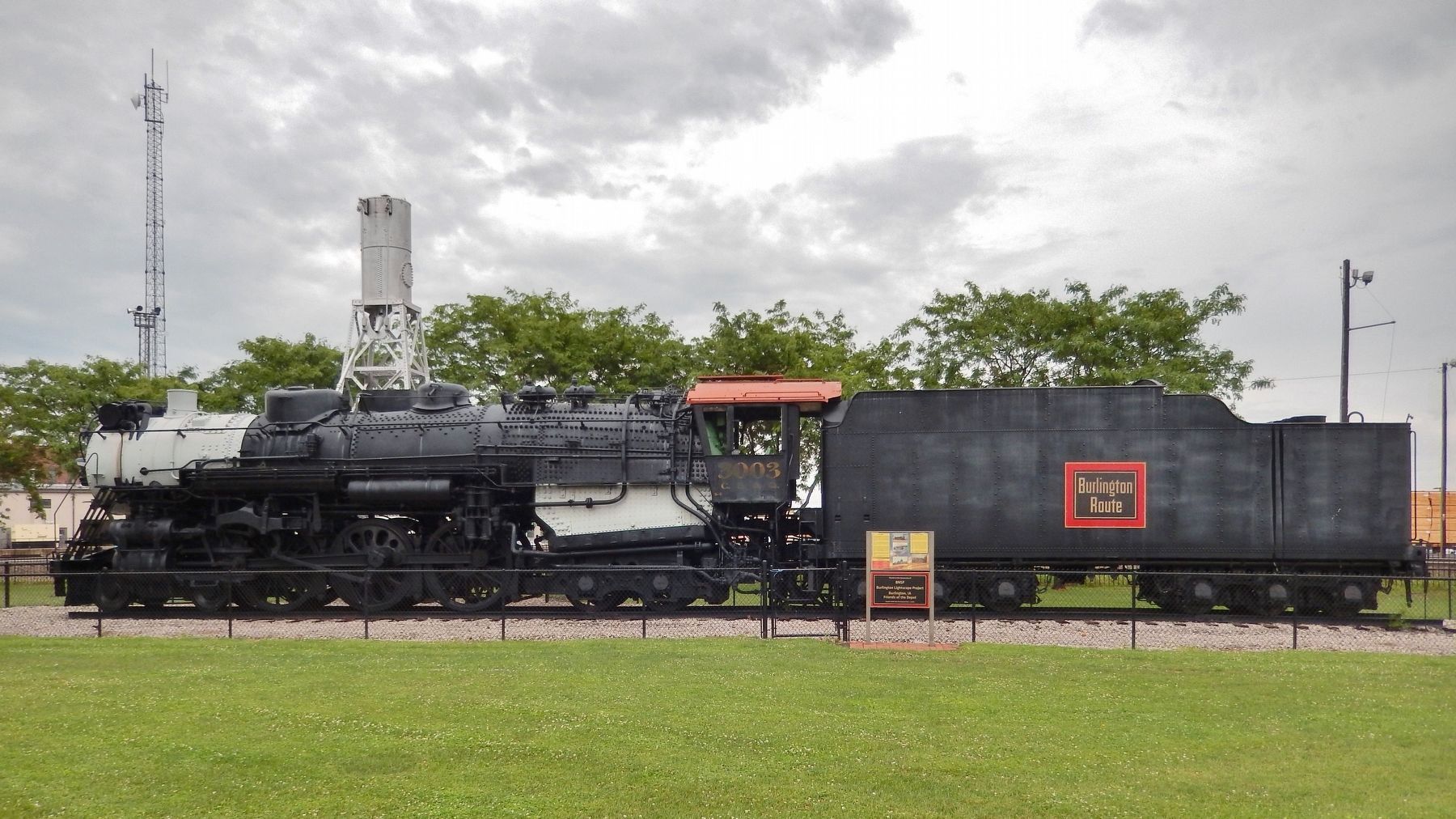
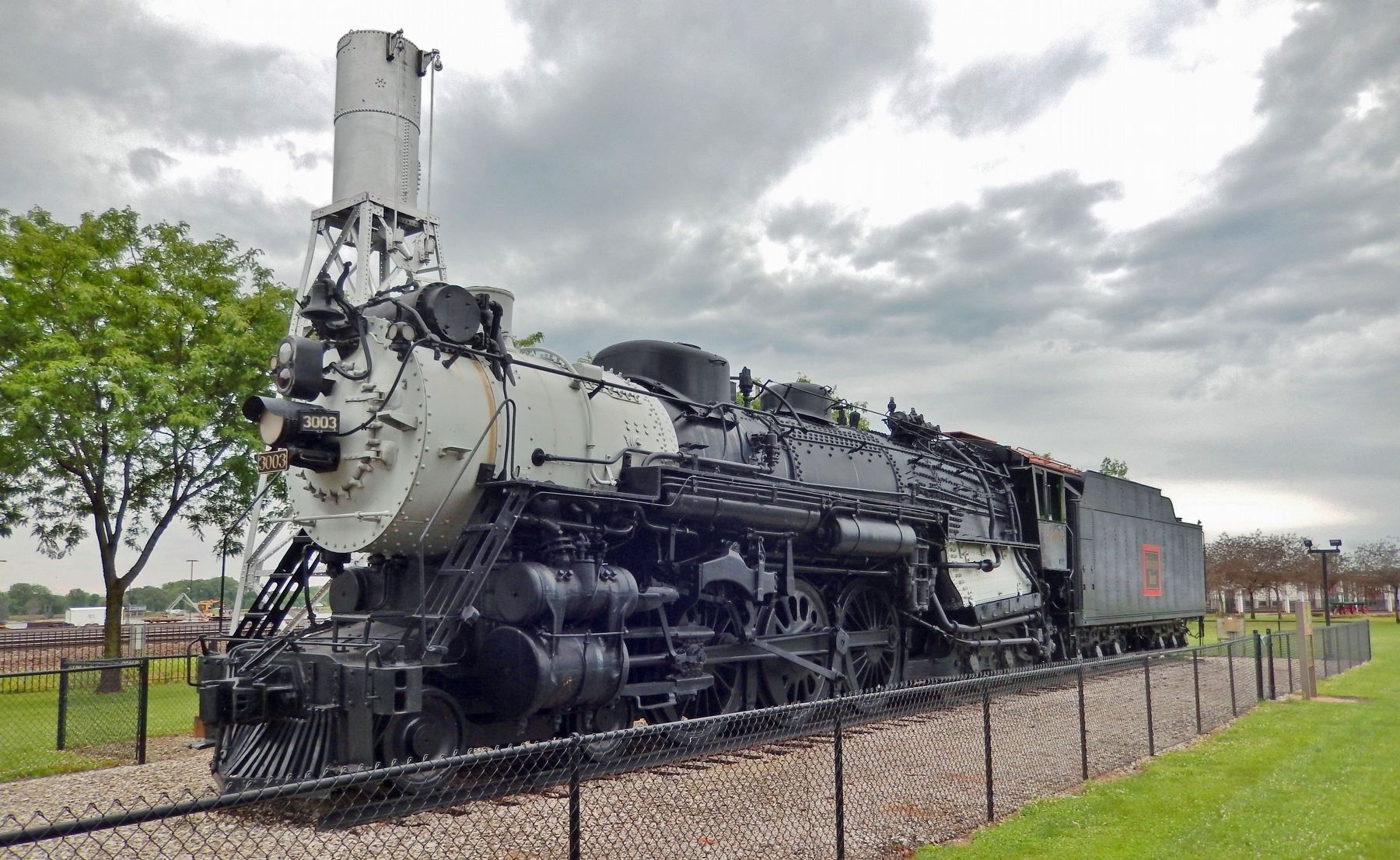
The Hudson 4-6-4 was an improvement from the steam locomotives designed by the American Locomotive Company. It was first used in 1927 by the New York Central. Since the New York Central mainline ran along the mighty Hudson River, the locomotives were given the Hudson name.
The locomotives represented one of the greatest technological achievements of that time. This was made possible by the commercial development of the outside bearing four wheel radial, trailing truck, and increased power output from fireboxes with grate areas so large they had previously been considered impractical. No. 3003 carried 24 tons of coal and 15,000 gallons of water. It
this page online
The CB&Q ordered a dozen S-4 Hudson locomotives which were assigned numbers 3000 to 3011. The No. 3003 operated on the CB&Q mainline for nearly 20 years before being replaced by more efficient diesel engines.
The No. 3003 was dedicated to the City of Burlington in 1961 and refurbished and rededicated in November 1991.
Commonwealth Cast Steel Engine Frames
Wheel Arrangement: 4-6-4
Boiler
Conical - with maximum diameter of 82"
Working pressure: 250 psi
Fuel: Soft coal
Firebox
Length: 131-7/8 inches
Width: 96 inches
radial staying, equipped with arch tubes
and a combustion chamber at the front.
Tender
Tank capacity:
Water – 15,000 U.S. Gallons
Fuel - 24 Tons
Wheels: 12 Diameter: 36"
Cylinders: 25" x 28"
78" spoke drivers
Baker long-frame valve gear
Barco, B-4 Power Reverse Gear
American multiple front-end throttle
Locomotive Superheater Company Type E
Standard Modified Type B stoker
Sellers Type K, non-lifting injector
Elesco K-50 Feedwater heater
Pair of Westinghouse 8-1/2”
cross-compound air pumps
Timkin
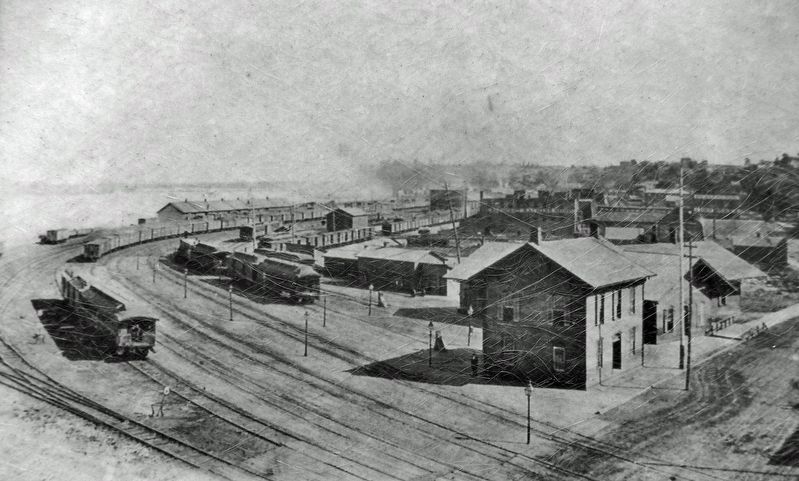
2. Marker detail: Market Square, circa 1873
In 1868 the B&MR and CB&Q built the first Union Depot at the location of this display known as Market Square. The above view taken in 1873 or 1874 shows the original two-story depot in the foreground. It was by then used for baggage and express. A new single story depot behind the first depot included an addition for a hotel and dining room facilities. Note the footbridge on the sidewalk. The new depot at that time was built over Hawkeye Creek.
pilot truck wheels
Franklin Type C-E booster on Delta
cast steel 4-wheel trailing truck
Fort Worth & Denver design five-chime whistle.
A second Union Depot was built behind the first depot at this location. It was a single story building which included a hotel and dining room facilities. To accommodate increased passenger travel, a third Union Station in the Victorian style was built south of this location. It was destroyed by the fire on January 20, 1943. To construct a replacement depot during World War II, the railroad had to make application to the War Production Board for authority. A temporary wooden depot was built north of the location until the existing flagstone depot was opened and dedicated
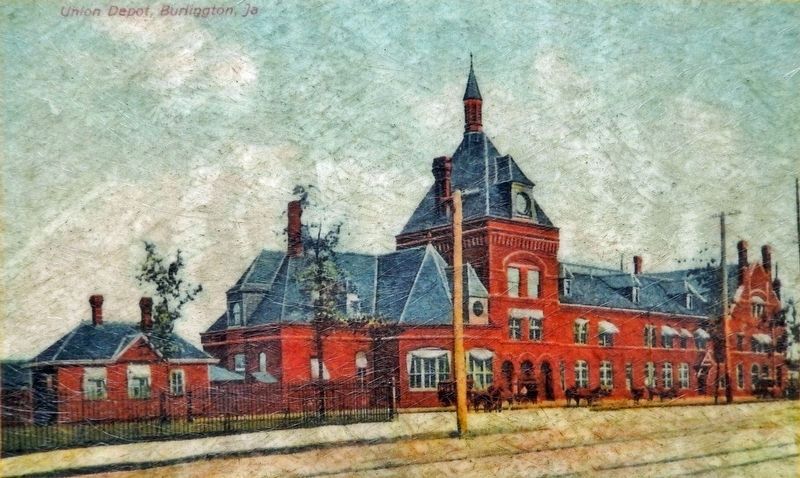
3. Marker detail: Victorian Union Depot
1893-1943
1893-1943
To accommodate increased passenger travel, this Union Depot was built south of this display in 1893. It was destroyed by fire on January 20, 1943. An overheated oil burner in the waiting room caused the fire which took the lives of four railroad employees.
The sand tower displayed with this locomotive was originally located near a roundhouse and other railroad facilities along the river near the foot of Locust Street.
Topics. This historical marker is listed in these topic lists: Architecture • Bridges & Viaducts • Industry & Commerce • Railroads & Streetcars. A significant historical year for this entry is 1868.
Location. 40° 48.418′ N, 91° 6.123′ W. Marker is in Burlington, Iowa, in Des Moines County. It is at the intersection of South Main Street and Division Street, on the right when traveling north on South Main Street. Touch for map. Marker is in this post office area: Burlington IA 52601, United States of America. Touch for directions.

Regionally, this marker is in Southern Iowa. It is also in the American Midwest, in the Corn Belt, and in the Great River Road Region. Globally, it is in North America, the Western Hemisphere, the Western World, and the Anglosphere. Historically, it finds itself in what was once the territory of the Mississippian Culture and also the Louisiana Purchase.
Other nearby markers. At least 8 other markers are
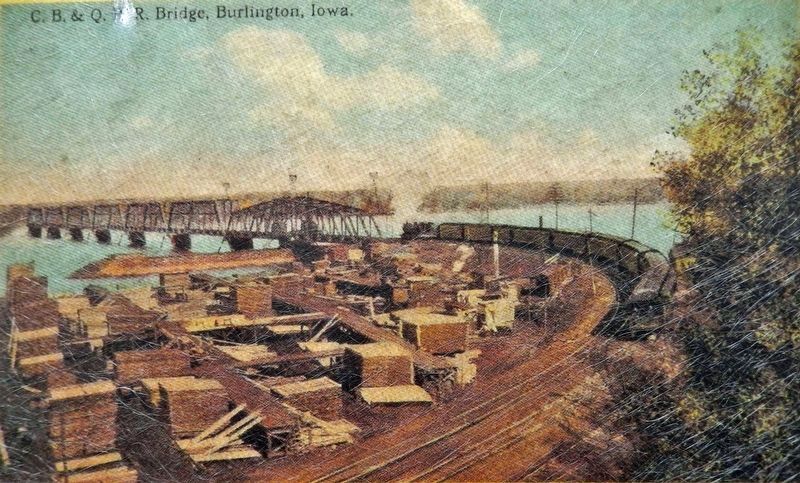
4. Marker detail: CB&Q R.R. Bridge
The first iron bridge across the Mississippi was completed in 1868 with funds and labor from the CB&Q. Prior to building the bridge, a ferry was used to provide connecting service from the CB&Q across the Mississippi River to the Burlington and Missouri Railroad. During reconstruction of the bridge in the early 1890s, a second track was added. Note the stacks of fresh cut lumber at the Burlington Lumber Company's drying yard. Burlington was an important location for sawmills due to the logs rafted down the Mississippi from Minnesota and Wisconsin. The lumber yard site in the photo is where The Wastewater Treatment Plant is now located.
Photographed by Cosmos Mariner, June 25, 2021
5. Engine No. 3003 / Market Square Marker
BNSF
Burlington Lightscape Project
Burlington, IA
Friends of the Depot
Engine 3003 was illuminated Nov. 7, 2013
Photographed by Cosmos Mariner, June 25, 2021
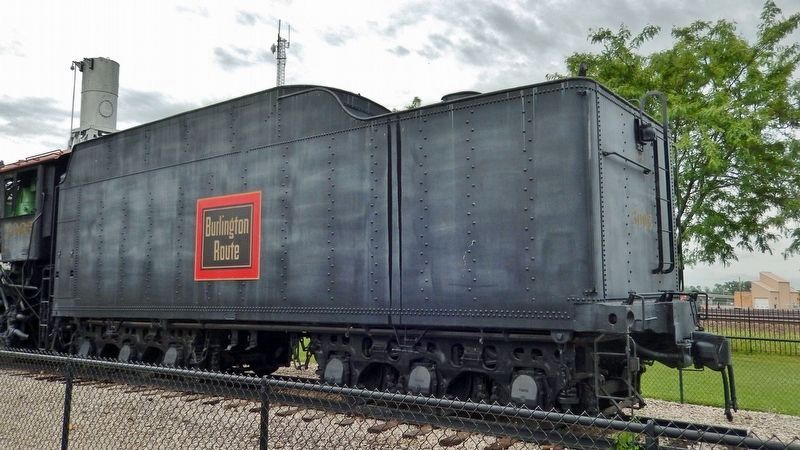
6. Engine No. 3003 - Tender
Photographed by Cosmos Mariner, June 25, 2021
7. Engine No. 3003 / Market Square Marker
Looking east from South Main Street.
Photographed by Cosmos Mariner, June 25, 2021
8. Engine No. 3003 & Sand Tower
Credits. This page was last revised on December 29, 2023. It was originally submitted on December 29, 2023, by Cosmos Mariner of Cape Canaveral, Florida. This page has been viewed 589 times since then and 95 times this year. Photos: 1, 2, 3, 4, 5, 6, 7, 8. submitted on December 29, 2023, by Cosmos Mariner of Cape Canaveral, Florida.
