Old Town in Alexandria, Virginia — The American South (Mid-Atlantic)
United States Naval Torpedo Station (Building Two)
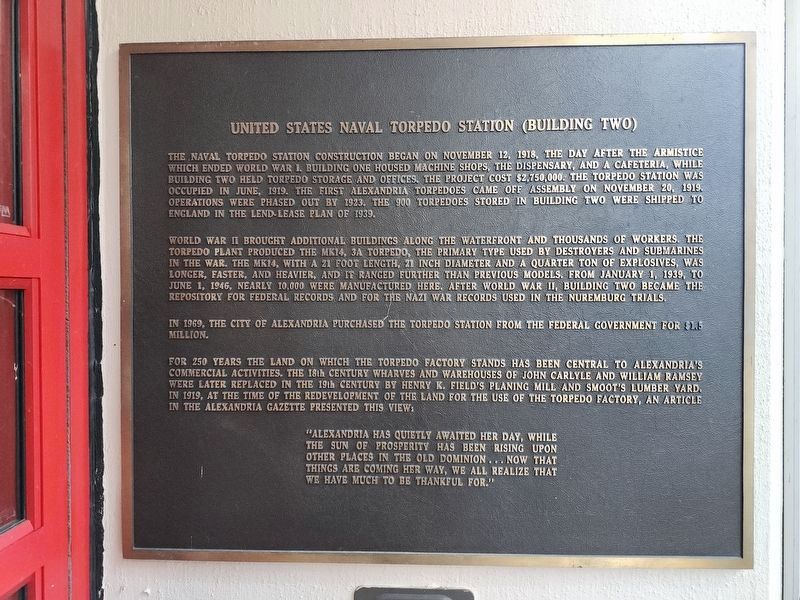
Photographed by J. Makali Bruton, November 23, 2025
1. United States Naval Torpedo Station (Building Two) Marker
The Naval Torpedo Station construction began on November 12, 1918, the day after the armistice which ended World War I. Building One housed machine shops, the dispensary, and a cafeteria, while Building Two held torpedo storage and offices. The project cost $2,750,000. The Torpedo Station was occupied in June, 1919. The first Alexandria torpedoes came off assembly on November 20, 1919. Operations were phased out by 1923. The 900 torpedoes stored in Building Two were shipped to England in the Lend-Lease plan of 1939.
World War II brought additional buildings along the waterfront and thousands of workers. The torpedo plant produced the MK14, 3A Torpedo, the primary type used by destroyers and submarines in the war. The MK14, with a 21 foot length, 21 inch diameter and a quarter ton of explosives, was longer, faster, and heavier, and it ranged further than previous models. From January 1, 1939, to June 1, 1946, nearly 10,000 were manufactured here. After World War II, Building Two became the repository for Federal records and for the Nazi war records used in the Nuremburg trials.
In 1969, the City of Alexandria purchased
this page online
For 250 years the land on which the Torpedo Factory stands has been central to Alexandria's commercial activities. The 18th Century wharves and warehouses of John Carlyle and William Ramsey were later replaced in the 19th Century by Henry K. Field's Planing Mill and Smoot's Lumber Yard. In 1919, at the time of the redevelopment of the land for the use of the Torpedo Factory, an article in the Alexandria Gazette presented this view:
"Alexandria has quietly awaited her day, while the sun of prosperity has been rising upon other places in the Old Dominion … Now that things are coming her way, we all realize that we have much to be thankful for."
Topics. This historical marker is listed in these topic lists: Industry & Commerce • War, World I • War, World II. A significant historical date for this entry is January 1, 1939.
Location. 38° 48.294′ N, 77° 2.402′ W. Marker is in Alexandria, Virginia. It is in Old Town. It is on North Union Street north of Fayette Alley, on the right when traveling north. Touch for map. Marker is at or near this postal address: 105 N Union
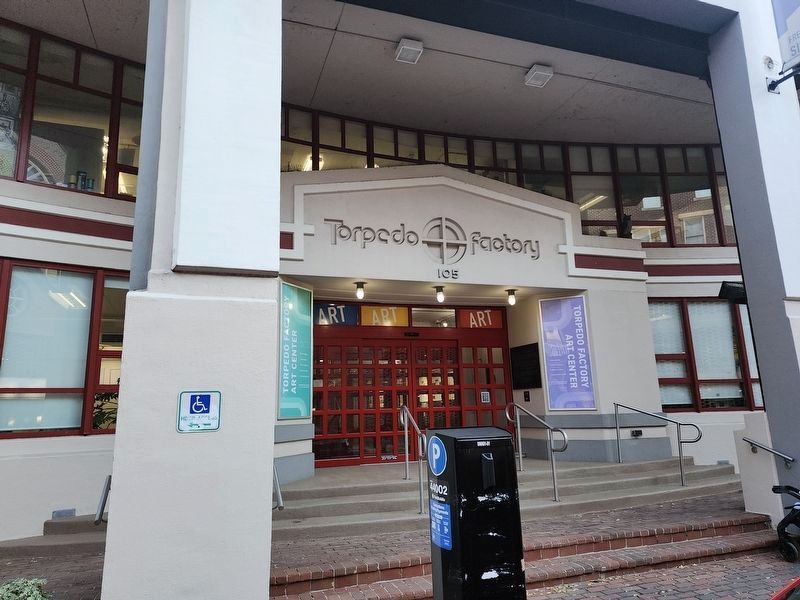
Photographed by J. Makali Bruton, November 23, 2025
2. United States Naval Torpedo Station (Building Two) Marker

Regionally, this marker is in the Washington Metropolitan Area and in Northern Virginia. It is also in the American South, specifically in the Upper South, in the Mid-Atlantic, and on the Eastern Seaboard. Globally, it is in the North Atlantic Region, North America, the Western Hemisphere, the Western World, and the Anglosphere. Historically, it finds itself in what was once the territory of the Mississippian Culture, one of the original Thirteen Colonies, one of the Confederate States of America, and the Antebellum South.
Other nearby markers. At least 8 other markers are within walking distance of this marker: Torpedo Factory Art Center (here, next to this marker); a different marker also named Torpedo Factory Art Center (a few steps from this marker); Plundered! (within shouting distance of this marker); The Civil War Comes to Alexandria (within shouting distance of this marker); Old Town Alexandria (within shouting distance of this marker); Alexandria Archaeology Museum (within shouting distance of this marker); Engin Artemel (within shouting distance of this marker); John Fitzgerald (about 300 feet away, measured in a direct line). Touch for a list and map of all markers in Alexandria.
Other markers no longer nearby. Alexandria (was within shouting distance of this marker but has been confirmed missing); Living History (was within shouting distance of this marker but has been replaced with another marker now near it); Visiting Old Town (was within shouting distance of this marker but has been replaced with another marker now near it).
Credits. This page was last revised on November 24, 2025. It was originally submitted on January 20, 2024, by Kevin W. of Stafford, Virginia. This page has been viewed 275 times since then and 26 times this year. Photos: 1, 2. submitted on November 24, 2025, by J. Makali Bruton of Washington, District of Columbia. • Devry Becker Jones was the editor who published this page.
