Mount Holly in Gaston County, North Carolina — The American South (South Atlantic)
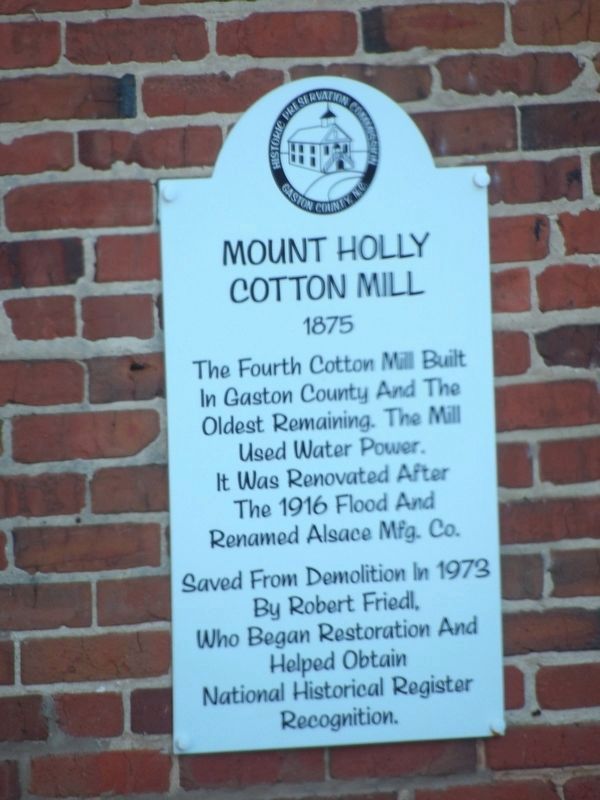
Mount Holly Cotton Mill
1875
Photographed by Duane and Tracy Marsteller, February 3, 2024
1. Mount Holly Cotton Mill Marker
The fourth cotton mill built in Gaston County and the oldest remaining. The mill used water power. It was renovated after the 1916 flood and renamed Alsace Mfg. Co.
Saved from demolition in 1973 by Robert Friedl, who began restoration and helped obtain National Historical Register recognition.
Topics and series. This historical marker is listed in this topic list: Industry & Commerce. In addition, it is included in the National Register of Historic Places (NRHP) series list. A significant historical year for this entry is 1875.
Location. 35° 18.043′ N, 81° 0.875′ W. Marker is in Mount Holly, North Carolina, in Gaston County. It can be reached from the intersection of North Main Street and Alsace Street, on the left when traveling south. Touch for map. Marker is at or near this postal address: 250 N Main St, Mount Holly NC 28120, United States of America. Touch for directions.

Regionally, this marker is in the Piedmont and in Greater Charlotte. It is also in the American South and specifically in the Upper South. Globally, it is in North America, the Western Hemisphere, the Western World, and the
this page online
Other nearby markers. At least 8 other markers are within walking distance of this marker: 123 North Main Street (approx. 0.2 miles away); 121 North Main Street (approx. 0.2 miles away); 107-119 North Main Street (approx. 0.2 miles away); Cannon-Lentz House (approx. ¼ mile away); 100 South Main Street (approx. ¼ mile away); 111 West Central Avenue (approx. ¼ mile away); 104 South Main Street (approx. ¼ mile away); 113 West Central Avenue (approx. ¼ mile away). Touch for a list and map of all markers in Mount Holly.
Regarding Mount Holly Cotton Mill. Excerpt from the National Register nomination:
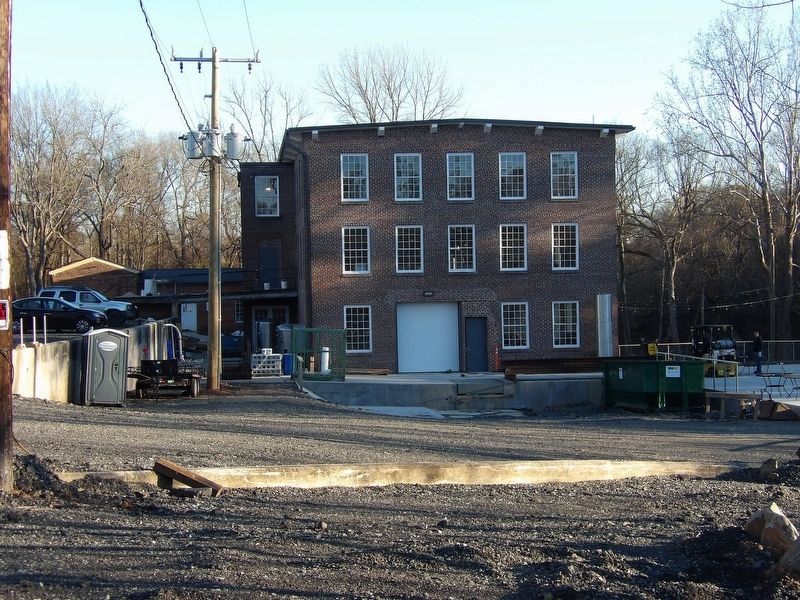
The Mount Holly Cotton Mill was built in 1875 by a partnership between Abel Peterson Rhyne, Daniel E. Rhyne, and Ambrose Costner along Dutchman's Creek near the Catawba River in Gaston County. It was the fourth textile mill built and the oldest surviving in Gaston County which retains the distinction claimed since the earlytwentieth century of having more textile mills than any other county in the United States. The Mount Holly Cotton Mill complex, which grew incrementally between 1875 and ca. 1919, is significant as an example of the functional Italianate-inspired industrial architecture that became a New South icon in the Gaston County landscape between the last quarter of the nineteenth century and the first decades of the twentieth. The 1875 establishment of the mill on the banks of Dutchman's Creek was a seminal event that sparked the 1879 change of the name of the adjacent settlement from Woodlawn to Mount Holly to recognize the mill, and the subsequent growth of the community into a flourishing textile production center that boasted four mills by 1891. In 1920 the Mount Holly Cotton Mill was merged into C. E. Hutchinson's American Yarn and Processing Company, and operated 5,700 spindles. In 1947 American Yarn acquired controlling interest in the Efrid Mills Company, and in 1953 the Mount Holly Cotton Mill complex was converted into a research unit. The site was abandoned in the early 1960s, and in 1973 was sold to an independent mill operator…Photographed by Duane and Tracy Marsteller, February 3, 20242. Mount Holly Cotton Mill MarkerPhotographed by Duane and Tracy Marsteller, February 3, 20243. Mount Holly Cotton MillView of the 1875 portion of the mill.
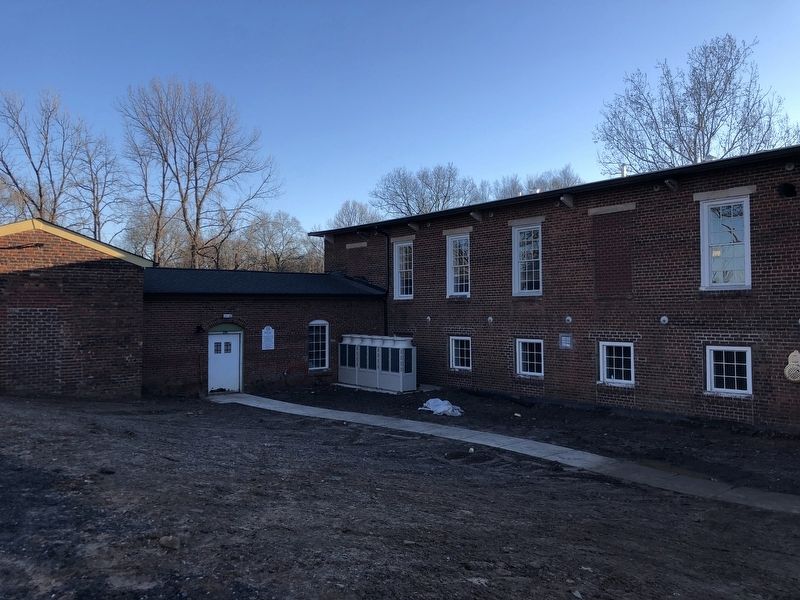
Also see . . . Mount Holly Cotton Mill (PDF). National Register nomination for the mill complex, which was listed in 1996. (Prepared by Lucy Penegar and Barry Jacobs; via North Carolina State Historic Preservation Office) (Submitted on February 10, 2024, by Duane and Tracy Marsteller of Murfreesboro, Tennessee.)
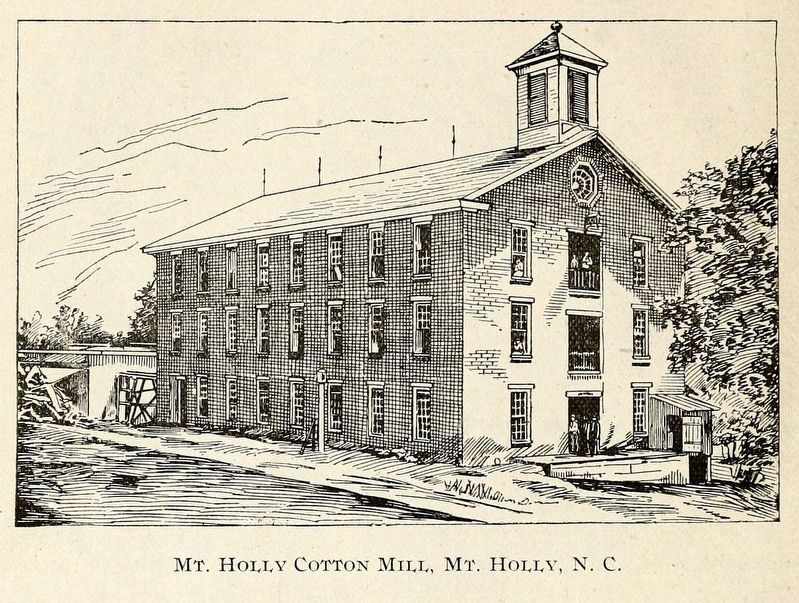
NC Bureau of Labor Statistics; from NC Government & Heritage Library via Flickr (CC BY 2.0), 1897
4. Mount Holly Cotton Mill
The mill began in March, 1875 with the construction of this rectangular three-story brick building. It became the center block of the present building when it was expanded in 1916.
Credits. This page was last revised on November 8, 2024. It was originally submitted on February 10, 2024, by Duane and Tracy Marsteller of Murfreesboro, Tennessee. This page has been viewed 762 times since then and 121 times this year. Photos: 1, 2, 3, 4. submitted on February 10, 2024, by Duane and Tracy Marsteller of Murfreesboro, Tennessee.
