Downtown Austin in Travis County, Texas — The American South (West South Central)
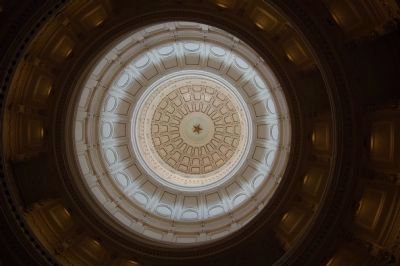
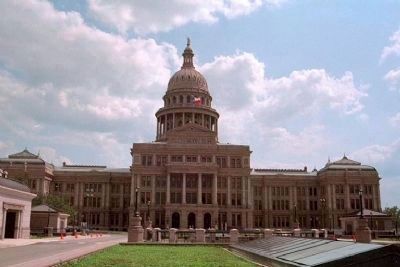
Texas State Capitol
Photographed by Keith Peterson, September 3, 2007
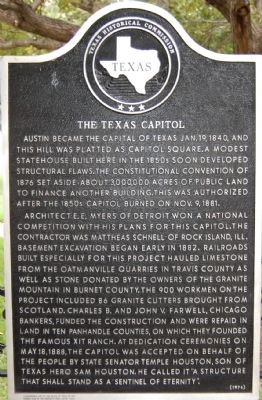
1. The Texas Capitol Marker
This previous version of the marker had similar text and was some yards east of the current location.
Austin became the capital of Texas Jan. 19, 1840, and this hill was platted as Capitol Square. A modest statehouse built here in the 1850s soon developed structural flaws. The Constitutional Convention of 1876 set aside about 3,000,000 acres of public land to finance another building. This was authorized after the 1850s capitol burned on Nov. 9, 1881.
Architect E.E. Myers of Detroit won a national competition with his plans for this capitol. The contractor was Mattheas Schnell of Rock Island, Ill. Basement excavation began early in 1882. Railroads built especially for this project hauled limestone from the Oatmanville quarries in Travis County as well as stone donated by the owners of the Granite Mountain in Burnet County. The 900 workmen on the project included 86 granite cutters brought from Scotland. Charles B. and John V. Farwell, Chicago bankers, funded the construction and were repaid in land in ten Panhandle counties, on which they founded the famous XIT ranch. At dedication ceremonies on May 18, 1888, the capitol was accepted on behalf of the people by state senator Temple Houston, son of Texas hero Sam Houston. He called it "a structure that shall stand as a sentinel of eternity".
Incise
A Bicentennial gift to the people of Texas by the Kiwanis Club of the University area, Austin, Texas
Erected 1976 by Texas Historical Commission. (Marker Number 14150.)
Topics. This historical marker is listed in these topic lists: Architecture • Settlements & Settlers.
Location. Marker has been permanently removed. It was located near 30° 16.362′ N, 97° 44.422′ W. Marker was in Austin, Texas, in Travis County. It was in Downtown Austin. It could be reached from 11th Street east of Congress Avenue, on the left when traveling east.
this page online
We have been informed that this marker is no longer there and will not be replaced. This page is an archival view of what was.
Regionally, this marker was in Central Texas. It was also in the American South. Globally, it was in North America, a Gulf of Mexico state, the Western Hemisphere, the Western World, and the Anglosphere. Historically, it found itself in what was once New Spain, the Republic of Texas, one of the Confederate States of America, and the Antebellum South.

Other nearby markers. At least 8 other markers are within walking distance of this location: Texas Highway Department (within shouting distance of this marker); Mexican Americans in 20th Century America (within shouting distance of this marker); Tejanos and Texas in the U.S. (within shouting distance of this marker); Tejanos in the Republic of Texas (within shouting distance of this marker); Tejanos Under the Mexican Flag (within shouting distance of this marker); Spanish Tejanos (within shouting distance of this marker); Southern Confederacy Monument (within
Photographed by Pat Fillipone, November 10, 2019
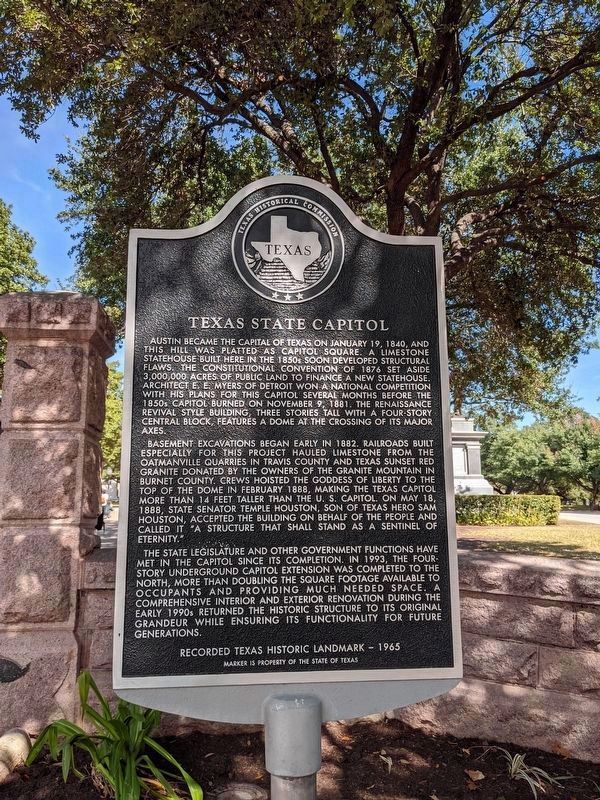
2. Texas State Capitol Marker
This newer version of the marker likely replaced the previous version. Most of the text is similar although the last paragraph includes information from the 1990s.
Also see . . . Texas State Capitol from Wikipedia. (Submitted on December 26, 2009, by Bill Pfingsten of Bel Air, Maryland.)
Photographed by Jeff Leichsenring, December 20, 2022
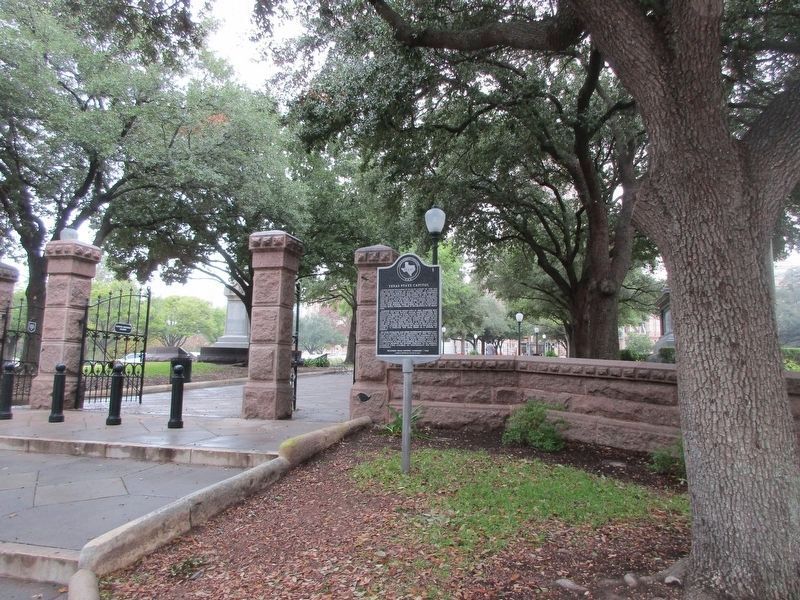
3. Texas State Capitol Marker
Photographed by Keith Peterson, September 3, 2007
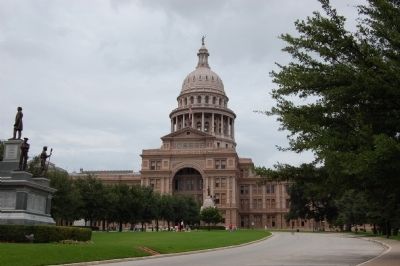
4. The Texas Capitol
Photographed by Keith Peterson, September 30, 2007
5. The Texas Capitol
Viewing of the interior dome
Photographed by Mike Stroud, May 26, 1996
6. The Texas Capitol, north side
Credits. This page was last revised on February 14, 2024. It was originally submitted on December 20, 2009, by Keith Peterson of Cedar Park, Texas. This page has been viewed 2,578 times since then and 238 times this year. Last updated on February 13, 2024, by Jeff Leichsenring of Garland, Texas. Photos: 1. submitted on December 20, 2009, by Keith Peterson of Cedar Park, Texas. 2. submitted on August 15, 2020, by J. Makali Bruton of Washington, District of Columbia. 3. submitted on December 28, 2022, by Jeff Leichsenring of Garland, Texas. 4. submitted on December 20, 2009, by Keith Peterson of Cedar Park, Texas. 5. submitted on February 11, 2010, by Keith Peterson of Cedar Park, Texas. 6. submitted on April 11, 2010, by Mike Stroud of Bluffton, South Carolina. • James Hulse was the editor who published this page.
