Bedford in Bedford County, Virginia — The American South (Mid-Atlantic)
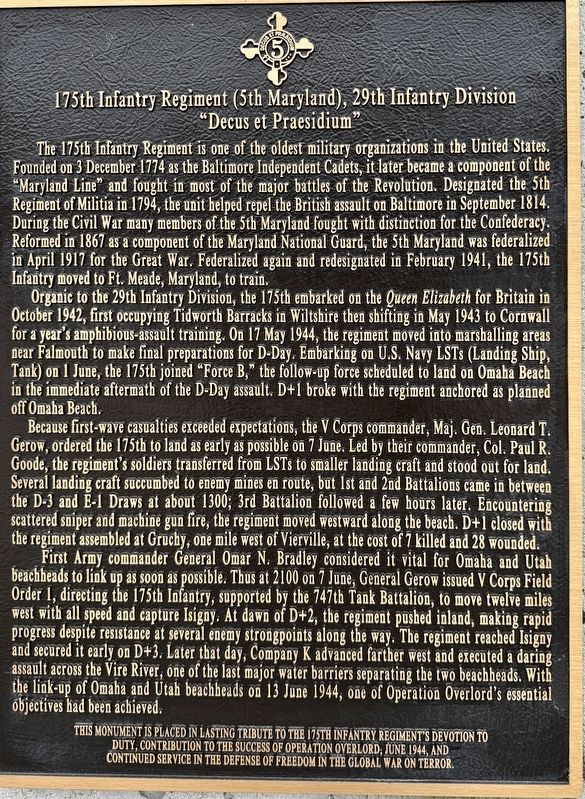
175th Infantry Regiment (Maryland), 29th Infantry Division
“Decus et Praesidium”
| — | National D-Day Memorial | — |
Photographed by Brandon D Cross
1. 175th Infantry Regiment (Maryland), 29th Infantry Division Marker
Organic to the 29th Infantry Division, the 175th embarked on the Queen Elizabeth for Britain in October 1942, first occupying Tidworth Barracks in Wiltshire then shifting in May 1943 to Cornwall for a year's amphibious-assault training. On 17 May 1944, the regiment moved into marshalling areas near Falmouth to make final preparations for D-Day. Embarking on U.S. Navy LSTs (Landing Ship, Tank) on
this page online
Because first-wave casualties exceeded expectations, the V Corps commander, Maj. Gen. Leonard T. Gerow, ordered the 175th to land as early as possible on 7 June. Led by their commander, Col. Paul R. Goode, the regiment's soldiers transferred from LSTs to smaller landing craft and stood out for land. Several landing craft succumbed to enemy mines en route, but 1st and 2nd Battalions came in between the D-3 and E-1 Draws at about 1300; 3rd Battalion followed a few hours later. Encountering scattered sniper and machine gun fire, the regiment moved westward along the beach. D+ 1 closed with the regiment assembled at Gruchy, one mile west of Vieville, at the cost of 7 killed and 28 wounded.
First Army commander General Omar N. Bradley considered it vital for Omaha and Utah beachheads to link up as soon as possible. Thus at 2100 on 7 June, General Gerow issued V Corps Field Order 1, directing the 175th Infantry, supported by the
Photographed by Brandon D Cross
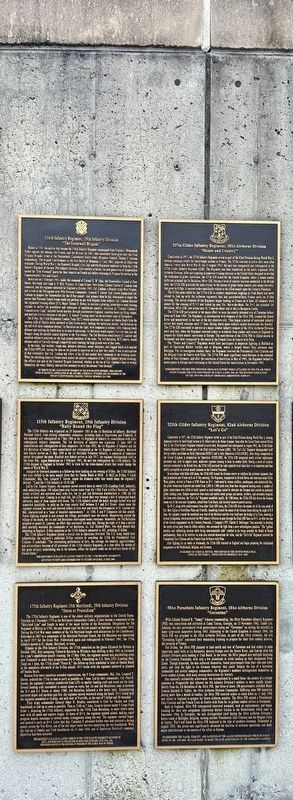
2. 175th Infantry Regiment (Maryland), 29th Infantry Division Marker (bottom left)
This monument is placed in lasting tribute to the 115th Infantry Regiment’s devotion to duty, contribution to the success of Operation Overlord, June 1944, and continued service in defense of freedom in the global war on terror.
Erected by National D-Day Memorial.
Topics and series. This memorial is listed in this topic list: War, World II. In addition, it is included in the U.S. National D-Day Memorial series list. A significant historical date for this entry is June 6, 1944.
Location. 37° 19.85′ N, 79° 32.17′ W. Memorial is in Bedford, Virginia, in Bedford County. It is
Public Domain
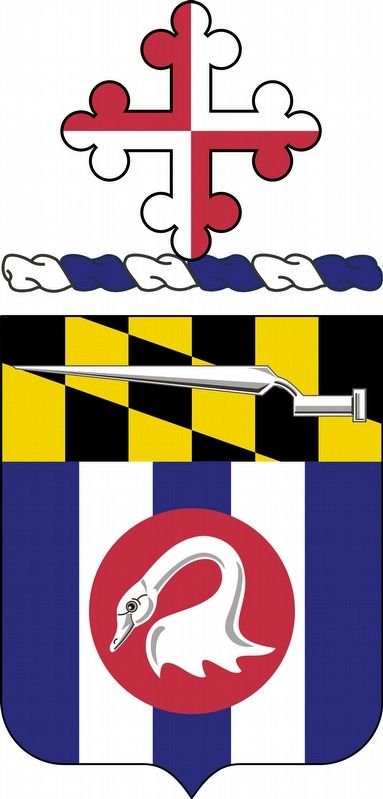
3. 175th Infantry Regiment (Maryland), 29th Infantry Division Emblem

Regionally, this memorial is in Southwest Virginia. It is also in the American South and specifically in the Upper South. Globally, it is in North America, the Western Hemisphere, the Western World, and the Anglosphere. Historically, it finds itself in what was once the territory of the Mississippian Culture, one of the original Thirteen Colonies, one of the Confederate States of America, and the Antebellum South.
Other nearby markers. At least 8 other markers are within walking distance of this marker: Company K, 116th Infantry Regiment (here, next to this marker); Company A, 116th Infantry Regiment (here, next to this marker); Company D, 116th Infantry Regiment (here, next to this marker); Company I, 116th Infantry Regiment (here, next to this marker); Company B, 116th Infantry Regiment (here, next to this marker); 506th Parachute Infantry Regiment, 101st Airborne Division (here, next to this marker); 508th Parachute Infantry Regiment, 82nd Airborne Division (here, next to this marker); 502nd Parachute Infantry Regiment, 101st Airborne Division (here, next to this marker). Touch for a list and map of all markers in Bedford.
Also see . . .
1. 175th Infantry Regiment (United States). (Submitted on February 13, 2024, by Brandon D Cross of Flagler Beach, Florida.)
2. National D-Day Memorial. (Submitted on February 13, 2024, by Brandon D Cross of Flagler Beach, Florida.)
Credits. This page was last revised on February 15, 2024. It was originally submitted on February 13, 2024, by Brandon D Cross of Flagler Beach, Florida. This page has been viewed 941 times since then and 106 times this year. Photos: 1, 2, 3. submitted on February 13, 2024, by Brandon D Cross of Flagler Beach, Florida. • Andrew Ruppenstein was the editor who published this page.
