French Quarter in New Orleans in Orleans Parish, Louisiana — The American South (West South Central)
Sicilian Jazz
⎯⎯⎯
Sicilian Swing & Rock n’ Roll
Photographed by Charles Marsala, January 19, 2020
1. Sicilian Contributions in Jazz, Swing, and Rock & Roll Marker
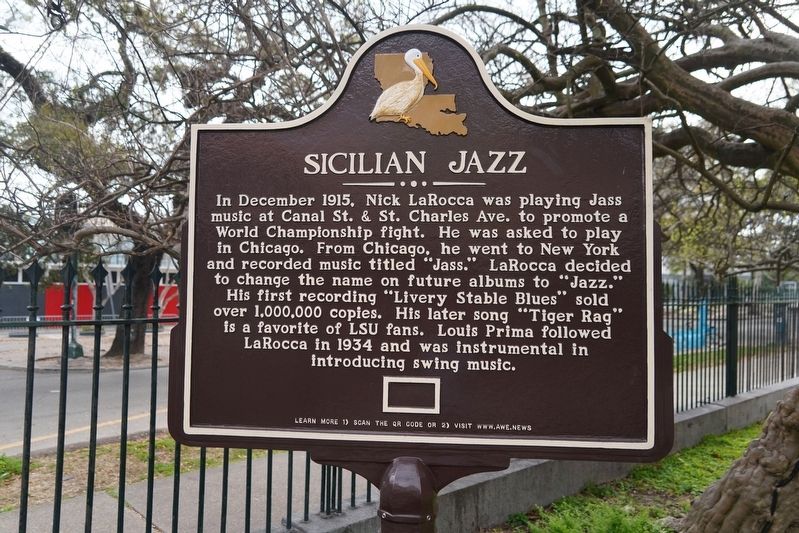
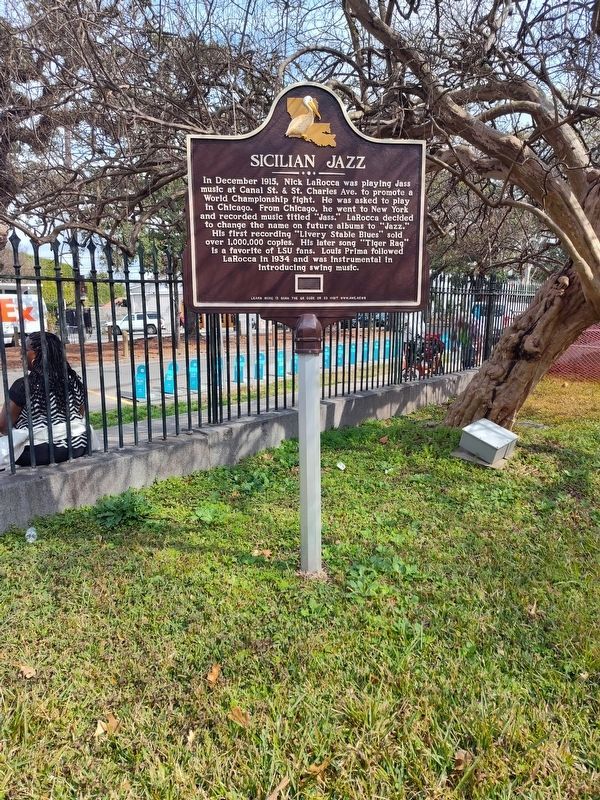
Sicilian Jazz. In December 1915, Nick LaRocca was playing Jass music at Canal St. & St. Charles Ave. to promote a World Championship fight. He was asked to play in Chicago. From Chicago, he went to New York and recorded music titled "Jass." LaRocca decided to change the name on future albums to "Jazz." His first recording "Livery Stable Blues" sold over 1,000,000 copies. His later song "Tiger Rag" is a favorite of LSU fans. Louis Prima followed LaRocca in 1934 and was instrumental in introducing swing music.
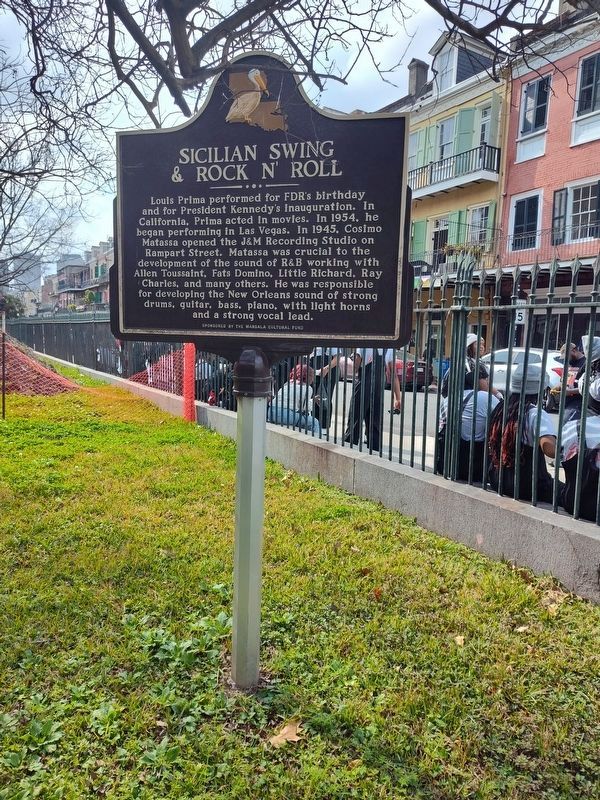
Sicilian Swing & Rock n’ Roll. Louis Prima performed for FDR’s birthday and for President Kennedy’s inauguration. In California, Prima acted in movies. In 1954, he began performing in Las Vegas. In 1945, Cosimo Matassa opened the J&M Recording Studio on Rampart Street. Matassa was crucial to the development of the sound of R&B working with Allen Toussaint, Fats Domino, Little Richard, Ray Charles, and many others. He was responsible for developing the New Orleans sound of strong drums, guitar, bass, piano, with light horns and a strong vocal lead.
Erected 2019 by Marsala Cultural Fund.
Topics. This historical
this page online
Location. 29° 57.713′ N, 90° 3.483′ W. Marker is in New Orleans, Louisiana, in Orleans Parish. It is in the French Quarter. It is at the intersection of Esplanade Ave and Decatur Street, on the right when traveling south on Esplanade Ave. Marker is located at the corner of Esplanade Ave. and Decatur St. on the grounds of the Jazz Museum. i. Touch for map. Marker is at or near this postal address: 400 Esplanade Ave, New Orleans LA 70116, United States of America. Touch for directions.

Regionally, this marker is in one of the River Parishes. It is also in the American South, specifically in the Deep South, on the Gulf Coast, and in the Great River Road Region. Globally, it is in North America, a Gulf of Mexico state, the Western Hemisphere, the Western World, and the Anglosphere. Historically, it finds itself in what was once New Spain, the Viceroyalty of New France, the territory of the Mississippian Culture, the Louisiana Purchase, one of the Confederate States of America, and the Antebellum

Photographed by Craig Doda, February 14, 2026
2. Sicilian Jazz / Sicilian Swing & Rock n’ Roll Marker
Other nearby markers. At least 8 other markers are within walking distance of this marker: Faubourg Marigny (within shouting distance of this marker); United States Mint (within shouting distance of this marker); Calle del Cuartel (within shouting distance of this marker); Fort St. Charles (about 300 feet away, measured in a direct line); Solomon Northup (about 400 feet away); New Orleans and the Domestic Slave Trade (about 500 feet away); Denis House (about 500 feet away); Bringier – Barnett House (about 500 feet away). Touch for a list and map of all markers in New Orleans.
More about this marker. Sicilians began arriving in New Orleans in the early 1800s. Palermo and New Orleans became trading partners due to the demand of the Sicilian Lemon as a cure for sailors getting scurvy. In the 1850s following the Crimean War, veterans of the Italian Army known as the Bersaglieri began arriving in New Orleans. From the 1870s to 1920s over 60,000 Sicilians were recruited to work on Sugarcane Plantations, the docks, and building the railroads. Sicilians brought their culture and music with them. The Jazz Museum has previously
Photographed by Craig Doda, February 14, 2026
3. Sicilian Jazz / Sicilian Swing & Rock n’ Roll Marker
Regarding Sicilian Jazz / Sicilian Swing & Rock n’ Roll. When Nick LaRocca and The Original Dixieland Jass Band arrived in New York in 1917, Jimmy Durante was playing and booking acts at the Alamo Cafe which was at the Apollo Theater in Harlem. Durante heard the band play at Columbus Circle and asked them to teach him Jass. Larocca recruited musicians from New Orleans to come to New York and form a band with Durante. During this time the name of the music was changed from Jass to Jazz. The musicians recruited by Larocca for Jimmy Durante’s Jazz and Novelty Band included African-American Achille Baquet. The second part of the marker is dedicated to Louis Prima who enjoyed a close working relationship with Cab Calloway. The third part of the marker mentions Sicilian Cosimo Matassa working with famous African-American recording artists such as Ray Charles, Fats Domino, and Little Richard in the 1940s and 1950s during segregation. Sicilians and African-Americans did not participate in the Jim Crow Laws from the 1890s to 1960s.
Also see . . .
1. AWE News. (Submitted on March 2, 2024, by Charles Marsala of Monroe, Louisiana.)
2. Original Dixieland Jass Band - Livery Stable Blues (YouTube, 3:10, 1917).
Photographed by Craig Doda, February 14, 2026
4. Sicilian Jazz / Sicilian Swing & Rock n’ Roll Marker
Additional keywords. Harlem New York Italian Little Palermo French Quarter Jazz Museum Decatur Street
Credits. This page was last revised on March 2, 2026. It was originally submitted on February 25, 2024, by Charles Marsala of Monroe, Louisiana. This page has been viewed 933 times since then and 105 times this year. Photos: 1. submitted on February 25, 2024, by Charles Marsala of Monroe, Louisiana. 2, 3, 4. submitted on March 1, 2026, by Craig Doda of Napoleon, Ohio. • James Hulse was the editor who published this page.
