
Amsterdam Oud-Zuid , North Holland, Netherlands — Northwestern Europe
Adriaen Valerius
Photographed by Andrew Ruppenstein, March 19, 2024
1. Adriaen Valerius Marker

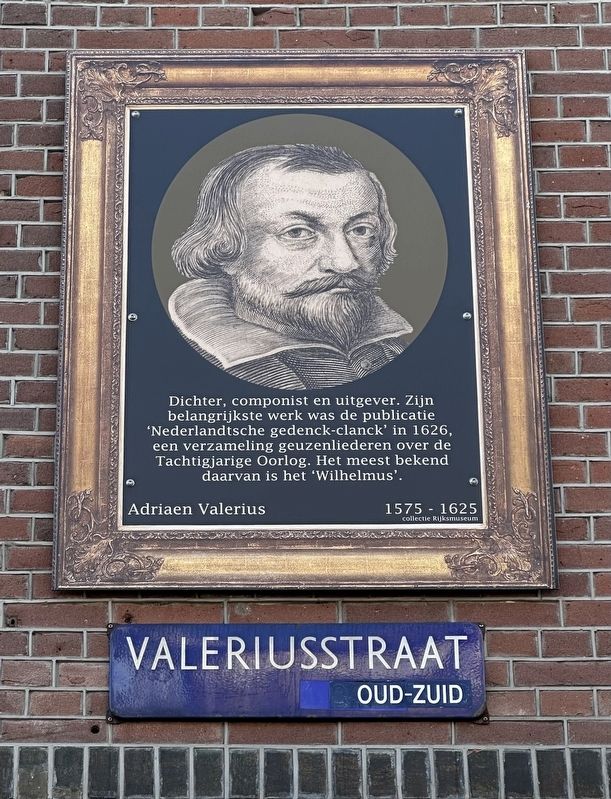
Dichter, componist en uitgever. Zijn belangrijkste werk was de publicatie 'Nederlandtsche gedenck-clanck' in 1626, een verzameling geuzenliederen over de Tachtigjarige Oorlog. Het meest bekend daarvan is het 'Wilhelmus'.
Poet, composer and publisher. His most important work was the publication of 'Nederlandtsche gedenck-clanck' in 1626, a collection of folk songs about the Eighty Years War, the most famous of which is 'Wilhelmus'.
Erected by Geef Straten Een Gezicht.
Topics and series. This historical marker is listed in this topic list: Arts, Letters, Music. In addition, it is included in the Give Streets a Face / Geef Straten Een Gezicht series list. A significant historical year for this entry is 1626.
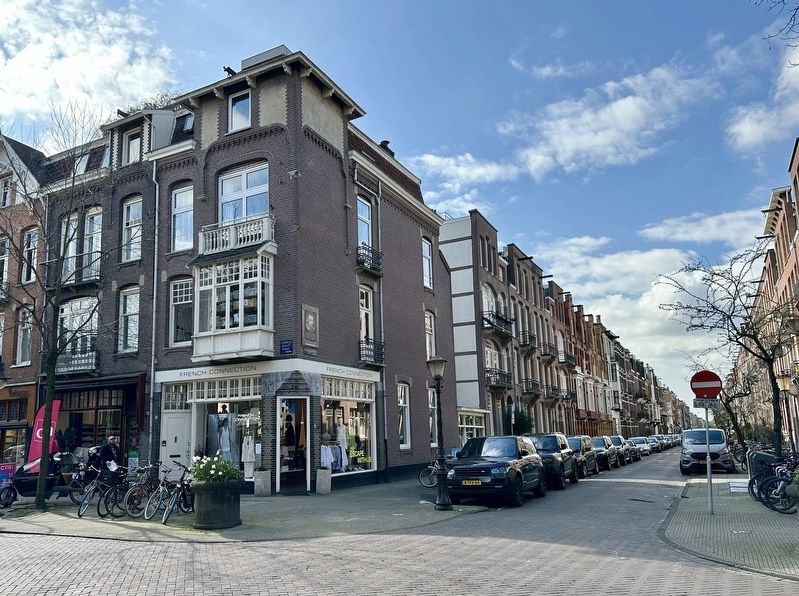
Location. 52° 21.287′ N, 4° 52.282′ E. Marker is in Amsterdam, Noord-Holland (North Holland). It is in Amsterdam Oud-Zuid. It is at the intersection of Valeriusstraat and Cornelis Schuytstraat, on the right when traveling east on Valeriusstraat. Touch for map. Marker is at or near this postal address: Cornelis Schuytstraat 36, Amsterdam, Noord-Holland
this page online

Regionally, it is in Europe, the European Union, Atlantic Europe, the Benelux Low Countries, the Schengen Area, Western Europe, and the Western World. Historically, it finds itself in what was once the Holy Roman Empire.
Other nearby markers. At least 8 other markers are within walking distance of this marker: Joannes Josephus Viotta (approx. 0.2 kilometers away); Etty Hillesum (approx. 0.3 kilometers away); Jacob Obrecht (approx. 0.3 kilometers away); Giovanni Palestrina (approx. 0.3 kilometers away); Johannes Verhulst (approx. 0.4 kilometers away); Gustav Adolph Heinze (approx. half a kilometer away); Johannes Bernardus van Bree (approx. half a kilometer away); Batholomeus Ruloffs (approx. 0.6 kilometers away). Touch for a list and map of all markers in Amsterdam.
Also see . . . Adrianus Valerius (Wikipedia).
Excerpt: A poet of not inconsiderable talent, Valerius worked on the great Zeelander compendium Zeeusche Nachtegael with a number of other poet-colleagues. The work would be published in 1623. His primary individual opus, on the other hand, is the collection(Submitted on March 30, 2024.)of folk poems and melodies on the Dutch Wars (1555–1625) Neder-landtsche gedenck-clanck, which he had collected and edited for thirty years until his death in 1625. The posthumous collection, published by his son François in 1631, gained instant popularity. The work, steeped in Protestant moralization and chiliastic attitudes, was both anti-Catholic and anti-Spanish and was studied in Zeeland both at home and Church as part of familial religious edification. The collection contained 76 songs (including Wilhelmus, which became the Netherlands' national anthem), and unusually for the time the songs were printed in musical notation (many similar collections named well-known tunes to which a printed text should be sung). Musical accompaniments were to be done by four-stringed citterns and seven-stringed lutes; the accompaniments were printed in tablature.Photographed by Andrew Ruppenstein, March 19, 20242. Adriaen Valerius Marker - wide view
Valerius' historical significance lies neither in his poetry's artistic expression, which was stunted and often bare, nor in the originality of his work, which is often viewed as derivative. Rather, his compendium served as a mirror on his time and mores, while the strong sense of Dutchnation and identity that permeate this collection would serve to make his work a popular favorite in the Netherlands in times of trouble (for example, during the German occupation of the Netherlands in the Second World War).Photographed by Tom Bosse, November 10, 20243. Adriaen Valerius Marker

Credits. This page was last revised on December 28, 2024. It was originally submitted on March 30, 2024, by Andrew Ruppenstein of Lamorinda, California. This page has been viewed 366 times since then and 41 times this year. Photos: 1, 2. submitted on March 30, 2024, by Andrew Ruppenstein of Lamorinda, California. 3. submitted on December 15, 2024, by Tom Bosse of Jefferson City, Tennessee.
