Columbus in Lowndes County, Mississippi — The American South (East South Central)
Errolton
Photographed by Duane and Tracy Marsteller, March 12, 2024
1. Errolton Marker
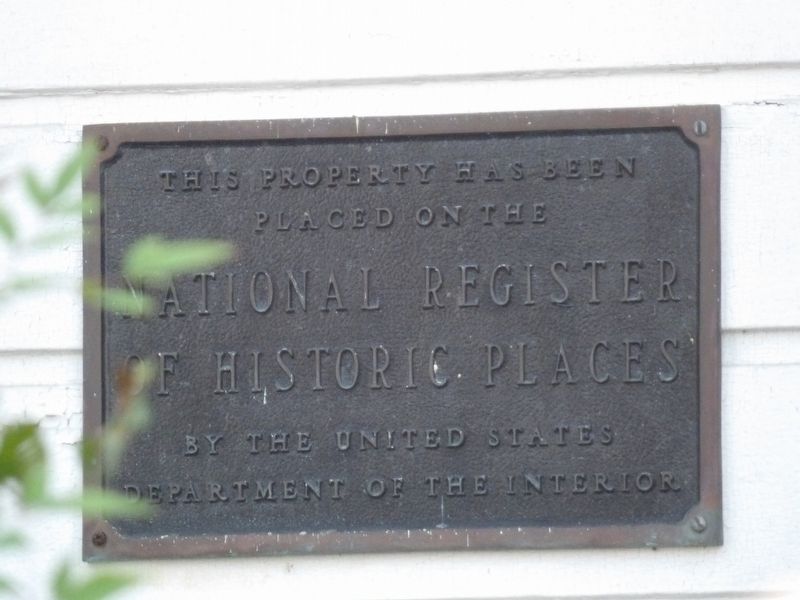
This property has been placed on the National Register of Historic Places by the United States Department of the Interior
Topics and series. This historical marker is listed in this topic list: Architecture. In addition, it is included in the National Register of Historic Places (NRHP) series list. A significant historical year for this entry is 1854.
Location. 33° 29.54′ N, 88° 25.85′ W. Marker is in Columbus, Mississippi, in Lowndes County. It is on 3rd Avenue South east of 2nd Street South, on the right when traveling east. Touch for map. Marker is at or near this postal address: 216 3rd Ave S, Columbus MS 39701, United States of America. Touch for directions.

Regionally, this marker is in East Mississippi, in the Black Prairie, and in the Golden Triangle. It is also in the American South, specifically in the Deep South, and in the Black Belt. Globally, it is in North America, a Gulf of Mexico state, the Western Hemisphere, the Western World, and the Anglosphere. Historically, it finds itself in what was once the territory of the Mississippian Culture, one of the Confederate States of America,
this page online
Other nearby markers. At least 8 other markers are within walking distance of this marker: Confederate Decoration Day (within shouting distance of this marker); St. Paul's Episcopal Church (about 600 feet away, measured in a direct line); Columbus Mississippi Blues (about 700 feet away); The Tennessee Williams Visitors Center (approx. 0.2 miles away); First Home of Tennessee Williams (approx. 0.2 miles away); Columbus (approx. 0.2 miles away); Robinson Road (approx. 0.2 miles away); First Methodist Church (approx. 0.3 miles away). Touch for a list and map of all markers in Columbus.
Regarding Errolton. Excerpts from the National Register nomination:
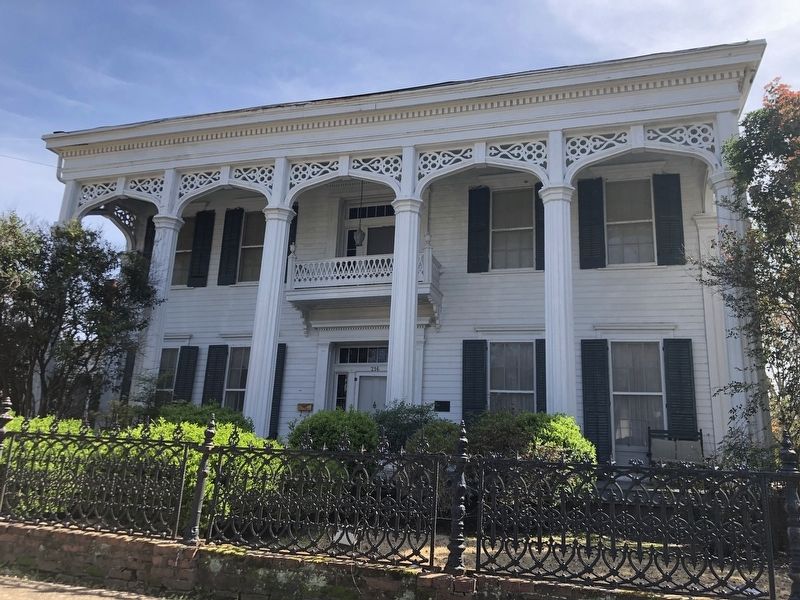
Originally called Weaver Place, the house was built in 1854 for William B. Weaver, a wealthy planter born in Culpeper, Virginia, in 1818, who became a prominent Columbus landowner and businessman with properties extending across the Tombigbee River. Weaver Place was constructed around the partially burned Alfred R. Wolfington residence, which was sold for $2,000 at public auction to William B. Weaver in November, 1853. Nell K. Wall, the only living descendantof William B. Weaver, described the incorporation of the Wolfington dining room and kitchen into the new construction and the existence at one time of two, two-room brick slave buildings and a brick wall on the south side of the lot.…Photographed by Duane and Tracy Marsteller, March 12, 20242. Errolton Marker
Weaver's house and the Wolfington residence were built on 16th section land, which made the property subject to a ninety-nine year lease administered by the trustees of Franklin Academy, the first free public school in Mississippi, founded in 1821. Prior to Weaver's purchase of the property, Wolfington had moved his house south of the 16th section line to avoid payment of a special municipal tax. At the expiration of the tax provision, he rolled the house back over the line onto its original foundation.…
In 1951 the property was sold by Nell K. Wall and Walter Weaver Kennedy, grandchildren of William B. Weaver, to Erroldine Hay (Mrs. T. D.) Bateman, mother of the present owner. Mrs. Bateman, who named the house Errolton in honor of her Scottish ancestry and one of the Hay plantations in South Carolina, was responsible for the restoration of the house.
Also see . . . Weaver Place (PDF). National Register nomination for the house, which was listed in 1978. (Prepared by Jack A. Gold; via Mississippi Department of Archives and History) (Submitted on April 9, 2024, by Duane and Tracy Marsteller of Murfreesboro, Tennessee.)
Credits. This page was last revised on April 9, 2024. It was originally submitted on April 9, 2024, by Duane and Tracy Marsteller of Murfreesboro, Tennessee. This page has been viewed 189 times since then and 33 times this year. Photos: 1, 2. submitted on April 9, 2024, by Duane and Tracy Marsteller of Murfreesboro, Tennessee.
