Quartier du Faubourg-du-Roule in Paris in Département de Paris, Île-de-France, France — Western Europe
Honoré de Balzac
Photographed by Andrew Ruppenstein, March 25, 2024
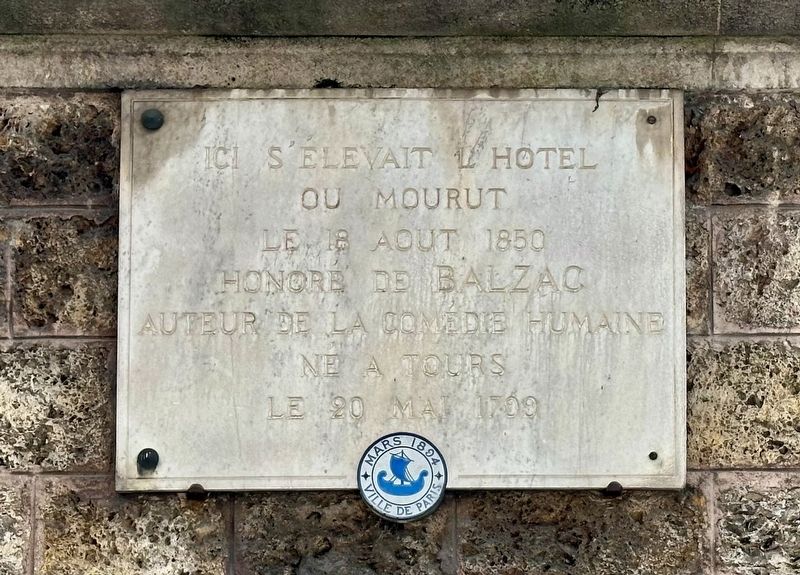
1. Honoré de Balzac Marker

ou mourut
le 18 aout 1850
Honore de Balzac
Auteur de La Comedie humaine
ne a Tours
le 20 mai 1799
Here stood the mansion where on August 18, 1850, Honoré de Balzac (born in Tours on May 20, 1799), the author of La Comedie humaine, died.
Erected 1894 by Ville de Paris.
Topics. This historical marker is listed in these topic lists: Arts, Letters, Music • Entertainment. A significant historical year for this entry is 1850.
Location. 48° 52.537′ N, 2° 18.175′ E. Marker is in Paris, Île-de-France, in Département de Paris. It is in Quartier du Faubourg-du-Roule. It is on Rue Balzac, on the left when traveling south. Touch for map. Marker is at or near this postal address: 28 Rue Balzac, Paris, Île-de-France 75008, France. Touch for directions.

Regionally, it is in the North Atlantic Region, Europe, the European Union, Atlantic Europe, the Schengen Area, Western Europe, a coastal Mediterranean country, and the Western World. Historically, it finds itself in what was once a French colony and also the Roman Empire.
Other nearby markers. At least
this page online
Also see . . . Honoré de Balzac (Wikipedia).
Overview: Honoré de Balzac (born Honoré Balzac; 20 May 1799 – 18 August 1850) was a French novelist and playwright. The novel sequence La Comédie humaine, which presents a panorama of post-Napoleonic French life, is generally viewed as his magnum opus.(Submitted on April 10, 2024.)
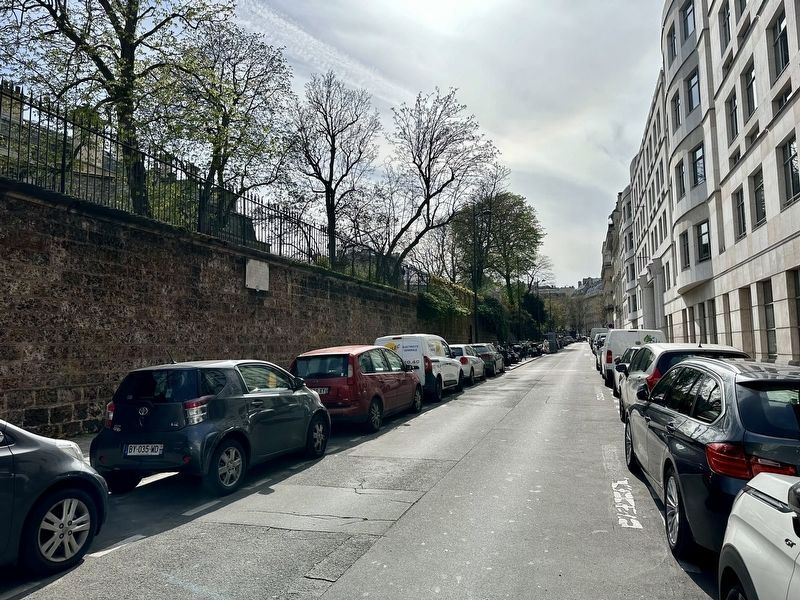
Owing to his keen observation of detail and unfiltered representation of society, Balzac is regarded as one of the founders of realism in European literature. He is renowned for his multi-faceted characters; even his lesser characters are complex, morally ambiguous and fully human. Inanimate objects are imbued withcharacter as well; the city of Paris, a backdrop for much of his writing, takes on many human qualities. His writing influenced many famous writers, including the novelists Émile Zola, Charles Dickens, Marcel Proust, Gustave Flaubert, and Henry James, and filmmakers François Truffaut and Jacques Rivette. Many of Balzac's works have been made into films and continue to inspire other writers. James called him "really the father of us all."Photographed by Andrew Ruppenstein, March 25, 20242. Honoré de Balzac Marker - wide view, looking south on Rue BalzacThe marker is visible here on the wall on the left.
Photographed by Andrew Ruppenstein, March 25, 2024
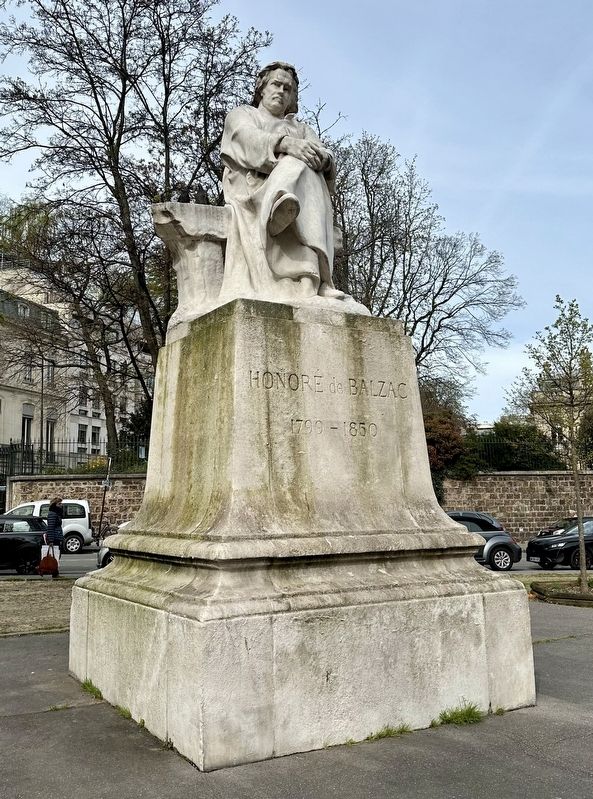
3. Honoré de Balzac statue
Located roughly 80 meters south of the marker, at the intersection of Rue Balzac and Rue Beaujon.
Eugène Giraud (published by L. Brochery, Paris), August 18, 1850
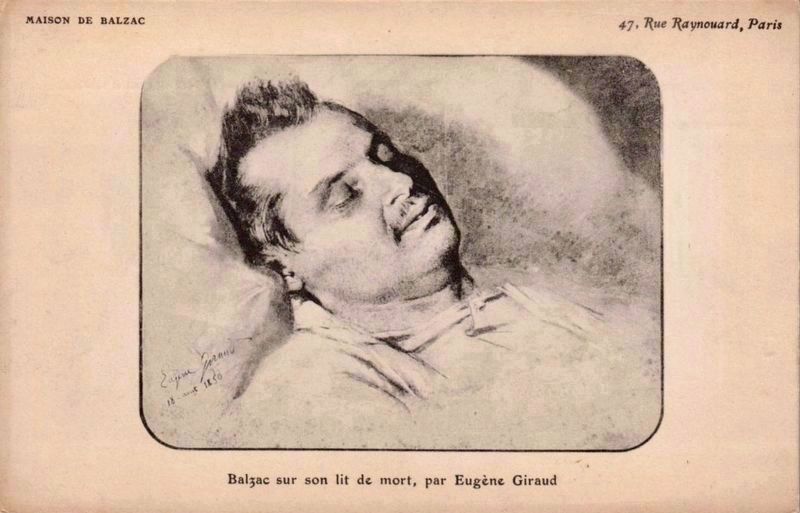
4. Balzac on his deathbed
Five months after his wedding, on Sunday, 18 August 1850, Balzac died of gangrene associated with congestive heart failure, in the presence of his mother — his wife, Eve de Balzac (formerly Countess Hańska) had gone to bed. He had been visited that day by Victor Hugo, who later served as a pallbearer and the eulogist at Balzac's funeral. Some modern researchers have attributed a factor in his death to excessive coffee consumption or a caffeine overdose (Balzac reportedly drank over 50 cups a day) but this has yet to be proved. - Wikipedia
Credits. This page was last revised on April 10, 2024. It was originally submitted on April 10, 2024, by Andrew Ruppenstein of Lamorinda, California. This page has been viewed 207 times since then and 41 times this year. Photos: 1, 2, 3, 4. submitted on April 10, 2024, by Andrew Ruppenstein of Lamorinda, California.
