Galveston in Galveston County, Texas — The American South (West South Central)
Nicholas J. Clayton
November 1, 1839 – December 9, 1916

1. Nicholas J. Clayton Marker
Clayton preferred to design churches. Examples are the First Presbyterian Church and Eaton Chapel. He was responsible for the University of Texas Medical School building, the Ashbel Smith Building known as “Old Red”, the Trueheart-Adriance building, the Ball, Hutchings & Co., and the John Sealy buildings, as well as the home of Colonel Walter Gresham known as the “Bishop's Palace”. Another of his palatial residences was “Open Gates” across from Monument Square which was the home of George Sealy, Sr. 1835-1901.
• Two hundred and fifty years ago, LaSalle visited Galveston and named it San Louis in honor of his sovereign, but Count Bernardo de Gálvez in 1777 renamed the island after himself, Gálvez, which later became Galveston.
• On December 9, 1836, Col. Michael Menard and nine associates purchased the present site of Galveston and organized the Galveston City Company. On February 5, 1841, this company was incorporated by the Republic of Texas, and liquidated in 1944.
• The first news of the victory of San Jacinto, April 21, 1836, was received by President David Burnet
this page online
Erected by Monument Square Partnership.
Topics. This historical marker is listed in this topic list: Architecture. A significant historical year for this entry is 1872.
Location. Marker is missing. It was located near 29° 17.965′ N, 94° 47.631′ W. Marker was in Galveston, Texas, in Galveston County. It was at the intersection of Broadway Avenue J (State Highway 87) and Rosenberg Street/25th Street, on the right when traveling east on Broadway Avenue J. Touch for map. Marker was at or near this postal address: 2425 Broadway Avenue J, Galveston TX 77550, United States of America. Touch for directions.

Regionally, this marker was in the Houston Metropolitan Area. It was also in the American South and on the Gulf Coast. Globally, it was in North America, a Gulf of Mexico state, the Western Hemisphere, the Western World, and the Anglosphere. Historically, it found itself in what was once New Spain, the Republic of Texas, and one of the Confederate States of America.
Other nearby markers. At least 8 other markers are within walking distance of this location: Galveston-Port Bolivar Ferry System
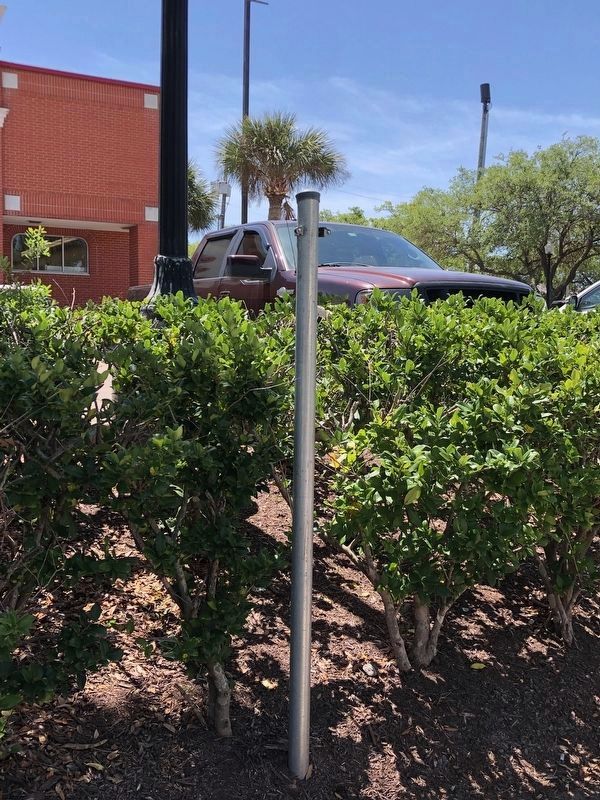
Photographed by Duane and Tracy Marsteller, April 13, 2024
2. Nicholas J. Clayton Marker (Missing)
Other markers no longer nearby. Open Gates (was within shouting distance of this marker but has been confirmed missing); Ashton Villa, 1859 (was about 400 feet away, measured in a direct line but has been confirmed missing).
Also see . . .
1. Clayton, Nicholas Joseph (1839–1916). He traveled to Houston from Cincinnati in October 1871. In 1872 he moved to Galveston to take a position as supervising architect for the construction of the First Presbyterian Church, designed by the Memphis, Tennessee, architects Jones and Baldwin. He remained in Galveston and began the practice of architecture there. ( Robert A. Nesbitt and Stephen Fox, Handbook of Texas , Texas State Historical Association)

Unknown; via Wikipedia (Public Domain)
3. Nicholas J. Clayton (1839-1916)
His works outside Galveston include Sacred Heart Catholic Church in Tampa, Florida and the Main Building of St. Edward's University in Austin, Texas.
2. Photograph of marker before it went missing. (Taken by Ken Lund, January 11, 2015; via Flickr) (Submitted on April 26, 2024, by Duane and Tracy Marsteller of Murfreesboro, Tennessee.)
Credits. This page was last revised on April 26, 2024. It was originally submitted on April 26, 2024, by Duane and Tracy Marsteller of Murfreesboro, Tennessee. This page has been viewed 262 times since then and 34 times this year. Photos: 1, 2, 3. submitted on April 26, 2024, by Duane and Tracy Marsteller of Murfreesboro, Tennessee.
Editor’s want-list for this marker. Closeup and wideview photographs of the marker • Can you help?
