Near Tuskegee in Macon County, Alabama — The American South (East South Central)
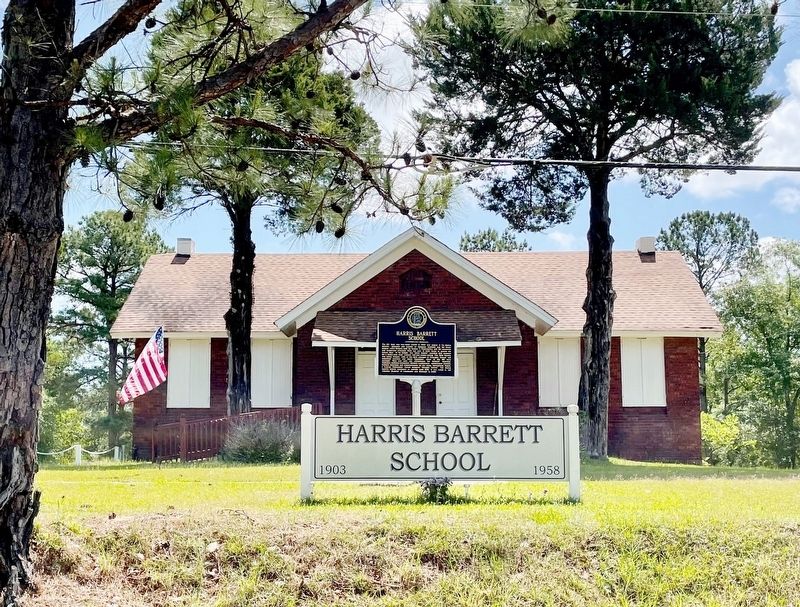
Harris Barrett School ⎯⎯⎯ The Southern Improvement Company (SIC)
Photographed by Mark Hilton, April 28, 2024
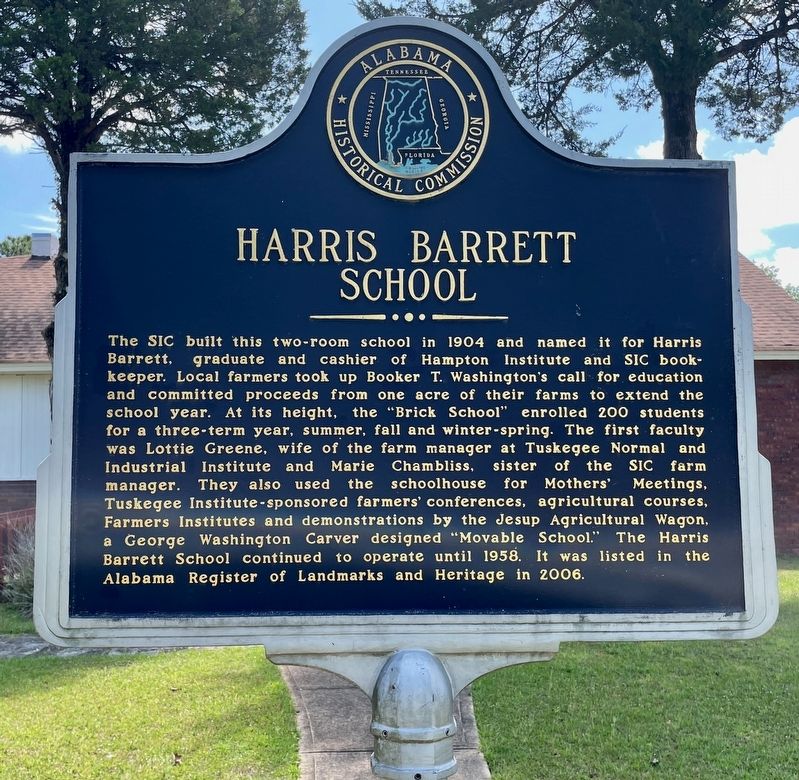
1. Harris Barrett School Marker
Inscription.
Harris Barrett School
The SIC built this two-room school in 1904 and named it for Harris
Barrett, graduate and cashier of Hampton Institute and SIC book-
keeper. Local farmers took up Booker T. Washington's call for education
and committed proceeds from one acre of their farms to extend the
school year. At its height, the "Brick School" enrolled 200 students
for a three-term year, summer, fall and winter-spring. The first faculty
was Lottie Greene, wife of the farm manager at Tuskegee Normal and
Industrial Institute and Marie Chambliss, sister of the SIC farm
manager. They also used the schoolhouse for Mothers' Meetings,
Tuskegee Institute-sponsored farmers' conferences, agricultural courses,
Farmers Institutes and demonstrations by the Jesup Agricultural Wagon,
a George Washington Carver designed "Movable School." The Harris
Barrett School continued to operate until 1958. It was listed in the
Alabama Register of Landmarks and Heritage in 2006.
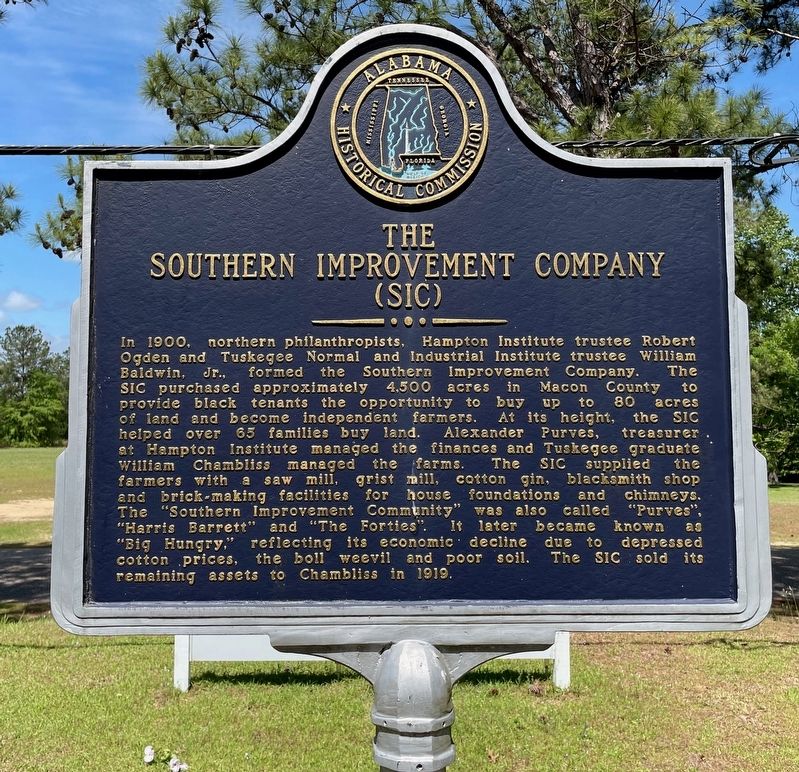
The Southern Improvement Company (SIC)
In 1900, northern philanthropists, Hampton Institute trustee Robert
Ogden and Tuskegee Normal and Industrial Institute
Click or scan to see this page online
trustee William
Baldwin, Jr., formed the Southern Improvement Company. The
SIC purchased approximately approximately 4,500 acres in Macon County to
provide black tenants the opportunity to buy up to 80 acres
of land and become independent farmers. At its height, the SIC
helped over 65 families buy land. Alexander Purves, treasurer.
at Hampton Institute managed the finances and Tuskegee graduate
William Chambliss managed the farms. The SIC supplied the
farmers with a saw mill, grist mill, cotton gin, blacksmith shop
and brick-making facilities for house foundations and chimneys.
The "Southern Improvement Community" was also called "Purves",
"Harris Barrett" and "The Forties". It later became known as
"Big Hungry," reflecting its economic decline due to depressed
cotton prices, the boll weevil and poor soil. The SIC sold its
remaining assets to Chambliss in 1919.
Marker is near Tuskegee, Alabama, in Macon County. It is on County Road 27 north of County Road 36, on the right when traveling north. Touch for map. Marker is at or near this postal address: 3167 Co Rd 27, Tuskegee AL 36083, United States of America. Touch for directions.
Regionally, this marker is in the American South, specifically in the Deep South, and in the Black Belt. Globally, it is in North America, a Gulf of Mexico state, the Western Hemisphere, the Western World, and the Anglosphere. Historically, it finds itself in what was once the territory of the Mississippian Culture, one of the Confederate States of America, and the Antebellum South.
Credits. This page was last revised on November 20, 2024. It was originally submitted on April 28, 2024, by Mark Hilton of Montgomery, Alabama. This page has been viewed 649 times since then and 109 times this year. Photos:1, 2, 3. submitted on April 28, 2024, by Mark Hilton of Montgomery, Alabama.