Bury St Edmunds in Suffolk, England, United Kingdom — Northwestern Europe (the British Isles)
The Abbey Gate
Photographed by Ray Gurganus, March 27, 2024
1. The Abbey Gate Marker
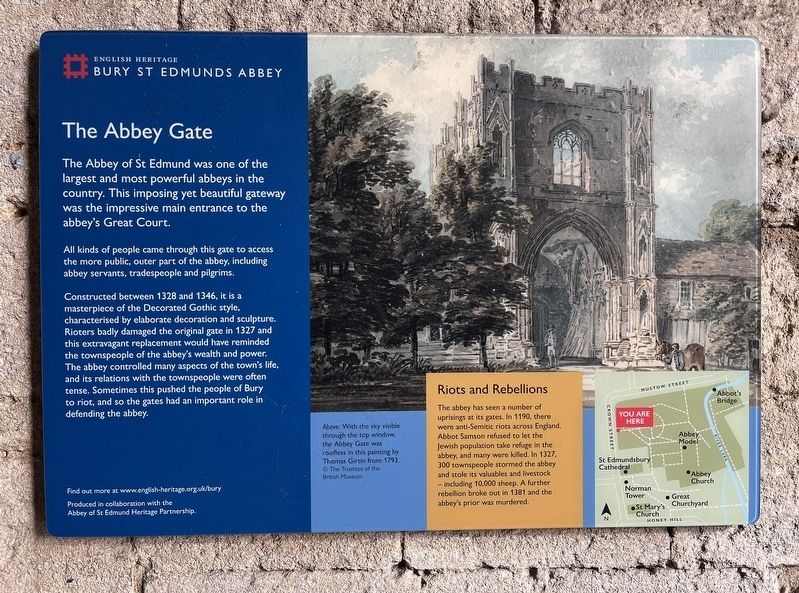
All kinds of people came through this gate to access the more public, outer part of the abbey, including abbey servants, tradespeople and pilgrims.
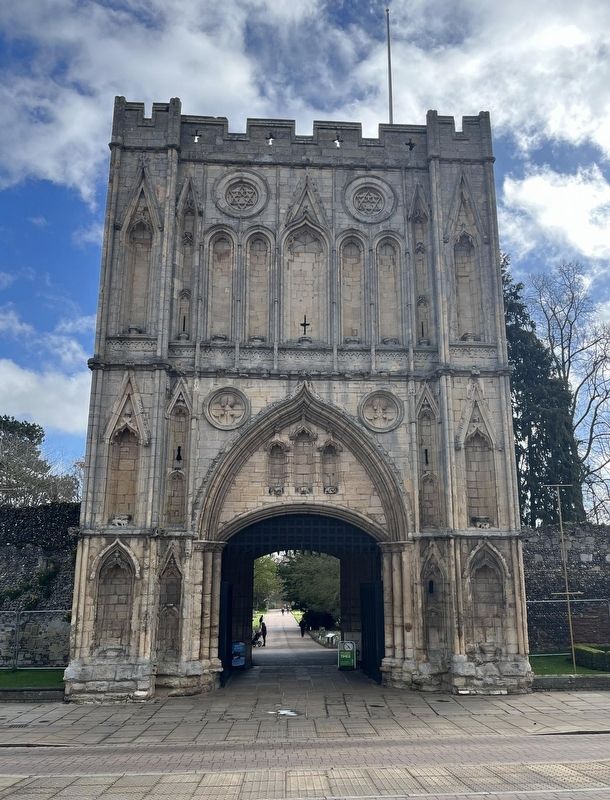
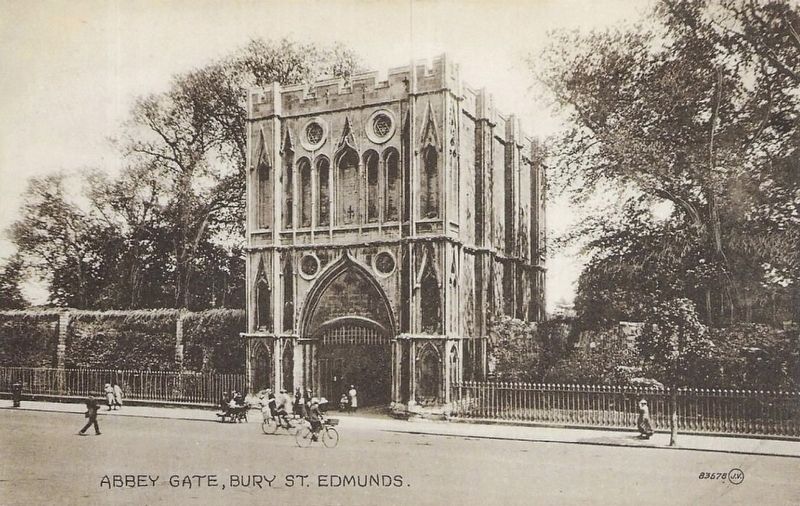
Constructed between 1328 and 1346, it is a masterpiece of the Decorated Gothic style, characterised by elaborate decoration and sculpture. Rioters badly damaged the original gate in 1327 and this extravagant replacement would have reminded the townspeople of the abbey's wealth and power. The abbey controlled many aspects of the town's life, and its relations with the townspeople were often tense. Sometimes this pushed the people of Bury to riot, and so the gates had an important role in defending the abbey.
Above: With the sky visible through the top window the Abbey Gate was roofless in this painting by Thomas Girtin from 1793.
The abbey has seen a number of uprisings at its gates. In 1190, there were anti-Semitic riots across England. Abbot Samson refused to let the Jewish population
this page online
Erected by English Heritage.
Topics. This historical marker is listed in these topic lists: Architecture • Forts and Castles • Religion & Religious Structures. A significant historical year for this entry is 1328.
Location. 52° 14.693′ N, 0° 42.977′ E. Marker is in Bury St Edmunds, England, in Suffolk. It can be reached from no nearby street. Inside the gate at the Abbey Gardens. Touch for map. Marker is in this post office area: Bury St Edmunds, England IP33 1RS, United Kingdom. Touch for directions.

Regionally, this marker is in East Anglia. Globally, it is on the Atlantic Ocean, in the North Atlantic Region, in Europe, in Atlantic Europe, on one of the British Isles, in the Western World, and in the Anglosphere. Historically, it finds itself in what was once the Roman Empire.
Other nearby markers. At least 8 other markers are within walking distance of this marker: The Abbey of St Edmund
Photographed by Ray Gurganus, March 27, 2024
2. The Abbey Gate
Photographed by John Valentine and Sons, circa 1905
3. The Abbey Gate
Credits. This page was last revised on June 24, 2026. It was originally submitted on May 4, 2024, by Ray Gurganus of Washington, District of Columbia. This page has been viewed 336 times since then and 100 times this year. Photos: 1, 2. submitted on May 4, 2024, by Ray Gurganus of Washington, District of Columbia. 3. submitted on May 4, 2024. • Andrew Ruppenstein was the editor who published this page.
